• TalkBass has been independent since 1998. Add your voice.
    Create a free account to reply to discussions, view embedded media, and browse with fewer display ads.
    Join freeLog in
    Want zero display ads or expanded classifieds tools? Compare plans.

Understanding Groove Tubes matching lettering system

Jan 24, 2005
1,561
2,253
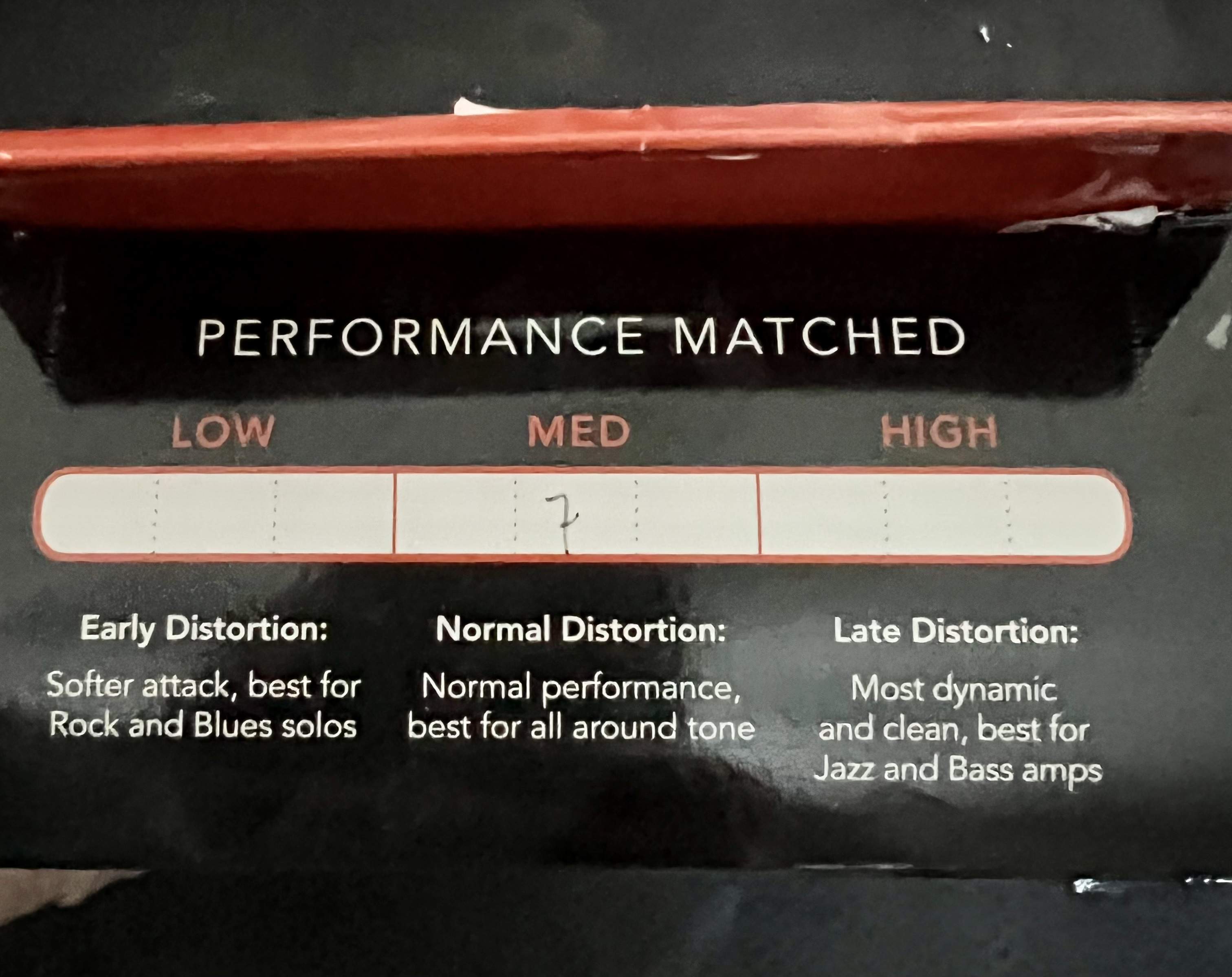
So I just bought an Orange AD200B. It came with four 6550 tubes but can also take KT88’s if you want. I collect tubes, I came across three pairs of Groove Tubes KT88’s with letters HBK under “ Performance “ and the #7 under “ Matched “ on the label of each tube. Does anyone know how to interpret GT’s matching system? Do the letters “ HBK “ designate that they are Tc matched with other GT KT88’s with “ HBK “ on them? Or does the #7 and color of the tube match them with other tubes? I did search and I could find nothing on this subject anywhere.

6CF0AD36-AE9E-4431-A479-C72A2B87787C.jpeg

AFDF183D-6DEB-47AA-B149-45DE2C585325.jpeg
 
I would think the « med » and « 7 » means they are all in the same range. Now, be aware that it could drift a bit once they’ll be used. Also, some matched tubes aren’t so well matched in reality but it depends on the company/factory.

The best is to have some way to measure current draw in operation but I don’t know if the AD200B has some test points or LED BIAS indicator?
 
As far as I know, GT uses a rating system that goes from 1-10. So if all three sets have a rating of 7, you should be good to go. My guess is the three letters are the initials of the person who tested/matched the tubes.

Back in the day the labels were hand written:
06446d20-6ec8-4ed5-b79f-5072d9a43ded_1.e9125642a1038b6917808dae1ecfd295.jpeg


The AD200 has an internal bias adjustment. Factory bias is surprising cold at 18-22mA per tube. The plate voltage reading I found is 675V. 22mA at 675V plate is about 42% dissipation (this is assuming a 35W tube). There may be a good reason for running the bias this cold, so I would not get too carried away with increasing the current.

The schematic shows a 1ohm 3W bias sense resistor on each cathode. But I found a thread that says many amps have a jumper in place of the resistor. Ref: Orange AD200B bias - Music Electronics Forum (music-electronics-forum.com)

The schematic also shows test points for each tube, which are tied to pin 8 of the tube socket. I have a gut shot of the amp, but I can't tell if the TPs are actually labeled on the board. To be honest you probably should measure across the resistor, rather than from ground to the test point. Apparently, per the thread linked above, the fuses can skew the readings a bit.

Confirm the value of bias sense resistors before setting the bias. If the resistors are 1 ohm adjust for 18-22mV. If the amp has jumpers in place of the resistors, you need a set of bias probes to measure the current, unless you are comfortable with the shunt method, which I don't recommend due to safety concerns.

Of course, some of the tubes will pull a little more current, and some will pull a little less. You may be able to sort the tubes in a different order to get better current matching.

Good luck!
 
  • Like
Reactions: Patrice B
I appreciate all the responses! Wasnex, you always have great info, thanks!!!!
So I actually have another set of GT KT88’s that are also rated for a 7. I did not think they were matched because I thought the lettering was some kind of matching system from GT. So now it looks like I’ll have four matched sets of GT KT88’s ( JJ’s in disguise by the looks of them ). I also have this meter for biasing the amp.

4A3EDB4C-5D9C-4AD3-8FD0-112CCDEFAEB1.jpeg
 
Pretty sure you are good to go. Before you pull the old tubes, adjust the bias for minimum current. Then install the new tubes and check for matching as you adjust the bias to get the current in range.

Before using your bias probes, check your documentation. Why? Some electronic bias probes are only rated up to about 550V. The plate voltage in this amp may rise close to 700V when the bias is maxed out to reduce tube current.

I have found references to a 1-10 rating system. The also use Low, Medium, and High power but these relate to the 1-10 system. From page 11. of the GT Reference guide , '“Medium” tubes fall in the 4-7 range and are most similar to stock tubes for many amplifiers, especially Fender. For amp service techs or those wishing to customize amplifiers to achieve specialized tone, “high” (8-10) and “low” (1-3) tube sets are available.'

Ref: GT_Ref_Guide 2012.pdf (fmicassets.com)

At one time I believe the used the terminology Soft, Medium, and Hard, but this also related to the 1-10 rating system.

From page 34:

• Tubes are graded according to distortion levels on a scale from 1 to 10
• Tubes with similar distortion levels are matched in pairs, quartets and sextets
• This creates opportunity to properly bias amp to maximize tube performance
• High graded tubes have more headroom and less distortion - fine scale is 8 - 10
• Medium graded tubes most commonly used in stock amps - fine scale is 4 - 7
• Low graded tubes are softest and quickest into soft clipping - fine scale is 1 - 3​

If you Google various GT branded output tubes, you will see a bunch of 3-digit designators. The only other idea I have is perhaps it's some sort of date code.

Just Googled "Groove Tube Date Code" and this came up (see the added green rectangle):

upload_2022-5-20_1-17-8.png

Ref: Groove Tubes (edgecastcdn.net)

I believe the mystery is solved :cool:.
 
  • Like
Reactions: Patrice B
Before using your bias probes, check your documentation. Why? Some electronic bias probes are only rated up to about 550V. The plate voltage in this amp may rise close to 700V when the bias is maxed out to reduce tube current.

Thanks again Wasnex! Per you recommendation, I looked up the specs of that bias meter and they had no listing of max plate voltage allowed. I looked up other bias meters on the web and they also had no listing of allowable plate voltage. I do have bias probes I can hook up to a DVM that can handle that type of voltage.