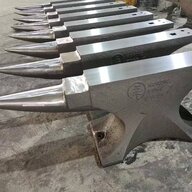
used one of these on a recent project....the hand reamer would of been better than the drill. imo


TalkBass has been independent since 1998. Add your voice.
Create a free account to reply to discussions, view embedded media, and browse with fewer display ads.
Join free Log in
Want zero display ads or expanded classifieds tools? Compare plans.

It will cut a tapered hole if you drive it straight in, but that's not the only application.A smaller-than-the hole sized reamer can be held at an angle so one side is flush against the side of the hole, then turned and pushed downward (as you ride around the hole) to scrape smooth shavings off the side of the hole. It's the same effect as sandpaper on a dowel but gives you more control, leaves a cleaner lip at the top, and removes more material as you scrape out the hole. I should have explained it better in my post.


As a further hint, when you're scraping down into the hole, be careful not to let the trailing edge scrape the bottom of the hole, as this can cause chipout. I hope that makes sense? Cut at the top/upper portion of the hole and flip it over to ream from the bottom to the top.I just bought one of these to slightly enlarge a headstock hole, but after reading this, it seems I was using it totally wrong. I’ll try this method and see if I can achieve what I want!

My apologies if I've misinterpreted the situation, but as I understand it, the tuning shaft will fit through the hole, but the ferrule is a little too large. If that's the case, another option is to contact Hipshot to see if they have a ferrule that fits a smaller hole but still works for that tuner. They've been kind enough to send me alternative-sized ferrules for free in the past.

It's pretty dang close. The grommet that threads in from the front fits like a charm. The part it threads into is juusssssstt too bigJscriv, is the new piece really, really close to the right size?
I bought Hipshot Xtender keys for my Carvin and Kiesel basses. They were the recommended replacements, but still were a tiny bit too big. Just a couple of swipes with sandpaper did the trick.
The ferrule fits great. The part it threads into that is attached to the tuning peg is too largeMy apologies if I've misinterpreted the situation, but as I understand it, the tuning shaft will fit through the hole, but the ferrule is a little too large. If that's the case, another option is to contact Hipshot to see if they have a ferrule that fits a smaller hole but still works for that tuner. They've been kind enough to send me alternative-sized ferrules for free in the past.

Ream the hole bigger from both sides until the outside edges of the hole are the correct diameter, and then finish off the inside waist area with a sharp knife, or a file. The reamer only applies excessive pressure if it's being forced into the cut and trying to hog out too much wood at once. Violin and cello pegs are fit with a reamer, after all.Huh? That's not going to work. It'll cut a tapered hole. Unless the max diameter is right on 9/16", and I've never seen a tapered reamer in that size. The one you've shown, which is commonly in hardware stores, is usually tapered 1/8" to 1/2". They make larger ones, like 1/4" to 1 1/2", but they are even steeper angle. And a lot more expensive.
Also, a tapered reamer pushes outward as it cuts, with a lot of force. Much more likely to split the headstock. I don't recommend them for this job.

Ream the hole bigger from both sides until the outside edges of the hole are the correct diameter, and then finish off the inside waist area with a sharp knife, or a file. The reamer only applies excessive pressure if it's being forced into the cut and trying to hog out too much wood at once. Violin and cello pegs are fit with a reamer, after all.
I suppose. My thinking was from the point of view of "If this is what was available to me, how would I go about accomplishing this task?"I understand what you are saying, Bill, but it's not going to work well in this case. All the commonly available taper reamers that I've seen that go larger than 1/2" are a much steeper angle than the 1/8"-1/2" ones. Using one to start the hole to the right diameter is going to make a narrow little chamfer. Almost all of the work is going to have to be done carefully with a file.
You and I might be able to use a taper reamer like that to make guide chamfers, and then hand file the hole to match. But we're pros with experience at things like this. I don't think we should be recommending taper reamers to a beginner. Too many ways to misunderstand the use and do some real damage.

Interesting perspective, Bruce. I have used one many times over the years. I enlarge the hole from one side until the diameter on the surface is right, then go in from the other side until its diameter is right. Then I use the right sized drill to cut the waisted middle to the right size. If the reamer is sharp it doesn't apply a lot of lateral force.Huh? That's not going to work. It'll cut a tapered hole. Unless the max diameter is right on 9/16", and I've never seen a tapered reamer in that size. The one you've shown, which is commonly in hardware stores, is usually tapered 1/8" to 1/2". They make larger ones, like 1/4" to 1 1/2", but they are even steeper angle. And a lot more expensive.
Also, a tapered reamer pushes outward as it cuts, with a lot of force. Much more likely to split the headstock. I don't recommend them for this job.


