• TalkBass has been independent since 1998. Add your voice.
    Create a free account to reply to discussions, view embedded media, and browse with fewer display ads.
    Join freeLog in
    Want zero display ads or expanded classifieds tools? Compare plans.

Double Bass upgrades to tailgut and ect.

Jeff,
I made mine with a fixed height. I have one for sitting and one for standing. Still experimenting.
I think from the description above I can make the aluminum locking collars in my shop. Still wondering on the 1/16 cable if you are using it with or without the plastic covering.
Awesome tail piece James. Had you compared it to a standard tail piece for tonal differences. either way very cool.
No plastic - it isn't clothesline!:)
 
  • Like
Reactions: Jeff Bonny
No plastic - it isn't clothesline!:)

LOL!
I have a fair bit of experience with 20'-100'+ runs of 7x19 1/4" and 3/16" galvanized wire. I know without a doubt that the black vinyl coated stuff I've occasionally used for visual masking purposes is much more sonically dampened and does not sing under tension like the uncoated wire does. The same would be true of smaller diameter wire.
 
So besides the really cool / unique visual factor, the holes cut down on the weight. Significantly?

Also, on most of the compensated tailpieces I've seen, the shorter length between TP and bridge is on the upper strings. At first I assumed that the photo just got turned around somehow, but then noticed the Spiro (Obligato?) bottoms and gut tops. What is the deal with this one?

'Apologies for the delayed response; I spent the weekend out giging with my bass, and the computer turned off;););)!

Nathan: The whole point is lowered mass. The visual stuff is just the leftover BS once I found the target weight. That particular bass responds better for what I need with lighter weight tailpieces. I've tried probably 20 different ones- it sits in the shop, so every time I get another bass in with an interesting tailpiece, I take a little break and restring it to try different combinations. I keep going back to this one, but I've also tried it on many other basses where it was not very successful. Ten differen basses... 15 different sets of strings and another fifteen different fittings until you find the right one for you. LOTS of other folks have come by, setup a bench for an hour, and tried this on their own basses. If you make it to the ISB in June, I'll likely have a half dozen different tailpiece styles and masses that I encourage everyone to take a little time out of their day and string them up. Sometime this winter I'll make up another batch of test models - there is a stack of beautiful, resonant, ancient old wood that I'm drooling over to try out. The trouble right now is that I spent the equivalent of a nice bass $$$ on my new Lynskey titanium mountain bike and it is the best month of the year to ride around here, so all I want to do is be outside riding single track, not in the shop huffing sawdust!!!

Did that fellow at the Oberlin Workshop a couple of years ago ever come out with a commercial bass tailpiece that had the variable weights and mass centers? The cello prototype that he showed off was COOL!

Pictured are Obligatos w/ gut. I probably string up about 50+ sets of strings a year, likely more. 99% of the time, when the day is done and I head out to a gig, it is Spirocore medium (occasionally Starks!) E A and real gut D G. What else would you expect from someone who plays loud, rowdy, period jazz and lives in North Carolina???????

j.
www.condino.com
www.kaybassrepair.com
 
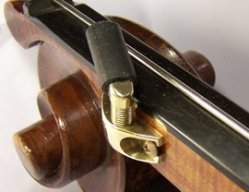
I use 1/16th" coated 133 strand SS aircraft cable. You need to remove the coating where clamp goes. I like the coating since it keeps the cable from digging into the saddle and TP. I haven't tried removing it to compare sound, but suspect the difference is minimal. The picture shows #6-32 flat bottom set screws. Flat bottom screws chew up the wire less than pointed or cup bottom. I now use M4 which are a bit wider.
clamp72.jpg


On tailpiece mass, there are differing opinions. Some European builders I know use lighter woods died black even on very expensive basses, preferring the lower mass. Others like the weight of a beefy ebony TP. I guess you just have to see what works for you.

Also, You Americans should try line drying your clothes! Save money, save energy, save the planet:D
 
  • Like
Reactions: james condino
Okay,
I have made my own oak end pin holder and end pin. I installed the 1/16 aircraft cable and made my own aluminum couplers. I drilled out my aluminum adjusters and carved spruce feet for my maple bridge. Re set the sound post. It sounds like a new bass. My last gig the guys said it was the best they have ever heard the bass sound. My amp settings were set lower than normal and I did not use my mic only the pick up. So on my bass it made a difference. I will post pics. My question is I have been fooling with getting the after length tuned to a perfect 4th. I have also read that it should be 1/6 the string length. How much difference does it make if the after length is not a perfect 4th or 1/6 the string length. I know using and mixing different gauge strings or brands has no effect on tuning the string length but would it have any effect on tuning the after length. Currently I have a standard ebony tail piece with the built in saddle. The tail piece will be my next adventure. I need to find the right piece of wood to play with. Thanks