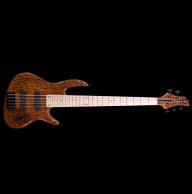
Whelp I have to learn upright bass for college auditions. I can basically play it within the three frets. Basically all I'm wondering, how do you transfer from
Electric jazz bass to upright?
Electric jazz bass to upright?

TalkBass has been independent since 1998. Add your voice.
Create a free account to reply to discussions, view embedded media, and browse with fewer display ads.
Join free Log in
Want zero display ads or expanded classifieds tools? Compare plans.

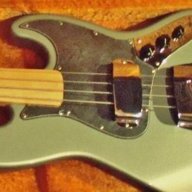

Open your electric bass case. Put electric bass in case and close the latches. Put case and bass in back of closet.
I did this cold back in late 1992. I bought a double bass, hit the woodshed and didn't play in public for almost two years (granted, I was in Graduate school for a year of that and didn't have a ton of spare time). The key is developing a strong hand-eye relationship that will aid in proper intonation.
In my opinion, a D neck would be better for the transition than would an Eb neck; but once you've learned the instrument better the Eb neck might make jazz a bit easier (but if you start on a D neck, it may be a bad idea to switch). By this I mean that the butt of the neck where it meets the body forms a thumb stop when you slide your fingering hand up the neck. If the note directly above your thumb is a D on the G string it's a D neck, if it's and Eb, well, you get the picture.
Beyond that, it's just a matter of acclimating your fingers to the lower notes and working your way around the fingerboard from there. Forget things like one finger per fret and learn to use 1, 2, and 4 in the lower range of the instrument (as always, lower means pitch, not orientation to the floor).
Good luck! It can be very rewarding.

 Good enough for what I do with it in my band, hardly anything that would get me through college. So if you want to get real with it, get a teacher pronto.
I spent three years studying double bass, until I injured my hand two years ago and switched back to bass guitar. IMO you should seek out a classical/orchestral double bass instructor. If you watch an orchestral player you will notice a degree of precision in their playing that is not present in non classically trained bassists, and you will hear it in their intonation. And what you will develop is not hand-eye coordination but hand-ear coordination. Classically trained double bassists pretty much don't look at their left hand, because they are reading the music. They continuously tune with their ear. Once you learn this technique you can apply it to any genre of music.
That said, there is obviously a big difference in right hand technique between classical (almost completely arco - i.e. with bow) and jazz (plucked with finger - i.e. pizzicato). A classical instructor won't help you much here, admittedly, so at some point you may need some help from a jazz player for RH technique as well as approach to the music.
A good example of a great bassist who plays both bass guitar and double bass is John Patitucci. He studied classical double bass, then switched to jazz. He has played BG and DB with Chick Corea for years. He has very good DB technique, as well as BG technique.
FWIW,
Jim