
Enjoy the benefits of a premium membership!
Upgrade Account
-
TalkBass has been independent since 1998. Add your voice.
Create a free account to reply to discussions, view embedded media, and browse with fewer display ads.
Join free Log in
Want zero display ads or expanded classifieds tools? Compare plans.
You are using an out of date browser. It may not display this or other websites correctly.
You should upgrade or use an alternative browser.
You should upgrade or use an alternative browser.
Using One Finger Per Fret And Being Uncomfortable
- Thread starter Donald Thompson
- Start date
More options
Who Replied?
I fought against using the pinky for years when I was younger and thought it was unnecessary. Once I gave up the fight and got used to it I noticed so many benefits of being able to know how and when to use the pinky, or when to position shift... but having the fourth finger available (and trained) to fret a note makes sense once you get used to it. I did exactly what your teacher is telling you to do by the way; played some simple basslines that I would normally play with index/middle but shifted to only using my ring/pinky. That way I knew the bassline already and could focus solely on strengthening and getting used to the fingers that were less practiced.
As others have said, unless there is a physical limitation to why you can't or you're getting pain... I'd get used to it. I certainly wish I'd seen the light earlier. (Different times when everything was from books because the internet wasn't the source of info/opinion as it is now and we had only books to learn from).
As others have said, unless there is a physical limitation to why you can't or you're getting pain... I'd get used to it. I certainly wish I'd seen the light earlier. (Different times when everything was from books because the internet wasn't the source of info/opinion as it is now and we had only books to learn from).

Where on the fingerboard is this? Lower down, I use an upright technique and typically don't use my pinky. Above the fifth fret, however, I do.
Do you mean you don't use your ring finger? Upright technique uses pointer, middle and pinky of the left hand to "fret" notes.

Do you mean you don't use your ring finger? Upright technique uses pointer, middle and pinky of the left hand to "fret" notes.
I've addressed my wording mistake several times now.


I didn't read every post. Fair point.I've addressed my wording mistake several times now.
Simandl technique teaches this. There are other techniques.Do you mean you don't use your ring finger? Upright technique uses pointer, middle and pinky of the left hand to "fret" notes.
That sort of leads to the conclusion that there is always more than one way to do things. As long as your result is musically sound, I don't see why it matters so much.

Simandl technique teaches this. There are other techniques.
That sort of leads to the conclusion that there is always more than one way to do things. As long as your result is musically sound, I don't see why it matters so much.
First time I saw Edgar use his pinky in
thumb position (F-D dyad in the Bach D minor prelude) I felt like I’d been lied to my whole life.
Playing exercises with just ring and pinky fingers makes sense. Playing normal bass lines (even without octaves) is another thing - I'm not sure how you could do that without shifting at least a bit given adjacent fingers can normally only stretch one or two frets sideways.I'm not talking about octaves. My teacher is making me play bass lines with just the pinkey and ring finger to avoid shifting and build independence between the two fingers.
Unless you mean that the end goal is to be able to use all fingers to avoid shifting in normal circumstances. In which case yes, correct your overall hand position first, then continue with the exercises that use ring and pinky fingers.
Note that even when playing one-finger-per-fret for a given song you don't have to keep your hand stretched out across four frets for the entire song. You can relax back to cover only three frets for the parts of the tune where that's all that's needed. And you can do slight left-right shifts without moving your thumb even within a single position in the neck, to reach the notes without continually stretching.
Last edited:

People tend to focus on the most efficient and economical fingerings ignoring that sometimes those fingerings don't set you up to execute what comes next.
Efficiency has a sound. Example. Playing a Gmaj pentatonic lick in one position with 1-2-3-4 fingering is efficient. But it might sound more greasy if you use a 1-2-4 box pattern fingering and slide up to grab III and/or VI. If it's in unison with a guitar you may want to play it with whatever fingering the guitarist is using.
So yes, definitely practice 1-2-3-4 fingerings along with every other way you can think of. Clearly differentiate between practice and playing. Practice is about expanding technique. Playing is about sound. Don't let technique limit sound.
Efficiency has a sound. Example. Playing a Gmaj pentatonic lick in one position with 1-2-3-4 fingering is efficient. But it might sound more greasy if you use a 1-2-4 box pattern fingering and slide up to grab III and/or VI. If it's in unison with a guitar you may want to play it with whatever fingering the guitarist is using.
So yes, definitely practice 1-2-3-4 fingerings along with every other way you can think of. Clearly differentiate between practice and playing. Practice is about expanding technique. Playing is about sound. Don't let technique limit sound.
I would suggest caution where hand/wrist discomfort or pain are concerned.
My left wrist is seriously messed up, to the point I can barely play anymore. I don't know 100% for sure, but I am convinced that it was damaged by me trying very hard to learn "one finger per fret" in first position, and pushing/trying really hard in spite of pain. (I had been influenced by some online video, which stated that everyone should play his way, and can learn to with effort: you jus have try and stretch things out...)
This was a number of years ago, and I am not happy about it.
My left wrist is seriously messed up, to the point I can barely play anymore. I don't know 100% for sure, but I am convinced that it was damaged by me trying very hard to learn "one finger per fret" in first position, and pushing/trying really hard in spite of pain. (I had been influenced by some online video, which stated that everyone should play his way, and can learn to with effort: you jus have try and stretch things out...)
This was a number of years ago, and I am not happy about it.
I would suggest caution where hand/wrist discomfort or pain are concerned.
My left wrist is seriously messed up, to the point I can barely play anymore. I don't know 100% for sure, but I am convinced that it was damaged by me trying very hard to learn "one finger per fret" in first position, and pushing/trying really hard in spite of pain. (I had been influenced by some online video, which stated that everyone should play his way, and can learn to with effort: you jus have try and stretch things out...)
This was a number of years ago, and I am not happy about it.
I'm sorry to hear that. that's awful. I guess the lesson here (as you say) is to not push through pain, and that goes for anything you do on the bass (except possibly fingertip callousing for beginners). I broke my index finger a few years ago trying to do stretches for exotic chords on the guitar under instruction from a video (just like you did). I can't bar chords easily now as a result. Everybody is built differently, there is no one-size-fits-all. "No pain, no gain" definitely does not fly in this situation.

I would suggest caution where hand/wrist discomfort or pain are concerned.
My left wrist is seriously messed up, to the point I can barely play anymore. I don't know 100% for sure, but I am convinced that it was damaged by me trying very hard to learn "one finger per fret" in first position, and pushing/trying really hard in spite of pain. (I had been influenced by some online video, which stated that everyone should play his way, and can learn to with effort: you jus have try and stretch things out...)
This was a number of years ago, and I am not happy about it.
This is a very good point and it is heartbreaking to read this. I am so sorry mjcarp79.
Pain is a warning sign - and trying to do more than, or stretch further than you can reasonably do can be damaging to your precious body in a long term or permanent way. There's no shortage of pianists who have permanently damaged themselves by trying to be Superman/Superwoman by asking more than the body could do. If you have a small hand, then forcing it to stretch beyond what it can do is a recipe for disaster.
After my mid-life crisis I transitioned to healthcare while still working nearly full-time in music. As a result I had quite a few musicians as patients. I saw this problem many times over - damaged tendons, torn attachments/insertions, focal dystonia and so on. That is why I think a flexible approach is a better option, especially when I see absolutely beast level chops among players who use something other than 1-2-3-4 fingerings. Using one finger per fret is just fine if you can do it without pain or undue discomfort. If not, it is better not to try to force it.
Last edited:
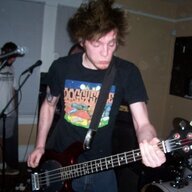
Sid Viscous did fine holding the neck like an axe handle.
That's because they didn't even bother plugging the poor schmuck in.
FYI - If you're listening to the record... well, it ain't Sid. (I think it was Glen Matlock, their original bassist on the record. He was fired because Sid better looked the part.)
D
Punk Monkees.That's because they didn't even bother plugging the poor schmuck in.
FYI - If you're listening to the record... well, it ain't Sid. (I think it was Glen Matlock, their original bassist on the record. He was fired because Sid better looked the part.)
Steve Jones played bass on all but Anarchy in the UK, which was played by Matlock. Sid pawed around on a couple of things but was mostly out with a case of hep.
The Monkees was a fake band made for TV. In comparison the Sex Pistols grew organically from their neighborhood, although Lydon auditioned for the gig. They took on a manager in order to succeed.
Entwistle was a phenomenally talented bassist who changed the course of electric bass playing.
Sid Vicious was a friend of the lead singer of the Sex Pistols.
The Monkees was a fake band made for TV. In comparison the Sex Pistols grew organically from their neighborhood, although Lydon auditioned for the gig. They took on a manager in order to succeed.
Entwistle was a phenomenally talented bassist who changed the course of electric bass playing.
Sid Vicious was a friend of the lead singer of the Sex Pistols.
Last edited:
Steve Jones played bass on all but Anarchy in the UK, which was played by Matlock. Sid pawed around on a couple of things but was mostly out with a case of hep.
The Monkees was a fake band made for TV. In comparison the Sex Pistols grew organically from their neighborhood, although Lydon auditioned for the gig. They took on a manager in order to succeed.
Entwistle was a phenomenally talented bassist who changed the course of electric bass playing.
Sid Vicious was a friend of the lead singer of the Sex Pistols.
There is evidence that Sid actually played live (not on the album of course). On this YouTube clip wait several seconds and listen to him botch his entrance. It must be him, it's too awful to be a pro stand in backstage.
They also played a bunch of gigs where the music was canned and Rotten sang over it live as the others played along with the track.
But Id better stay on topic....umm...okay, I'm pretty sure Sid isn't using 1 finger per fret. Just a hunch. Not that there's anything wrong with that.

You move the lower fingers if you need to, of course. You know perfectly well that's not what I'm talking about. What you shouldn't do is habitually have them hovering over the fingerboard. It makes shifting harder, you lose accuracy and the unsupported fingers suffer with fatigue. This is entirely standard, universally taught technique on all string instruments, bowed or plucked or whatever. Nothing controversial, and nothing to be gained by ignoring thisNot if any one of those fingers is going to jump to a higher string.
Is everything a scale?
Or chromatic?


