I'm pretty sure he's been called the Henry Ford of guitars, or something to that effect. There's not a whole lot of old time craftsmanship in making a slab with a bolt-on neck.

Enjoy the benefits of a premium membership!
Upgrade Account
-
TalkBass has been independent since 1998. Add your voice.
Create a free account to reply to discussions, view embedded media, and browse with fewer display ads.
Join free Log in
Want zero display ads or expanded classifieds tools? Compare plans.
You are using an out of date browser. It may not display this or other websites correctly.
You should upgrade or use an alternative browser.
You should upgrade or use an alternative browser.
V/V/T = Why?
- Thread starter LeonD
- Start date
More options
Who Replied?

Well, he must have loosened up in his older years, because Music Man is a completely different beast, as well as G&L with all their extra switches.
Fender didn't make switches, so all their stuff had to be designed around what was available (and what Leo was willing to pay for). He was one of those rare guys who had a lot of talent/smarts AND business sense. A lot of guys can put out an amazing product, but they flat out suck at running a business. Leo could do both.

And from the other side of the coin, how many 4001 Rics or any other basses which came with a LP circuit have you seen "upgraded" to VVT? Zero?
I don't see Ric people doing much in the way of mods at all. But Fender people are constantly modding their basses and doing things way more exotic than the LP circuit, assuming we even know what that is. When I do a search for it I get a wide variety of different circuits that claim to be the LP circuit. I don't think even the most complex one would require any routing but maybe I have not seen the one you are talking about. Do you have a diagram or link to it that you can post?

Haha It's not that bad. If you've got a good iron it's pretty easy.Everybody was tight back then, from his era. I wish the soldering to the back of the pots thing had never become a thing.

I don't have a good iron, and I don't want to ruin pots by melting them.
It thinks it's a bad practice, but the local luthier looked at me like I was mad when I asked him to do a job w/o soldering to the back of the pots.
It thinks it's a bad practice, but the local luthier looked at me like I was mad when I asked him to do a job w/o soldering to the back of the pots.
It may seem somewhat counter intuitive to someone who has not been properly trained in soldering but the hotter irons do less damage to the pot because you are not on it as long as you would need to be with weaker iron.I don't have a good iron, and I don't want to ruin pots by melting them.

These are over simplifications that can be unintentionally misleading…V/V/T lets one roll in or out a different tone
V/B/T adds one pickup in while subtracting from the other.
How VVT behaves depends on the taper of the pots used for the volume controls and whether they are wired for independent function or dependant function. Linear taper volume pots will not have the same effect on the tone as the volume is rolled down as audio taper pots will. Independent function seems to be the standard for volume controls on 2-pickup bass guitars since I see it on most 2-pickup basses regardless of brand. Not really sure why because in a live gig setting, dependent function would be better since that would allow either volume control to act as the master.
How VBT behaves depends on the type of ganged pot used to create the blend control. A proper ganged pot for use as a blend control has one pot full ON while the other is turned down past the center detent. They achieve this by making half the track sweep of each pot a dead short after the center detent. Those shorted tracks appose each other, thus allowing one pickup to be on full while the other is being turned down - and put both pickups on full while in the center detent position.
I think M/N is the proper taper for a blend, but I've never heard of two volume pots being dependant on one another.
I like to see a wiring diagram for that.
I like to see a wiring diagram for that.
I think M/N is the proper taper for a blend, but I've never heard of two volume pots being dependant on one another.
I like to see a wiring diagram for that.
A proper blend pot will have a linear taper and a center detent.
[Invalid or Expired Link Removed]
Wiring volume pots to work dependent is very easy. This is how most guitars with 2 pickups and 2 volume controls are wired. It's just a matter of swapping lugs. In this link below, they use the phrase "alternative volume control wiring" to describe making the volume controls independent from each other (which is how most 2 pickup 2 volume basses I have ever seen have been wired).
[Invalid or Expired Link Removed]
I wired two of my basses in series, so now neither of my volume pots have grounded lugs. In my mind, this is better for less loading, but it's probably just my imagination.
Instead of lowering the volume by shunting the signal to ground, it's just making a short circuit of both ends of the coils.
Instead of lowering the volume by shunting the signal to ground, it's just making a short circuit of both ends of the coils.
It may seem somewhat counter intuitive to someone who has not been properly trained in soldering but the hotter irons do less damage to the pot because you are not on it as long as you would need to be with weaker iron.
That's the way to keep from damaging components with too much heat- use an iron large enough for the job, or a hot gun:
Just be sure the tip is fully hot before engaging the work. *and have the work tinned, scraped, fluxed, etc before applying the heat- get in/ get out.
but I'm also not dumping $100 on a "soldering station" that I'm going to use once in a blue moon.
Hot guns work just fine if you use them right, and not expensive at all- Radio Shack, etc.
Radio Shack disappeared in my area. I got my 25 watt iron at Home Depot.
As long as I don't have to desolder wire from the back of pots, it works fine.
As long as I don't have to desolder wire from the back of pots, it works fine.
I hope I didn't already post this, but here is the job I did on my own Fender bass recently.
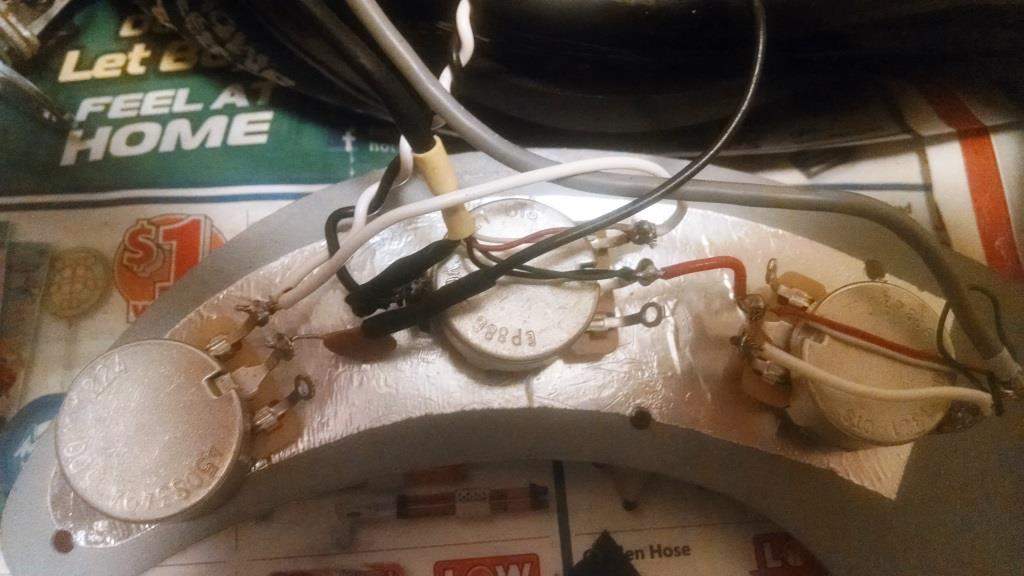
It's really quiet now, and I did not solder to the pot bodies.
It's really quiet now, and I did not solder to the pot bodies.
It isn't usually necessary to scrape pots to get them to take to soldering most of the time. It is best to tin a spot on the back ahead of time though. I would not recommend using a gun. It is best to use a pencil iron. You can get a pencil iron capable of getting hot enough for around $50.00 - $60.00.
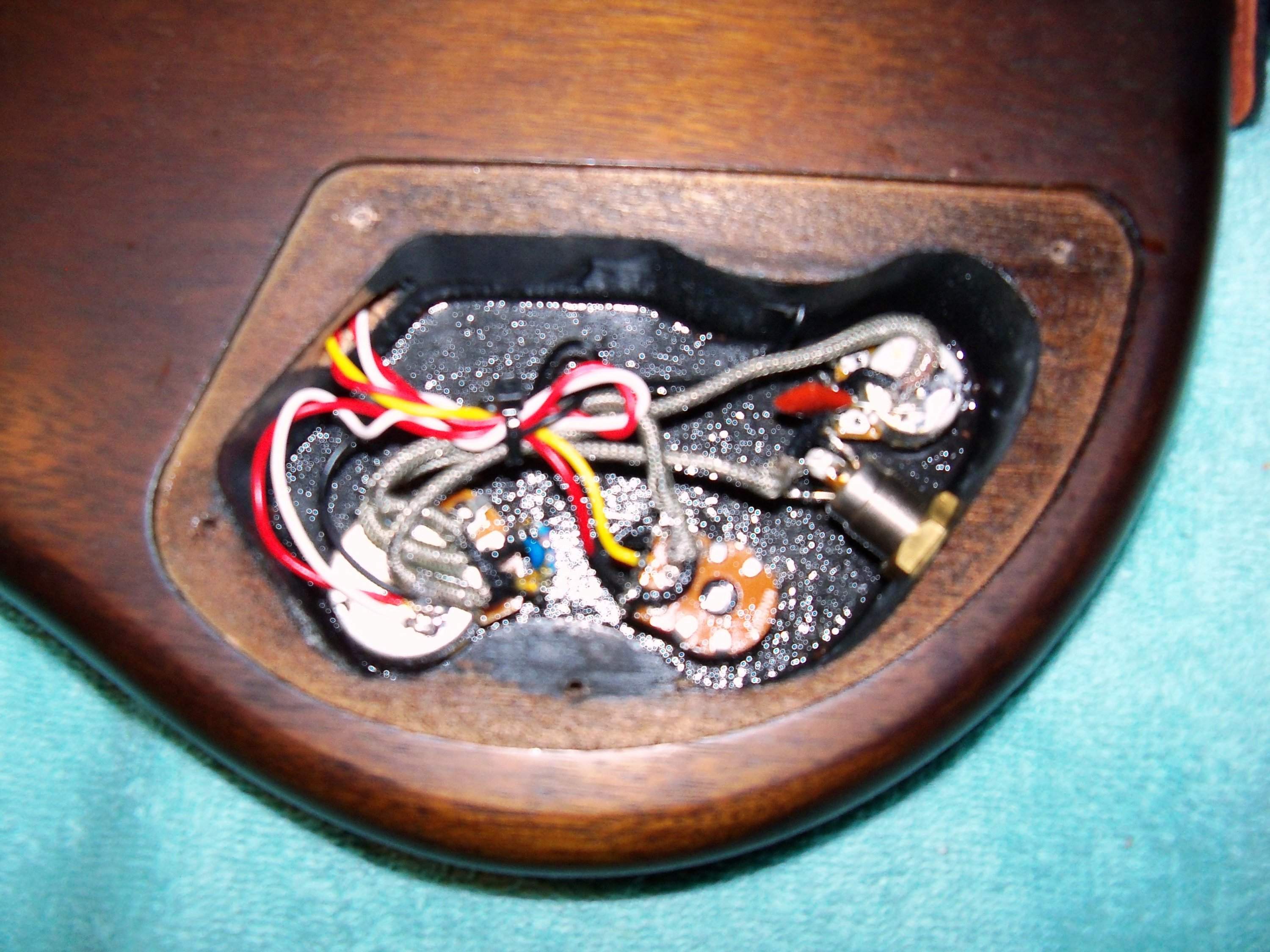
Anyways, here is a pic I took of my miKro bass control cavity after I rewired it for VBT. I had just cleaned the pots with DeoxIt when I took this pic.
Anyways, here is a pic I took of my miKro bass control cavity after I rewired it for VBT. I had just cleaned the pots with DeoxIt when I took this pic.