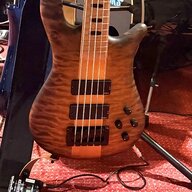
I didn't play it so far, but connecting it to a 115 box, I can hear odd noises like high frequency oscillations (scope says ca. 17 to 100kHz).

Enjoy the benefits of a premium membership!
Upgrade Account
-
TalkBass has been independent since 1998. Add your voice.
Create a free account to reply to discussions, view embedded media, and browse with fewer display ads.
Join free Log in
Want zero display ads or expanded classifieds tools? Compare plans.
You are using an out of date browser. It may not display this or other websites correctly.
You should upgrade or use an alternative browser.
You should upgrade or use an alternative browser.
Verellen Octal
- Thread starter coreyfyfe
- Start date
More options
Who Replied?
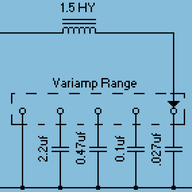
Not everyone here is a tube tech (and I'm not either); I'm just telling you that I wouldn't let the above stop me from using the Verellens in an ultralinear amp, as any competent tube amp tech (or any tech who can read a schematic) should be able to make this mod:
As someone said earlier, the ultralinear taps had been contributing some negative feedback. This could probably be replaced by tapping a little from the secondary to the splitter in the usual way (consult schematics of similar amps that are not ultralinear).
At least one extremely popular tube amp (with otherwise similar topology in the power amp) had no such tap from the secondary, but you'd have to study how they did that.
Please ignore this post once the more heavyweight advice arrives.
As someone said earlier, the ultralinear taps had been contributing some negative feedback. This could probably be replaced by tapping a little from the secondary to the splitter in the usual way (consult schematics of similar amps that are not ultralinear).
At least one extremely popular tube amp (with otherwise similar topology in the power amp) had no such tap from the secondary, but you'd have to study how they did that.
Please ignore this post once the more heavyweight advice arrives.

- Feb 12, 2006
- 60,961
- 5
- 220,636
- Disclosures
- Development Engineer-Mesa Boogie, Development Engineer-Genzler (pedals), Product Support-Genz Benz
Stability is much more difficult than you think here, it’s an incredibly difficult challenge which may not have a universal real world answer (IME).It works, that the important thing! Things like oscillation should be manageable. If it is an UL issue, then it isn't plug and play.
Today I tested the Verellen Octal in my Hiwatt DR405-clone (six 6550).
First measurements with the 6550:
Voltages G1 and anode without load (Stand By off)
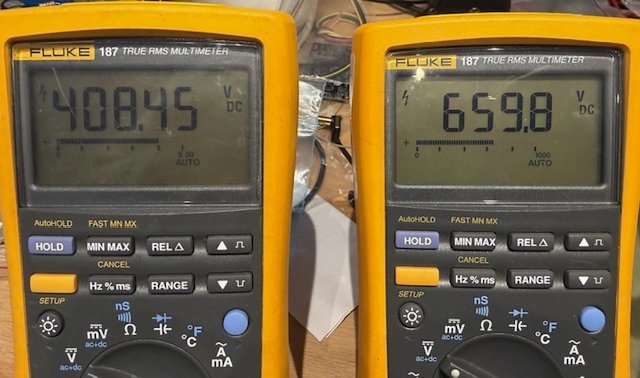
Voltages G1 and anode full power sine 1000 Hz
Spectrum at 8 ohm
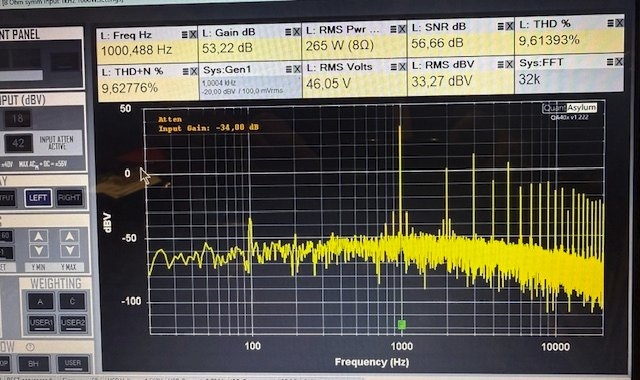
Not full power, may be due to the 12AT7 in PI and driver. In this amp is G1 current and more than 300W not possible.
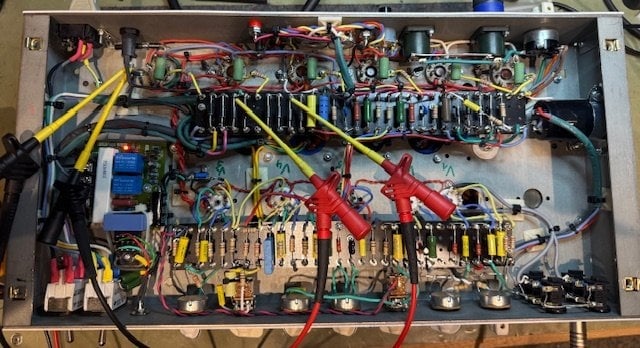
Foto of the amp's guts. Not military grade, but it works:
Now change to the Octals.
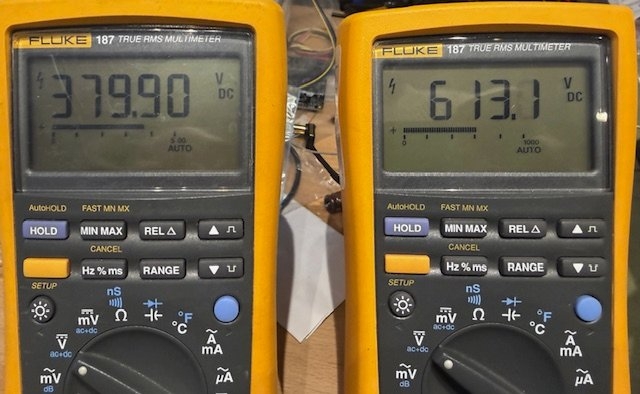
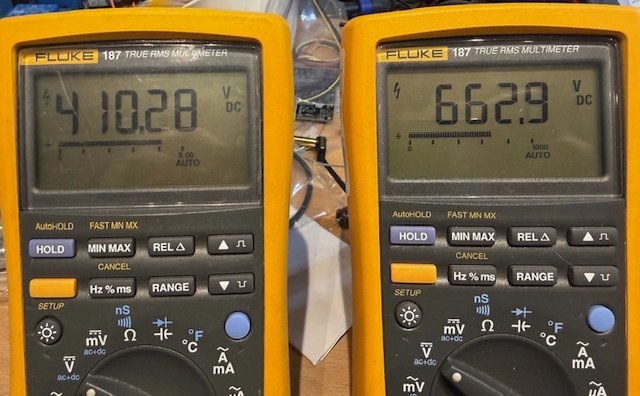
Voltages with Stand By off (a little higher due to less 6,3V heater current, approx. 0,8 instead 12 amperes)
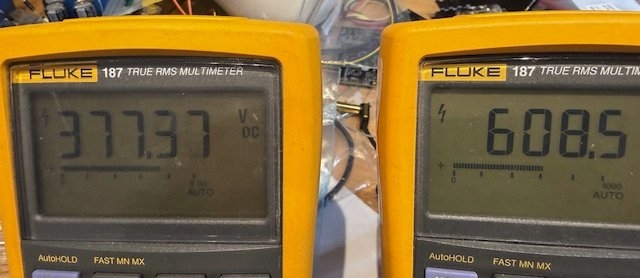
Voltages at full power
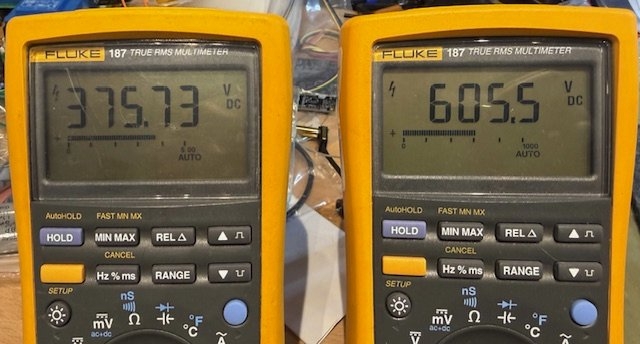
A little lower due to increased power
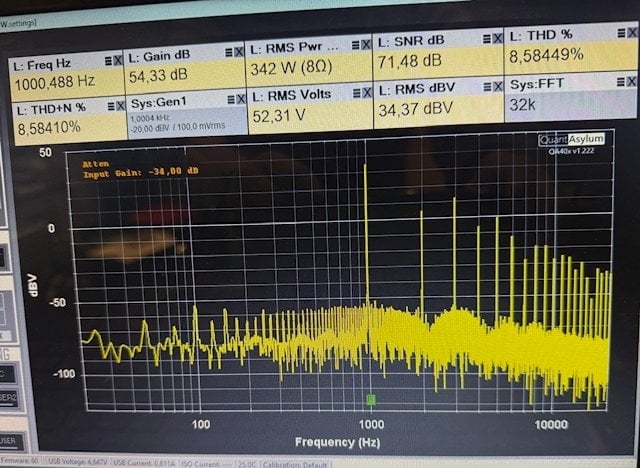
342 W at 8 ohm and THD 8,5% instead 265 W at 8 ohm and THD 10%!!
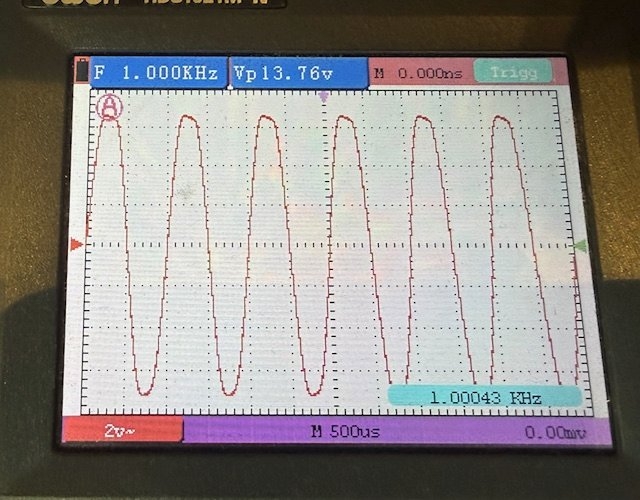
No oscillations at any power level
Same at 4 ohm
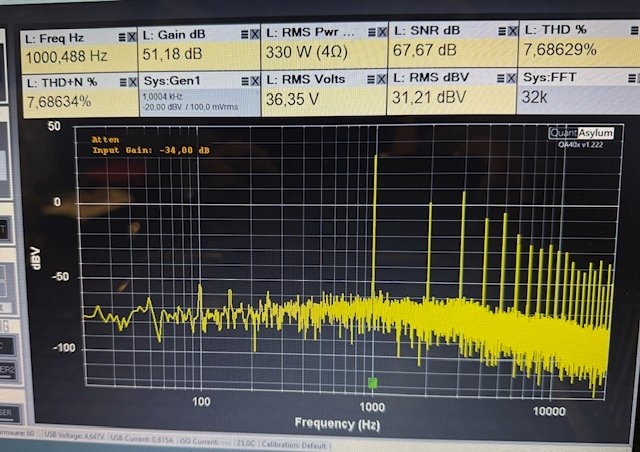
No oscillations at all.
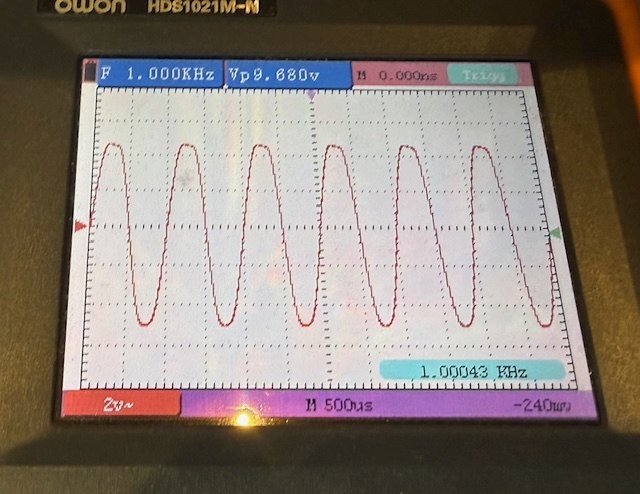
This are measurements on the workbench, now I have to hear the amp. But these results are awesome!
Clearly increase of Power and SNR, no oscillations!
Edit: The hum level at full power decreases with octals a lot also!
First measurements with the 6550:
Voltages G1 and anode without load (Stand By off)
Voltages G1 and anode full power sine 1000 Hz
Spectrum at 8 ohm
Not full power, may be due to the 12AT7 in PI and driver. In this amp is G1 current and more than 300W not possible.
Foto of the amp's guts. Not military grade, but it works:
Now change to the Octals.
Voltages with Stand By off (a little higher due to less 6,3V heater current, approx. 0,8 instead 12 amperes)
Voltages at full power
A little lower due to increased power
342 W at 8 ohm and THD 8,5% instead 265 W at 8 ohm and THD 10%!!
No oscillations at any power level
Same at 4 ohm
No oscillations at all.
This are measurements on the workbench, now I have to hear the amp. But these results are awesome!
Clearly increase of Power and SNR, no oscillations!
Edit: The hum level at full power decreases with octals a lot also!
Last edited:
The Studio Bass wasn't in good shape, the IM distortion (all multiples of 50Hz) does show it.
I own a nearly exact copy, the Super Twin, will test it also. May be, the oscillations I found are result of the bad shape of the Studio Bass or there is a problem with UL amps. To get it out, I will check my Bassman 135 (UL also) with the Octals too.
The Octals are getting hot, but not nearly as hot like the valves before. I'll measure the temperatures after f. e. 10 min full power and install two low noise 12V fans left and right on the chassis, blowing directly on the Octals.
After this I will test my 500W amp with six Octals instead of six KT 120. But I'll decrease the anode voltage from 820V to approx. 700V, the Octals are released to 700V, not more.
I own a nearly exact copy, the Super Twin, will test it also. May be, the oscillations I found are result of the bad shape of the Studio Bass or there is a problem with UL amps. To get it out, I will check my Bassman 135 (UL also) with the Octals too.
The Octals are getting hot, but not nearly as hot like the valves before. I'll measure the temperatures after f. e. 10 min full power and install two low noise 12V fans left and right on the chassis, blowing directly on the Octals.
After this I will test my 500W amp with six Octals instead of six KT 120. But I'll decrease the anode voltage from 820V to approx. 700V, the Octals are released to 700V, not more.
Last edited:
Today I tested the Verellen Octal in my Hiwatt DR405-clone (six 6550).
First measurements with the 6550:
Voltages G1 and anode without load (Stand By off)
View attachment 7438108
Voltages G1 and anode full power sine 1000 Hz
View attachment 7438109
Spectrum at 8 ohm
View attachment 7438110
Not full power, may be due to the 12AT7 in PI and driver. In this amp is G1 current and more than 300W not possible.
Foto of the amp's guts. Not military grade, but it works:
View attachment 7438111
Now change to the Octals.
Voltages with Stand By off (a little higher due to less 6,3V heater current, ca. 0,06 instead 12 amperes)
View attachment 7438112
Voltages at full power
View attachment 7438113
A little lower due to increased power
View attachment 7438114
342 W at 8 ohm and THD 8,5% instead 265 W at 8 ohm and THD 10%!!
No oscillations at any power level
View attachment 7438115
Same at 4 ohm
View attachment 7438116
View attachment 7438117
No oscillations at all.
View attachment 7438118
This are measurements on the workbench, now I have to hear the amp. But these results are awesome!
Clearly increase of Power and SNR, no oscillations!
Edit: The hum level at full power decreases with octals a lot also!
You mention the heater current - how are your voltages looking with octals vs tubes?
I’ve checked on a few amps, in my Mesa 400 with 6550 I was seeing about 6.5VAC, it would go up to 6.7V with 6L6 and 6.9V with the octals.
I didn’t compare B+ in the 400, but did look at it in some others. Saw a little increase in my ampeg V2 but not so significant as to concerning as far as voltage tolerance of caps, etc.
But I did measure the temperatures.
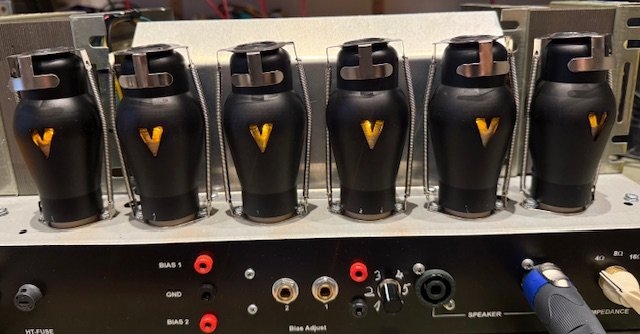
Situation witout signal, master at 0, after 3 min
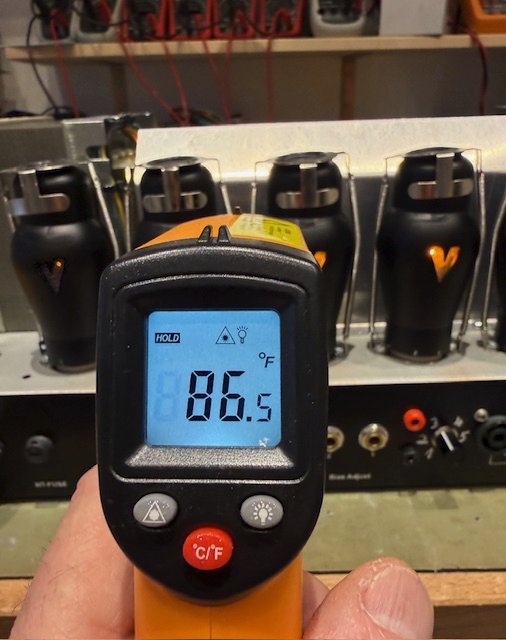
Full power after 1 min, all 1000Hz sine wave
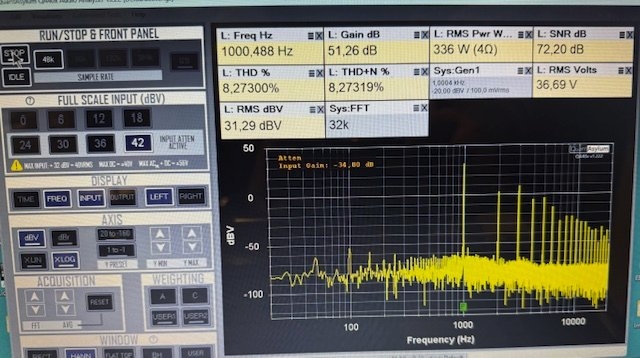
2 min
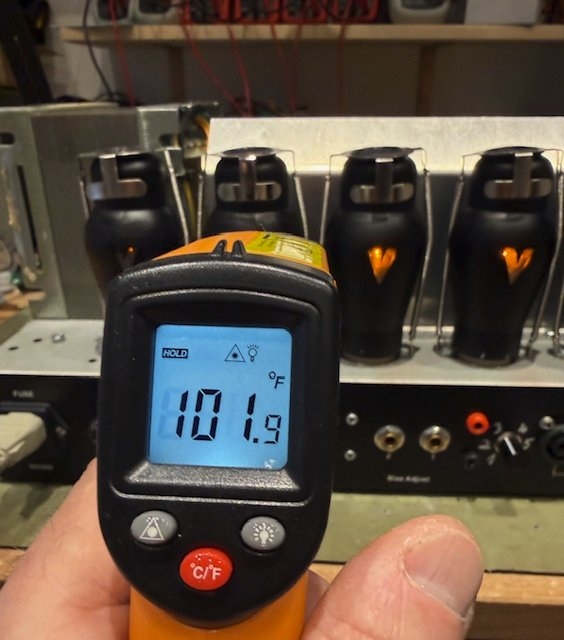
5 min
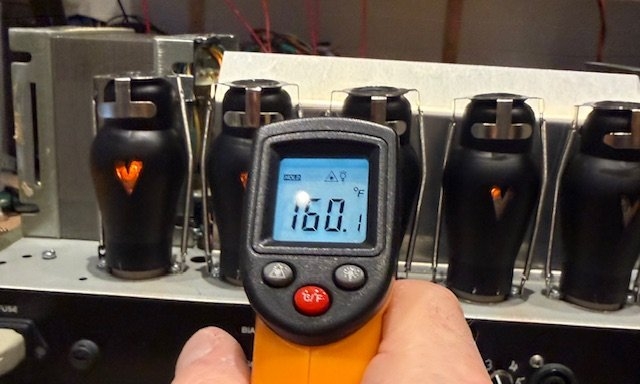
10 min
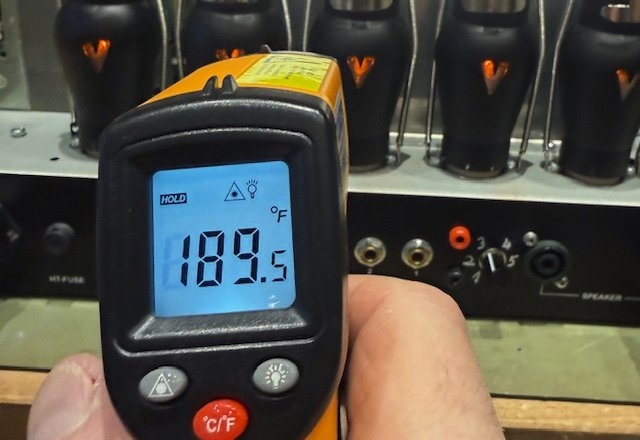
After 15 min (now 100Hz full power)
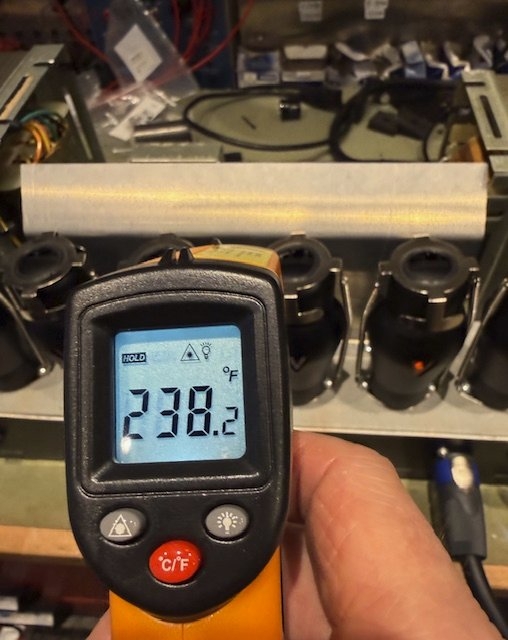
I didn't measure any temps in this setting (without active cooling and as signal a sine wave) over 240 degree F = 115 degree Celcius. I think, thats quite good!
But active cooling in these amps with more than 300W will be recommended and necessary, as Verellen says.
Edit: I measured the temp at the center of five cooling ribs.
Situation witout signal, master at 0, after 3 min
Full power after 1 min, all 1000Hz sine wave
2 min
5 min
10 min
After 15 min (now 100Hz full power)
I didn't measure any temps in this setting (without active cooling and as signal a sine wave) over 240 degree F = 115 degree Celcius. I think, thats quite good!
But active cooling in these amps with more than 300W will be recommended and necessary, as Verellen says.
Edit: I measured the temp at the center of five cooling ribs.
Last edited:
I wonder what the distortion of the former is, also at 265W. If you're hooked up again and can conveniently report this, it would be interesting.342 W at 8 ohm and THD 8,5% instead 265 W at 8 ohm and THD 10%!!
I think I like the other behaviors and flavorings from tube amps a lot more than power tube distortion (for example I like KT88s much, much more than 6L6GC for this reason). So to me it's a plus if these devices have less of *that* distortion.
(A LOT happens in the most common type of splitter/driver as the signal gets big (less so in a Hiwatt or clone but that's another subject.)
Last edited:
I have to check the signal at all preamp stages, PI and driver, because I get some 4-5% distortion at the preamp output, when there is enough level to drive the power section to max power. May be, there is an issue, I remember 300W at 2% distortion with the 6550.I think I like the other behaviors and flavorings from tube amps a lot more than power tube distortion (for example I like KT88s much, much more than 6L6GC for this reason). So to me it's a plus if these devices have less of *that* distortion.
(A LOT happens in the most common type of splitter/driver as the signal gets big (less so in a Hiwatt or clone but that's another subject.)
Connected to a box I notice some (little) hum, which is also seen in the spectrum diagram (100 Hz).
The Hiwatt clone Mywatt I own has exactly zero (0) hum, because the preamp tubes are heated with 12,6V DC and there is no hum loop at all.
May be I build a 6,3V DC voltage device for the preamp valves, if the hearable hum without signal persists. And check for hum loops.
- Feb 12, 2006
- 60,961
- 5
- 220,636
- Disclosures
- Development Engineer-Mesa Boogie, Development Engineer-Genzler (pedals), Product Support-Genz Benz
Some preamp circuits actually capitalize on the behavior of increased distortion at higher levels to enhance the texture (which is sometimes incorrectly attributed to the power amp). This is especially true with power amp topologies using higher global feedback ratios.
@cfortner did you notice any difference in tone or presence when playing your amps with those Octals?
The information you posted are extremely interesting but wayyyy beyond my knowledge.
I'm a player, not an engineer
The information you posted are extremely interesting but wayyyy beyond my knowledge.
I'm a player, not an engineer
The results above are measurements, I didn't play it, first I have to install some fans...
I'll report here.
I'll report here.
Before I put the amp back into the headshell, I installed two 60mm fans on the left and the right and a 120mm fan in the middle blowing from the front to the back.
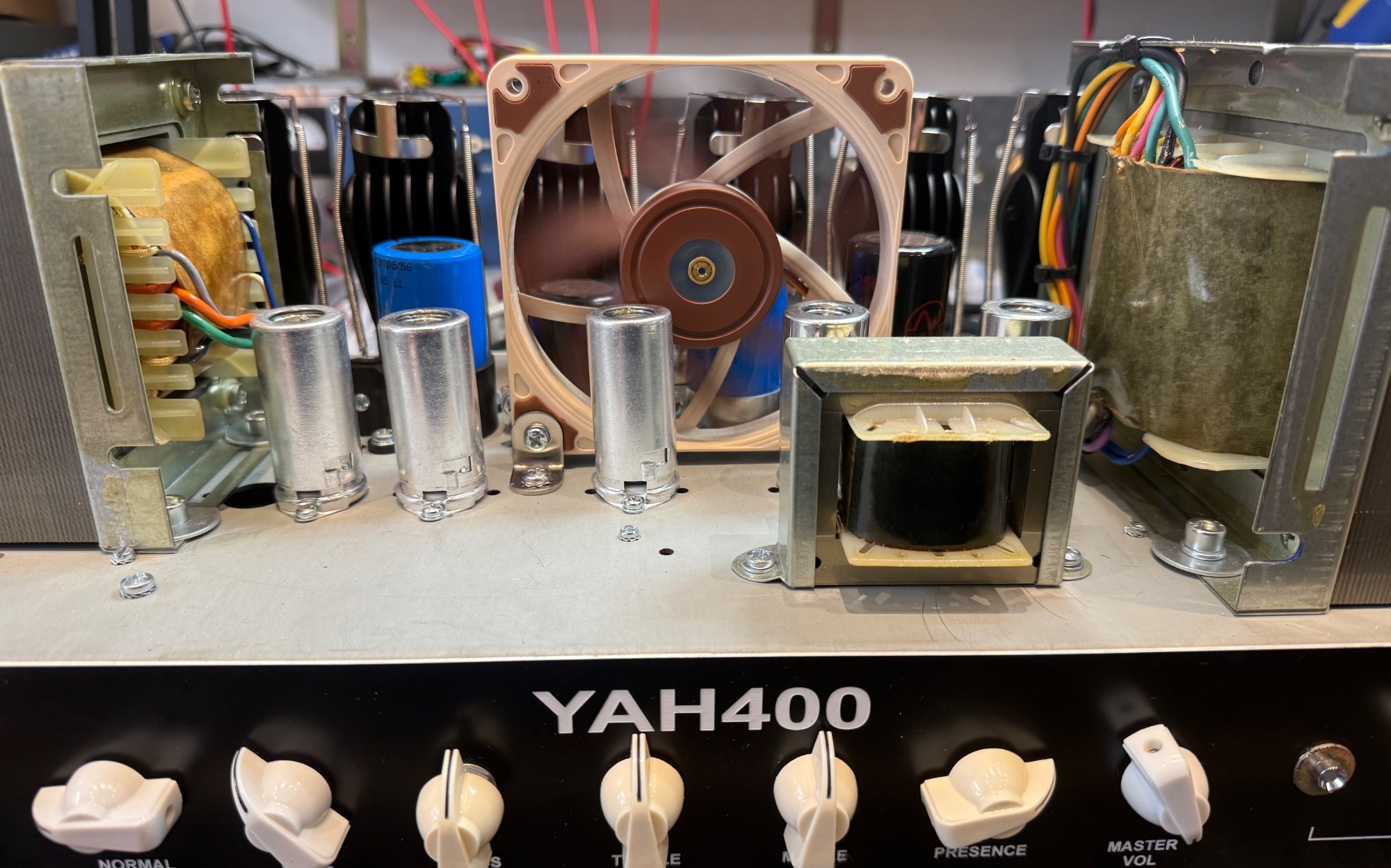
That's the spectrum at full power
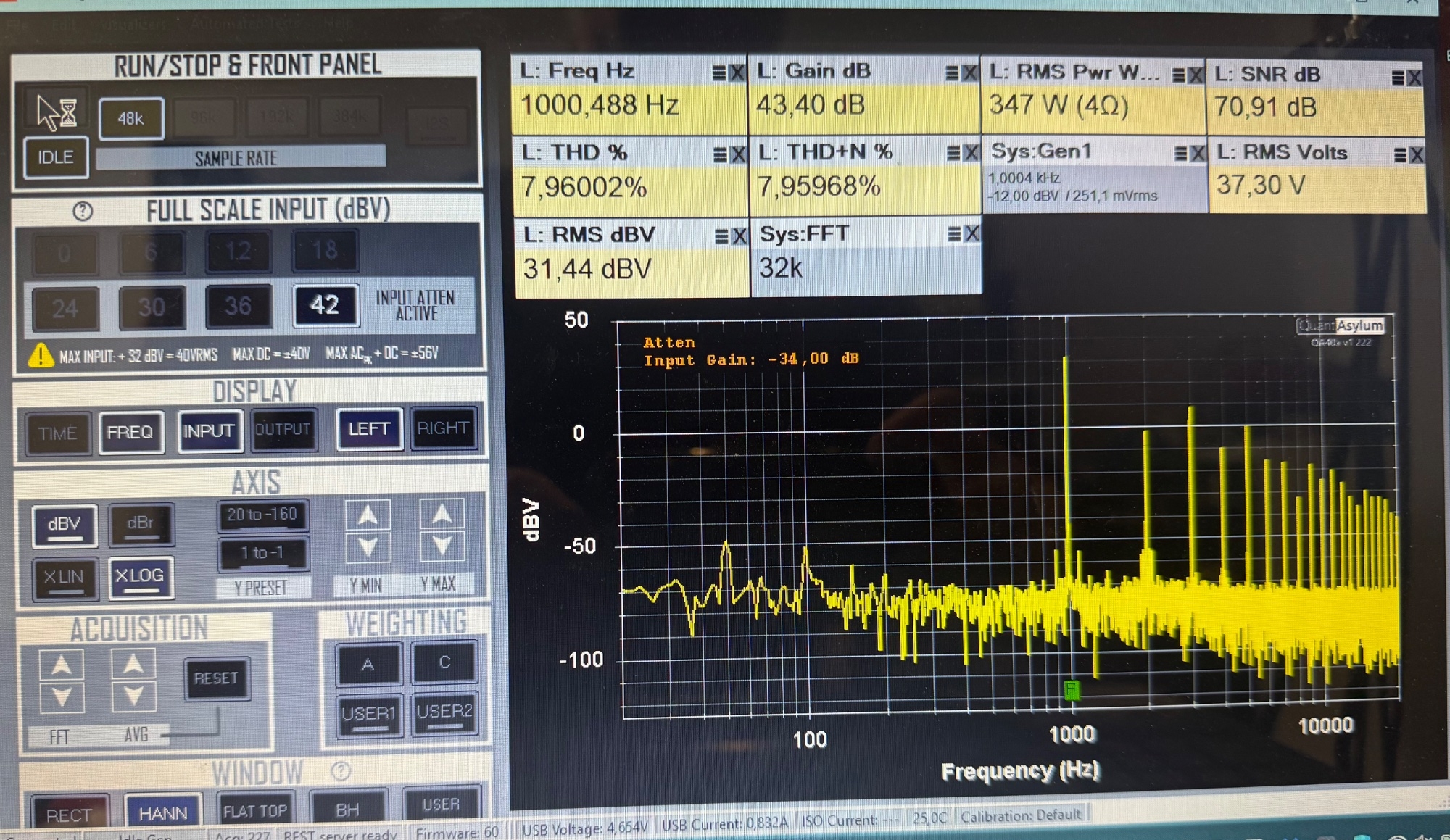
After more than 10 min I didn't measure any temperatures over 140 degrees Fahrenheit.
The 12V fans are very silent at 7,1V DC from heaters 6,3V AC.
Now I'll probe it in our rehearsal.
Edit: Sorry, no temperatures over 140 degrees Fahrenheit, I corrected this above.
That's the spectrum at full power
After more than 10 min I didn't measure any temperatures over 140 degrees Fahrenheit.
The 12V fans are very silent at 7,1V DC from heaters 6,3V AC.
Now I'll probe it in our rehearsal.
Edit: Sorry, no temperatures over 140 degrees Fahrenheit, I corrected this above.
Last edited:


