
Enjoy the benefits of a premium membership!
Upgrade Account
-
TalkBass has been independent since 1998. Add your voice.
Create a free account to reply to discussions, view embedded media, and browse with fewer display ads.
Join free Log in
Want zero display ads or expanded classifieds tools? Compare plans.
You are using an out of date browser. It may not display this or other websites correctly.
You should upgrade or use an alternative browser.
You should upgrade or use an alternative browser.
Vintage Fender basses
- Thread starter bassfart
- Start date
More options
Who Replied?
I bought my all original 77 jazz because it was a great price and I knew I could resell it for more than what it cost. After playing it, I'm keeping it. It's a heavy 3 bolt and it's fantastic.
Play what you like, you can't put a price on how much you enjoy it.
Play what you like, you can't put a price on how much you enjoy it.
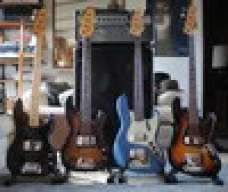
I bought my '75 P brand new. Seems the '75s are not very popular, but it doesn't matter because I have no plans to sell it. I don't play it, but it's a sentimental thing.
Fenders will always appreciate in value, especially vintage and Pre CBS.
If you look at one of the most sought after vintage Fender basses, the first year 1960 Jazz, it cost about $280 new and now one in excellent/original condition can fetch around 20K on average. Although that's a lot of money it's taken 50 years to get that kind of money. It works out at about $400 a year. There are much better ways to invest.
Also, 70's Fender basses are great but they will not follow the same trend as the 1960 - 64 Jazz basses and P basses.
If you love them and enjoy playing them, then you should keep them. Ten years from now they will appreciate but not enough to get excited over IMO.
If you look at one of the most sought after vintage Fender basses, the first year 1960 Jazz, it cost about $280 new and now one in excellent/original condition can fetch around 20K on average. Although that's a lot of money it's taken 50 years to get that kind of money. It works out at about $400 a year. There are much better ways to invest.
Also, 70's Fender basses are great but they will not follow the same trend as the 1960 - 64 Jazz basses and P basses.
If you love them and enjoy playing them, then you should keep them. Ten years from now they will appreciate but not enough to get excited over IMO.

- Jun 3, 2009
- 3,330
- 399
- Disclosures
- Bassgearu, Music Industry Consulting and Sales. Tech 21, NBE Corp, Sonosphere.
Fender seems to be the only "vintage" bass market. All other basses, even from the '50s, seem to be available for pennies. I have never understood that. While we at TB know of the legendary Matsumoku factory, a mint Aria Pro II SB 1000 still only sells for about what a new RI does. You can get Westones for a song, even though at 30 years old they are still better then ANY bass made in the US at the same time.
The vintage market was driven by wealthy Japanese collectors for many years. The market is now just starting to see the new Chinese collector. They will be looking for US Fender, so prices I am sure will remain stable and grow modestly.
I have one of each of the Kubickis made. They still are only worth half of the price of a new one and aren't growing much. Music Man, Leo's other revolution, you would think would be on par with the Fenders, but they aren't. Go figure...
The vintage market was driven by wealthy Japanese collectors for many years. The market is now just starting to see the new Chinese collector. They will be looking for US Fender, so prices I am sure will remain stable and grow modestly.
I have one of each of the Kubickis made. They still are only worth half of the price of a new one and aren't growing much. Music Man, Leo's other revolution, you would think would be on par with the Fenders, but they aren't. Go figure...

Here's a couple of examples:
62 Jazz
60 Precision
64 Gibson Thunderbird bass
I wonder what they might actually sell for.
62 Jazz
60 Precision
64 Gibson Thunderbird bass
I wonder what they might actually sell for.
As an eBay Associate, TalkBass may earn a commission from qualifying purchases.

Fenders will always appreciate in value, especially vintage and Pre CBS.
Also, 70's Fender basses are great but they will not follow the same trend as the 1960 - 64 Jazz basses and P basses.
If you love them and enjoy playing them, then you should keep them. Ten years from now they will appreciate but not enough to get excited over IMO.
The 70's Fender basses have already followed the trend of the early 60's basses. It wasn't that long ago where you could buy them all day long for $400. Now.... well I'll tell you that if 15 years ago you told me that one of those late 70's boat anchors would sell for north of $1,500, I'd say you were crazy.
Tens of thousands of people will want vintage gear. As time goes by, run of the mill stuff from the late 90's are going to be vintage instruments. Prices will increase on all vintage gear. Sure, a '79 P-bass will never be worth as much as a '61 P-bass, but it's unrealistic to expect that to happen.
Fender seems to be the only "vintage" bass market. All other basses, even from the '50s, seem to be available for pennies. I have never understood that. While we at TB know of the legendary Matsumoku factory, a mint Aria Pro II SB 1000 still only sells for about what a new RI does. You can get Westones for a song, even though at 30 years old they are still better then ANY bass made in the US at the same time.
The vintage market was driven by wealthy Japanese collectors for many years. The market is now just starting to see the new Chinese collector. They will be looking for US Fender, so prices I am sure will remain stable and grow modestly.
I have one of each of the Kubickis made. They still are only worth half of the price of a new one and aren't growing much. Music Man, Leo's other revolution, you would think would be on par with the Fenders, but they aren't. Go figure...
I dunno, I see Gibsons and Rickenbackers selling for insane money on the vintage bass market. Often bringing more than Fenders. Vintage MM Stingrays always bring more money than their Fender peers.
I don't see China as the future of the vintage guitar market. Culturally, the Japanese are closely connected to America. China isn't. There are no rock and roll roots in China to fuel a vintage guitar mania. And the average Chinese makes a fraction of the salary of their Japanese counterparts.

- Jun 3, 2009
- 3,330
- 399
- Disclosures
- Bassgearu, Music Industry Consulting and Sales. Tech 21, NBE Corp, Sonosphere.
I dunno, I see Gibsons and Rickenbackers selling for insane money on the vintage bass market. Often bringing more than Fenders. Vintage MM Stingrays always bring more money than their Fender peers.
I don't see China as the future of the vintage guitar market. Culturally, the Japanese are closely connected to America. China isn't. There are no rock and roll roots in China to fuel a vintage guitar mania. And the average Chinese makes a fraction of the salary of their Japanese counterparts.
the new wealthy Chinese see American as a status luxury. Just like the Japanese did a decade ago.
There are a handful of Gibsons in the bass market that garner price, and vintage Rics sometimes get big bucks, but you can still find EBs, Victorys and Grabber/Rippers in the affordable range. If these were Fenders they woud be priceless.
The late 70s Japanese basses, based on quality, uniqueness and innovation should be getting a lot more then Fenders of the same years, but dont. the only conclusion is that Fender is about the only thing considered vintage to the collector. Stanley Jay of Mandolin Bros told me not long ago that nothing Japanese can be considered vintage. If his mindset is prevelant, then collectors will only look for Fender and Gibson and Ric ever.

dukeplaysbass
Supporting Member
Investment is something that with time and effort will repay you with an actual livelihood or something close to it. Think: a small business, an education, $15,000 each year invested in diverse securities for 30 years, an apprenticeship in a trade, etc., IMHO, those are investments.
<snip>
The S&P 500 has gained 60% in the last 3 yearsjust sayin'
I've taken issue with the good Doctor before, and respectfully do so here.
ALL of what Dr Jim talks about are investments. But, investments are not only long-term. In fact, most real investors are constantly re-evaluating their portfolio in order to take advantage of short-term gains, and diversifying that risk with long-term stable assets that won't appreciate at astronomical rates but are far less likely to have huge downturns in value, either.
That said, most people don't have $15k per year to invest in securities. And if you did, and have been doing so, you got hit hard. While Dr Jim's 3-year return figure for the S&P 500 is interesting, it doesn't tell the whole story. That 60% return is AFTER of the 45% TOTAL loss suffered in 2008.
For those of you who care, here's an example. Say at the beginning of 2008, you had $1000 in a fund indexed to the S&P 500. By the end of that year, you lost 45%. That means your balance shrunk to $550. Over the next 3 years, however, you gained a total of 60%. Your balance is now $880.
If you bought at the right time, you scored. If you didn't buy at the right time - or held on as the so-called "experts" told ya to do - you took it in the shorts.
In the end, nobody knows what's going to happen. To the S&P, to real estate, and to vintage basses alike.
But could buy something good, used at Guitar Center and probably make that same 25% in a quick flip. It all depends on how hard you want to work your money. If you're really looking for investments - 25% profit is the same regardless of what you sold to make it - what matters is how much of a risk you took to make it and how sure you are at evaluating what you are buying and what the market is paying.
Yep - that's investing, too. It's short term, of course. But it's still and investment of cash, backed with research and knowledge, on the idea that it will return a profit. And the 25% you might make on a flip is better than the returns of the S&P 500 over the last FOUR years....
But really, all of these "vintage instruments as investment" threads basically air the same pro and con arguments. Does anybody know what will happen to the vintage market? Nope. Can we all make a guess? Yep. Should you keep the axes? I dunno. You have to figure out how much you love them, what your cash/asset situation is, what kind of future expenses/investments you might have, your ability/desire/resolve to sell them when the time comes, etc, etc, etc.
I'm really no help here.

the new wealthy Chinese see American as a status luxury. Just like the Japanese did a decade ago.
There are a handful of Gibsons in the bass market that garner price, and vintage Rics sometimes get big bucks, but you can still find EBs, Victorys and Grabber/Rippers in the affordable range. If these were Fenders they woud be priceless.
The late 70s Japanese basses, based on quality, uniqueness and innovation should be getting a lot more then Fenders of the same years, but dont. the only conclusion is that Fender is about the only thing considered vintage to the collector. Stanley Jay of Mandolin Bros told me not long ago that nothing Japanese can be considered vintage. If his mindset is prevelant, then collectors will only look for Fender and Gibson and Ric ever.
The Chinese and Japanese cultures are so different that they may as well exist on different planets. If the wealthy Chinese do see American as status luxury, vintage guitars aren't what they're looking for. The Japanese have been immersed in American culture since 1945, the Chinese have not. As such, they have no connection to vintage American guitars. If the Chinese start buying guitars, they'll be more likely to buy brand new custom shop Fenders than vintage Fenders.
The reason some vintage Gibsons have not kept pace with some vintage Fenders (besides the obvious reason) is that the variety of Fender products during the 60's and 70's was very limited. Gibson had a much wider variety. Many (most, IMO) of those Gibson models were turkeys. Most pros didn't play them, and therefore they have a lower value in the vintage market.
Up until the early 80's, most Japanese basses were made for a price point. They were mostly cheaper copies of Fender products. Even the 80's models that were exceptional have lower prices because the players people want to emulate played Fenders, Gibsons or Ric's. Ask any kid whether they'd rather have a bass like JPJones played or the guy from Spandau Ballet played and you'll get your answer.
If Stanley Jay of Mandolin Bros thinks that nothing Japanese can be considered vintage, then he's a boob.

Jim Carr
Dr. Jim
- Jan 21, 2006
- 16,223
- 7,614
- 76
- Disclosures
- fEARful Kool-Aid dispensing liberal academic card-carrying union member Musicians Local 72-147
Hi Duke12—thanks for your thoughtful comments. I've tried to stay as brief as as could in my reply.
Sadly, most don't, even if they can. A married couple (under 50) can put away $5000 each tax-deferred once a year in an IRA. Saving an additional $5k means saving less than $90 a week each. My Grandfather always said pay yourself first—by saving.
If one can't save $15k a year, shoot for 5, or 10k!
Yet, inflation is going to take it's bite—more on that later.
True, I didn't try to tell the whole story, and still can't—and the figures above don't tell the whole story, either.
Yes, investors were hit hard in 2008-9. However, diversification matters, as does time. While the last 5 years have been the worst for most sectors of the stock market since the Great Depression (1929-1941), those who panicked are the ones in real pain. They sold and locked in their losses for good. Those who didn't are fine and stand to do very well in the recovery—which is happening—though too slowly!
No. Timing the market as a consistent strategy is impossible, IMHO. Investing is not as simple as sitting on a lump sum and worrying, LOL! It takes time and consistent dollar cost averaging, IME.
If one were regularly buying (say the SP index once a month), those investments made when prices were low are now appreciated—in more ways than one!
Short runs are one thing, but in the long run, stocks in productive companies beat bonds, gold, real estate, cash, inflation, art, tulip bulbs, and vintage basses. It is all about risk and what is productive.
Don't believe me, I'm just a retired music teacher. Read what Warren Buffet said recently. Argue with his figures if you can: Invalid Link Removed
I've taken issue with the good Doctor before, and respectfully do so here.
That said, most people don't have $15k per year to invest in securities. And if you did, and have been doing so, you got hit hard.
Sadly, most don't, even if they can. A married couple (under 50) can put away $5000 each tax-deferred once a year in an IRA. Saving an additional $5k means saving less than $90 a week each. My Grandfather always said pay yourself first—by saving.
If one can't save $15k a year, shoot for 5, or 10k!
Yet, inflation is going to take it's bite—more on that later.
While Dr Jim's 3-year return figure for the S&P 500 is interesting, it doesn't tell the whole story. That 60% return is AFTER of the 45% TOTAL loss suffered in 2008.
For those of you who care, here's an example. Say at the beginning of 2008, you had $1000 in a fund indexed to the S&P 500. By the end of that year, you lost 45%. That means your balance shrunk to $550. Over the next 3 years, however, you gained a total of 60%. Your balance is now $880.
True, I didn't try to tell the whole story, and still can't—and the figures above don't tell the whole story, either.
Yes, investors were hit hard in 2008-9. However, diversification matters, as does time. While the last 5 years have been the worst for most sectors of the stock market since the Great Depression (1929-1941), those who panicked are the ones in real pain. They sold and locked in their losses for good. Those who didn't are fine and stand to do very well in the recovery—which is happening—though too slowly!
If you bought at the right time, you scored. If you didn't buy at the right time - or held on as the so-called "experts" told ya to do - you took it in the shorts.
No. Timing the market as a consistent strategy is impossible, IMHO. Investing is not as simple as sitting on a lump sum and worrying, LOL! It takes time and consistent dollar cost averaging, IME.
If one were regularly buying (say the SP index once a month), those investments made when prices were low are now appreciated—in more ways than one!
In the end, nobody knows what's going to happen. To the S&P, to real estate, and to vintage basses alike.
Yep - that's investing, too. It's short term, of course. But it's still an investment of cash, backed with research and knowledge, on the idea that it will return a profit. And the 25% you might make on a flip is better than the returns of the S&P 500 over the last FOUR years....
But really, all of these "vintage instruments as investment" threads basically air the same pro and con arguments. Does anybody know what will happen to the vintage market? Nope. Can we all make a guess? Yep. Should you keep the axes? I dunno. You have to figure out how much you love them, what your cash/asset situation is, what kind of future expenses/investments you might have, your ability/desire/resolve to sell them when the time comes, etc, etc, etc.
I'm really no help here.
Short runs are one thing, but in the long run, stocks in productive companies beat bonds, gold, real estate, cash, inflation, art, tulip bulbs, and vintage basses. It is all about risk and what is productive.
Don't believe me, I'm just a retired music teacher. Read what Warren Buffet said recently. Argue with his figures if you can: Invalid Link Removed

For the sake of my earlier point that you could invest in older basses, from Guitar Center, and make a little money:
1983 Pbass - $550 plus shipping. Ummm the last two 1983 Fenders listed for sale on Tbass were $1750 and $950 (who knows what they sold for).
Want to invest (for the short term OR long term, a little money)?
It won't supply you with a liveliehood unless you can flip it for a profit and then do it again and again, but it will "make you money" (which is another definition of investment).
Invalid Link Removed
1983 Pbass - $550 plus shipping. Ummm the last two 1983 Fenders listed for sale on Tbass were $1750 and $950 (who knows what they sold for).
Want to invest (for the short term OR long term, a little money)?
It won't supply you with a liveliehood unless you can flip it for a profit and then do it again and again, but it will "make you money" (which is another definition of investment).
Invalid Link Removed


You might be going nuts, not sure what your talking about.
Invalid Link Removed
Invalid Link Removed

Are you suggesting buying a used piece of gear at Guitar Center and making a profit by flipping it? If so, it's just not feasible. GC has already marked it up, you'd have a hard time getting another 25% on top of that.
If you look hard enough, you can make $$$. Exception, not the rule....
My guitarist bought a nearly mint Gibson Les Paul 2008 Standard today for approx $1450 at a "super duper blow out sale"
 this is a $1900-2000 guitar on Craigslist all day long....
Am I going nuts or everyone's got an avatar like this??
Invalid Link Removed
I was beginning to think JimmyM was EVERYWHERE.


