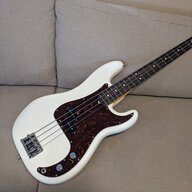
I've been AB'ing my basses quite a bit the last few months, and stumbled into some contradictions that I need help making sense of!
Curious to get input from more knowledgeable folks!
- I've compared 4 basses:
- '67 Jazz with original pups (La Bella LT Flats)
- G&L JB5 with the standard alnico single-coils (La Bella LT Flats)
- Ric 4003 with the high-gain pups (La Bella RX Nickel Rounds)
- Squier Jazz with Nordstand N4JSEs (split coil hum bucking) (D'Addario NYXL Rounds)
- Of these, the '67 Jazz pickups have some interesting properties:
- They're the hottest by a decent margin
- They're the clearest/most bell-like (even with flats) with the most high and low extension
- They're least-affected by EMF noise when soloed despite little to no shielding (excluding the humbucking Nordstrands). They're also quieter than the single-coil Bill Wilde Keystones in my Strat, and the Burstbuckers in my LP when split.
- The bridge pup was rewound by Lindy Fralin, but shares all of the above qualities with the all-original neck pup; i.e. the rewind has had no discernible positive or negative effects.
- They sound the least like the G&L alnico pups, despite being the most similar in construction and materials. The G&L's are the muddiest and weakest of the four.
- #1 and #2 are odd, as I've often heard that hotter pups nearly always tradeoff with clarity, but that's clearly not the case here.
- #3 is hard to understand and makes me wonder if the specific Alnico V recipe used (with any variations inherent to manufacturing at that time) is less susceptible to certain frequency bands of interference. All of the above + considering #4 has me wondering if the secret sauce is in the magnet alloy, and if so, what made it unique and is that "recipe" still available today?
Curious to get input from more knowledgeable folks!