• TalkBass has been independent since 1998. Add your voice.
    Create a free account to reply to discussions, view embedded media, and browse with fewer display ads.
    Join freeLog in
    Want zero display ads or expanded classifieds tools? Compare plans.

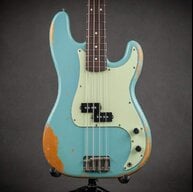
Vintera ii 60s precision with la bella flats

i realised why my unit weight measurement for the la bella 110 was wrong and it wasnt the dugital scale fault. I should have weighed the entire string minus the ball. And then divided that figure by the scale length. So it should have been the mass of 47" which would have been
0.08889130398lbs divided by 34" (scale length) = 0.00261445011 lbs/inch
Is that right? In theory, you could have had 2 kilometres of the same string, and its unit weight (mass per linear inch) would have been the same as that of the commercial string. In order to obtain it, you should have weighed the 2km-long coil and divided the result by ...however many confounded inches are in two kilometres.
 
Is that right? In theory, you could have had 2 kilometres of the same string, and its unit weight (mass per linear inch) would have been the same as that of the commercial string. In order to obtain it, you should have weighed the 2km-long coil and divided the result by ...however many confounded inches are in two kilometres.
(Or, of course, you could have weighed whatever length in inches you chose from the same coil, but then divided the value by the same length.)

To be clear, I have no explanation for what might have gone wrong in your original measurement.
 
(Or, of course, you could have weighed whatever length in inches you chose from the same coil, but then divided the value by the same length.)

To be clear, I have no explanation for what might have gone wrong in your original measurement.
That's the mistake I made at first and thus arrived at a unit weight that was under valued ie failing to divide the weight of chosen string length ( i used a 46" section originally) by the scale length. If you only divide the weight by number of total inches you have not factored in the scale length used for the unit weight calculation. Thus divide the chosen length of string section’s weight by the scale length.
So originally I weighed a 46" section of la bella 110 and obtained 39.45grams or .087lbs . I then divided that by 46" to get .00189130434 which I wrongly inferred was the Unit weight and thus led to believe the tension was as per a Chrome 100 and therefore thinking the tension was less than the reality. The reality being that the weight of the string section had to be divided by the scale length value, not the total length value ie .087lbs divided by 34" not 46". The resulting .002558822 is the Unit weight number to be used in the tension calc. On that basis the 110 la bella had a tension of 51.96lbf tuned to E1. So def up there with the Roto77's as mentioned.
Apologies for clogging thread with my calculation ravings he he.

So OP, you asked the question. Have you tried the La Bella 1954's yet?
 
Last edited:
That's the mistake I made at first and thus arrived at a unit weight that was under valued ie failing to divide the weight of chosen string length ( i used a 46" section originally) by the scale length. If you only dicide the weight by number of total inches you have not factored in the scale length used for the unit weight calculation. Thus divide the string section weight by scale length
So originally I weighed a 46" section of la bella 110 and obtained 39.45grams or .087lbs . I then divided that by 46" to get .00189130434 which I wrongly inferred was the Unit weight and thus led to believe the tension was as per a Chrome 100 and therefore thinking the tension was less than the reality. The reality being that the weight of the string section had to be divided by the scale length value, not the total length value ie .087lbs divided by 34" not 46". The resulting .002558822 is the Unit weight number to be used in the tension calc.
Here's a relevant exchange I had with Jon Moody:
I suppose the OP meant an instrument or way to measure tension without knowing the unit weight (=linear mass) of the strings, but now that I think about it, could it be so simple as cutting exactly one inch of string and putting it on a precision scale, then calculate tension with the formula?
Yeah, it's that simple. I'd probably encourage you to cut 34" of string (basically, lop the ball end and the tapered part off), weight it and then divide by how long it is. That's what Skip from Kalium instructed me to do, when I tackled this project a couple of years back.
Note how he advises to divide by 34", but also to start with a 34" long section.
 
But, seeing that the scale length is already factored into the tension equation, you could do it in a non destructive way by

1. Taking a string either unused or used and measuring from the rear of the ball end to the tip

2. Weigh it and take off the weight of the ball end from that weight

3. Divide that weight by the length of the string in step 1

4. Convert from grams to pounds if neccessary.

5. Use resulting Unit Weight number in the tension equation

E.g say you wanted to know the tension of a D string .060 for which you had no data

1. Take a new or used .060. Measure from rear of ball to tip of string. Let's say its 46.283"

2. Weigh it. Lets say it is 12.075 grams with ball. A bass ball end is around .075 grams. So take that off, leaving 12g

3/ Divide 12 grams by measurement from step 1 ie 12/46.283 = 0.25927446362 grams/inch

4. Convert grams to lbs = .000572lbs/inch. Our magic Unit Weight

5. Do the tension equation

2x (34x73.42) ie 2x scale length x D2 frequency
= 4992.56. Now square that.
Take that large number and multiply by the UW number in step 4 ie .000572

Divide that large number (14,257.4748622) by 386.4

= 36.89lbf in tension

And before anyone says what’s all this got to do with the price of bread. Everything he he
 
Last edited:
You're in luck because I have the same bass and went through the same exact strings. Your neck, despite being very thin front to back, will be fine with the Jamersons (or Duck Dunns).

The next gauge down are not the FS but the FM (49-109). From what I understand, the Jamersons have a thicker core than all the other DTFs.

These strings are huge and a lot stiffer than the Fenders. I like them a lot but I'm heavy handed. Compared to the 9050s they are dark, scooped in the mids and loud.
I like being able to play the Fenders on my other P bass for a nice change but they become noodles on stage because I dig in. The 100 E is too floppy for me.

There are two things to know about the Jamersons and they both concern the E string.

First of all, it sounds weird. Different from the other 3 (which are very even) and always kind of out-of-tune with itself and sharp, though the tuner says it's in tune. Overtones, I guess. A year in, this issue has been mitigated with the strings mellowing out, but it's still there.
My Fenders OTOH feel and sound more even.
However, I hear this with all flatwound E strings, it's just more evident here because the core is so thick.
There are several posts here where people contacted Labella for a replacement and the issue never went away. As I said, it's inherent in all flats, just more jarring with the Jamersons.

The other issue is the E string needs to be super long to intonate, so you'll have to push back the saddle quite a bit.
If you use foam under the strings, ahead of the bridge, like most people, the E string will be sharp. I have foam over the strings, under the ashtray, and slanted so it sits right on top of the saddle, so my intonation is good (with the overtone caveat above).
 
Last edited:
  • Like
Reactions: Prodigus Filius
You're in luck because I have the same bass and went through the same exact strings. Your neck, despite being very thin front to back, will be fine with the Jamersons (or Duck Dunns).

The next gauge down are not the FS but the FM (49-109). From what I understand, the Jamersons have a thicker core than all the other DTFs.

These strings are huge and a lot stiffer than the Fenders. I like them a lot but I'm heavy handed. Compared to the 9050s they are dark, scooped in the mids and loud.
I like being able to play the Fenders on my other P bass for a nice change but they become noodles on stage because I dig in. The 100 E is too floppy for me.

There are two things to know about the Jamersons and they both concern the E string.

First of all, it sounds weird. Different from the other 3 (which are very even) and always kind of out-of-tune with itself and sharp, though the tuner says it's in tune. Overtones, I guess. A year in, this issue has been mitigated with the strings mellowing out, but it's still there.
My Fenders OTOH feel and sound more even.
However, I hear this with all flatwound E strings, it's just more evident here because the core is so thick.
There are several posts here where people contacted Labella for a replacement and the issue never went away. As I said, it's inherent in all flats, just more jarring with the Jamersons.

The other issue is the E string needs to be super long to intonate, so you'll have to push back the saddle quite a bit.
If you use foam under the strings, ahead of the bridge, like most people, the E string will be sharp. I have foam over the strings, under the ashtray, and slanted so it sits right on top of the saddle, so my intonation is good (with the overtone caveat above).

Have you tried a bit if lead or tungsten tape on the 110 la bella?
See Here
Read somewhere on TB that the lower the pitch + the stiffer the core ,can produce undesirable side effects
 
Last edited:
  • Like
Reactions: HaphAsSard
@popeye567

I have the Labella 0760M Jamerson set on a Vintera II 50's P and have had no issues. I had some rounds on it before with about 185 lbs of tension. Before installing the Labellas I did a ca. 1/3 turn on the truss rod and the neck ended up pretty much perfectly straight after installing the strings.

Now, in my experience, going from strings with 140 something lbs of tension to strings with 180 something lbs of tension requires a 1/4 turn on the truss rod. Since this 40 odd lbs increase in tension requires a 1/4 turn, I'd assume that the 1/3 turn needed when going from 180 something lbs to the 0760M set indicates that the Jamerson set is probably in the ballpark of 230 something lbs of tension in E standard. The heavy gauge 50-110 Rotosound flats are 253 lbs by comparison.