• TalkBass has been independent since 1998. Add your voice.
    Create a free account to reply to discussions, view embedded media, and browse with fewer display ads.
    Join freeLog in
    Want zero display ads or expanded classifieds tools? Compare plans.

Double Bass Violin Family Shoulders

I've known for some time that the double bass is more related to the viol/gamba family than to the violin family. I know that double bass is relatively non-standardized compared to other string instruments. I recently watched a video about the viola da gamba and the player mentioned the main build differences between gambas and violins. He talked about the shoulders as a main difference; those of the gamba family slope upward and meet at the heel of the neck where as violin family shoulders meet perpendicular to the neck. I've looked all over for a bass with these "violin shoulders" but haven't seen anything made. is there a real reason for this besides tradition?obviously sloped shoulders allow easier access into the higher positions but ive seen plenty of basses with extremely broad shoulders that throw this consideration to the side.
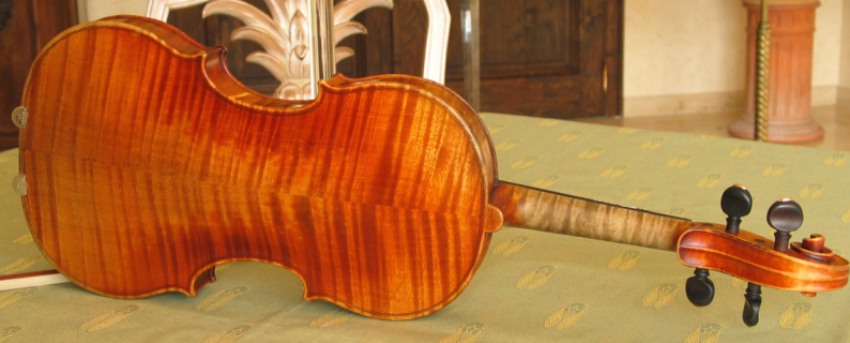
Vuillaume_violin_backside.jpg

[Invalid or Expired Link Removed]
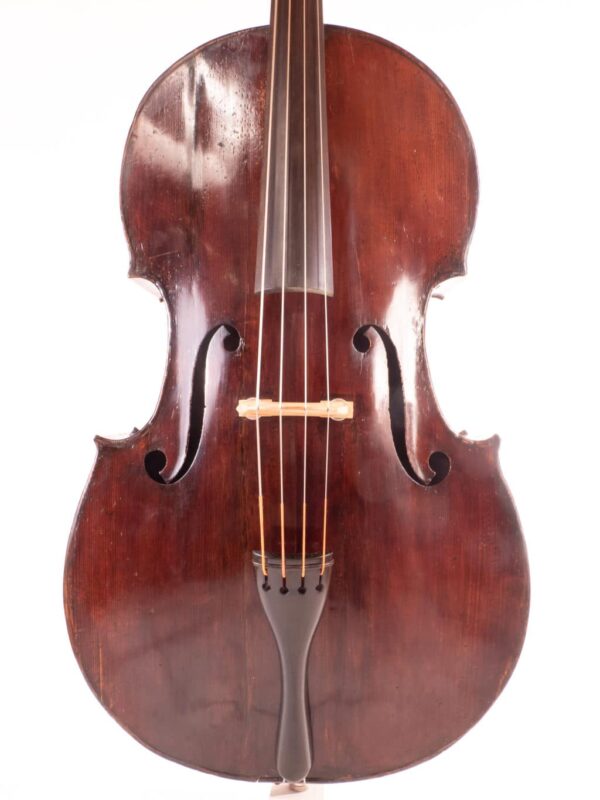
 
A lot of French makers used the shoulders you described. I've heard them referred to as cello shoulders more than once. Some of those basses have been cut down to improve access to the upper register. Here's Charlie Haden's bass, still in it's original form.
[Invalid or Expired Link Removed]


I think the main reason you don't see them much is because it really does make it harder to play higher up the bass.
 
No, the double bass is a member of the violin family, NOT the viol family.

However, because it's so big and it's played vertically, two elements are used in its construction that are also used in the viols: the sloped shoulders (for ease of access to high notes) and the flat back (when present; to use wood more efficiently). It's like saying a tool shed and a privy are the same thing because they both use 2 x 4s and siding for the walls and shingles for the roof.
 
  • Like
Reactions: Don Hergert
From everything I've been able to digest about this so far, it sounds to me like there is insufficient information to say with 100% certainty either way.

But I can easily imagine both theories are right...

If I were an Italian violin-schooled luthier visiting Spain and hearing the voila da gamba for the first time, I'd think "I can build one of those when I get home, it's just a big violin tuned in 4ths", and that's what I'd build.

So to a significantly large extent, the double bass takes its design from the violin, but it was inspired by the viola de gamba.

That's my theory, and I'll probably change it tomorrow.
 
Maybe I'm weird, but I think this is a great discussion...

So to me, the more important question is, "What has caused the violin family and the viol family to be considered different families???" If it was, as it appears to be, simply their geographic origin during roughly the same time period, that seems too weak of a reason to separate these otherwise very similar families (causing at least a little bit of familial contention among various arco and pizz instrument players).

Not that I'm anywhere even close to the highly studied quality of musical instrument historian that might be involved with this kind of decision, but if I were, I'd be sorely tempted to promote the idea of joining the two families into a "bowed and plucked box with a neck and strings" family and settle it once and for all.
 
  • Like
Reactions: nogbert
This illustrates my point though, violin/cello shoulders are very uncommon but im not convinced they would be any more difficult to play over. if the width and depth are they same i would imagine they would be the same? i wonder if there is any impact on sound. i've heard that violin and cello are designed to be as resonant as possible whereas the viola isn't as big as it should be to have maximum clarity (or something like that)

i wonder what a "perfectly proportioned" bass would look like?
 
  • Like
Reactions: Don Hergert
violin/cello shoulders are very uncommon but im not convinced they would be any more difficult to play over.

I own a bass that has a similar shape to Charlie Haden's above, although not at all similar in quality. :-) It is definitely harder to access notes in higher areas of that instrument. When you have the opportunity, play some basses with big shoulders, I think you'll see what I mean.
 
Last edited:
my understanding of physics isnt perfect but wouldnt a circular resonant chamber be the loudest?

The problem with the washtub is that unless it is treated acoustically the tub creates a metallic tone. But if this were a wooden structure, and especially if it were half-round like half of a hollow ball, the acoustics for the back should be near perfect. My involved-but-uneducated interpretation of current violin/viol back and rib structure is that it's an effort to make the half-ball into a more manually usable shape.
 
The problem with the washtub is that unless it is treated acoustically the tub creates a metallic tone. But if this were a wooden structure, and especially if it were half-round like half of a hollow ball, the acoustics for the back should be near perfect. My involved-but-uneducated interpretation of current violin/viol back and rib structure is that it's an effort to make the half-ball into a more manually usable shape.

You are not too far from describing a gigantic Mexican guitarron body minus the waist indentions.
 
  • Like
Reactions: Don Hergert
Yes, I listened intently to one being played yesterday at a local Mexican restaurant... I talked to the player about how good it sounded. Very resonant, very pure deep tones. He described the tuning to me, which I've since forgotten, but it's not simply an octive guitar tuning; I described 4ths and 5ths tunings with him but I don't think it meant anything to him. He did say his dad used to play tololoche, which interestingly is tuned in 4ths, but a 4th higher than double bass (ADGC).