• TalkBass has been independent since 1998. Add your voice.
    Create a free account to reply to discussions, view embedded media, and browse with fewer display ads.
    Join freeLog in
    Want zero display ads or expanded classifieds tools? Compare plans.

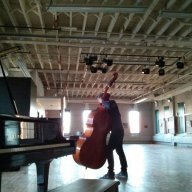
Double Bass visual representation of different scale lengths

Excellent, now please calculate how many cents out-of-tune one would be by substituting one fingered position for the other. Or not... :)
 
Fingered string length of a (tempered) halftone above the open string:

fingered_string_length_a_tempered_halftone_above_the_open_string = open_string_length / 12th_root_of(2)

Calculate this for 41.5 and 41.75 inches, subtract one result of the other and you have the difference.


If you want just intonation there are several ratios, depending on function of the interval:

fingered_string_length_a_tempered_halftone_above_the_open_string = open_string_length * 15/16 (lead tone to root, in C major: B to C in G to C triads)
fingered_string_length_a_tempered_halftone_above_the_open_string = open_string_length * 24/25 (root to raised root, in C major: C to C# in C to A triads)
fingered_string_length_a_tempered_halftone_above_the_open_string = open_string_length * 128/135 (minor seventh to major seventh, in C major: Bb to B in C7 to Cmaj7)
(there are probably some more ratios, but the last is complicated enough, I think)
 
Open E to F on a 41 inch scale = @ 2.30 inches
Open E to F on a 41 3/4 inch scale = @ 2.34 inches, or a little more than 1/32.

That isn't a lot, but I went through the same issue with my left hand having a too short pinky, and trying to figure out exactly my largest stretch from E string 1/2 F to D string 1st position 2nd finger F. I then extrapolated the largest scale I can accommodate, and false nutted my CCB down accordingly.

If a person does shorten the scale, and doesn't want to reset the neck or splice the neck down, then one has to be careful with a false nut so that the string still lays in the groove and is secure coming over the nut witness point, and the string path is smooth so tuning is smooth and there is no risk of the string grabbing or kinking. Shortening can also affect intonation of D or Eb at the heel. On my CCB, it helped better establish the neck as a D neck instead of "in between" as it was before.
 
There was a chart posted in here somewhere - thought I'd seen one anyway...
My 4/4 Strunal has a playable string length of 44.5". I'd think you'd need at least 43" to be able to claim 4/4. Not that it's anything to aspire to....playing on 44.5 gets old fast some days...