• TalkBass has been independent since 1998. Add your voice.
    Create a free account to reply to discussions, view embedded media, and browse with fewer display ads.
    Join freeLog in
    Want zero display ads or expanded classifieds tools? Compare plans.

Walnut as a neck wood?

rojo412

Sit down, Danny...
Supporting Member
Feb 26, 2000
10,912
15,058
46
Cleveland, OH.
Would there be any issues with using walnut as a main neck wood? Or as a fingerboard?

I ask because I received a few large pieces of pretty straight-grained walnut to work with. And I know it works fine as stringers. But I'd be using this as the wider, outer parts of a 5-7 piece neck, laminated with maple.
(This would not be a 1-piece neck)

And while I'm at it, I've wondered if it could serve as a good fingerboard wood as well. Seems sturdy and dense enough, certainly as much or more than maple. And it's very pretty!

Personally, I've never seen it used that way. So I have to wonder why... and I'm sure someone here could enlighten me on the topic, so thanks in advance for any advice.
 
Last edited:
Walnut works fine as a neck wood. I'm using it on several different models of basses that I'm building these days.

As compared to hard maple, walnut is a bit softer, weaker and lighter weight. So, you have to take those things into consideration in your designs. But it's harder, stronger, and heavier than mahogany.

Walnut is plentiful in supply and reasonably priced. Around here, it's about $9/bf. My local supplier has 4/4 boards up to 12" wide, and stocks 6/4 and 8/4. It machines nicely and takes a finish well.

One thing to watch out for is that many walnut boards have big sweeping weaves in the grain. Those can look nice on a body, but you want to avoid that in necks. Try to work with the straightest grain for the shank of the neck.

I haven't been using walnut for fingerboards, but it should be okay for fretted instruments. It's too soft for a fretless fingerboard, unless the surface is hardened with epoxy or something.
 
Last edited:
I'm not sure about Walnut is an optimum wood for a fingerboard, I don't think it'll take the finger wear too well but it makes a very stable neck. I agree about using in a laminate with maple. I've used a 1" Walnut / 0.5" maple / 1" Walnut laminate on a 5 string headless I built a long time ago and it's very stable and sounds great, a very funky burble. Mated to Jazz pickups...it'll sound great. Maple and Walnut seem to work well together as tone woods and look great too.
 
  • Like
Reactions: honza992
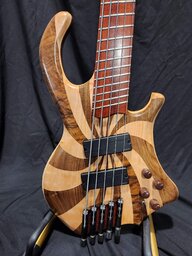
I did a solid walnut neck in this build.
Walnut Jazz
It's QS. It moved on me a bit after I finished it, and I had to redo the FB. Once I did that it seems to be OK.
I probably won't do a solid walnut neck anymore, and as others have alluded, a laminate walnut will serve you better.
 
There's a pretty good consensus but I'll chime in and say that I also use it regularly for bass and guitar necks. As above, I go for the straighter grained sections for neck material and use the more swirly grained stuff for bodies.

As Bruce said, it's also reasonably priced and I can pick it up locally in 8/4 wide enough for 1 piece bodies (12"+). The other thing I like is that as I use it for both necks and bodies I can often select boards where one section has more interesting grain suitable for bodies while another section has straight grain that I use for necks.
 
Awesome news, I'll be using this ASAP. I lucked out with quite a lot of walnut from a friend, no charge. Some boards are crazy curly and amazing (great tops!)... and some are very straight grained. I was planning on using the straight stuff as stringers, but to know I can go the whole hog... well, that's stellar news!

Why do you suppose it's rare to use as neck material? Not like I believe that everything the big companies do is always right, but you don't see many major builders using it. I just figured there had to be a good reason.

Then again, those companies also make a lot of mistakes frequently, so why do I care what they do?:D
 
Why don't more manufacturers use walnut? Cost and risk. Walnut is about twice the price of maple to buy, and then because of the grain, you will get fewer necks per board. Plus, there may be more risk of warpage or cracks. To a manufacturer, it's an extra cost option that will only appeal to a small segment of the customers.

Hard maple is the best wood for necks. It's hard to argue against that. It's plentiful and low priced, very strong and impact resistant, long straight grain boards, very easy to finish, etc. Simple and reliable. That's why Leo chose it, and used it almost exclusively.
 

Latest posts