• TalkBass has been independent since 1998. Add your voice.
    Create a free account to reply to discussions, view embedded media, and browse with fewer display ads.
    Join freeLog in
    Want zero display ads or expanded classifieds tools? Compare plans.

Walter Woods Amps History and Development

Hmmm, so it's a wet-blend knob for a parallel effects loop that also happens to modify the EQ when nothing is plugged into the effects loop. Interesting.

No (well, yes... it would control the mix but no, it would most certainly not affect EQ). While that may be what you perceive, I can assure you no audio EE would ever design a circuit like that. What's probably happening is that the effects send is normalled to the return. My best guess is that the effects send is after the input buffer or input gain stage and the return is post whatever electronics are responsible for producing rolloff below 100 Hz that Ken has referred to numerous times in this thread. If this is the case then increasing the mix would bypass that circuit in the signal flow sending a flat signal to the power amp input.

This may or may not be the case (as I said, I'm guessing). This could be easily confirmed by looking at the schematics. I guess some models included the schematics on the inside of the amp (I've found at least one such schematic for one of the minis). If such a document exists for the Electroacoustic model it should be fairly easy to figure out what's going on. I'm pretty certain that it's nothing unique or magic though.

Cheers, Joe
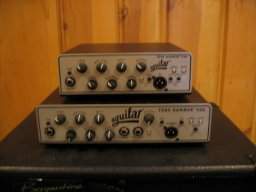
 
No (well, yes... it would control the mix but no, it would most certainly not affect EQ). While that may be what you perceive, I can assure you no audio EE would ever design a circuit like that. What's probably happening is that the effects send is normalled to the return. My best guess is that the effects send is after the input buffer or input gain stage and the return is post whatever electronics are responsible for producing rolloff below 100 Hz that Ken has referred to numerous times in this thread. If this is the case then increasing the mix would bypass that circuit in the signal flow sending a flat signal to the power amp input.

This may or may not be the case (as I said, I'm guessing). This could be easily confirmed by looking at the schematics. I guess some models included the schematics on the inside of the amp (I've found at least one such schematic for one of the minis). If such a document exists for the Electroacoustic model it should be fairly easy to figure out what's going on. I'm pretty certain that it's nothing unique or magic though.

Cheers, Joe

+1 in that I'm sure there is no 'on purpose' circuitry in there that was thought out by Walter. As posted throughout this thread by many owners/users, Walter keeps his designs very close to the vest, and does not provide ANY documentation to anyone regarding the design of the amp (in the past, going so far as to file part numbers off of components).

When I've talked to Walter in the past about the impact of that knob on the tone, he was very coy, and if I remember, he was the one that called it a 'magic knob' (might be misremembering there, since that term for that knob has been around for years), not so much communicating that it was a super complex, thought out thing, but rather that it did something that you would not expect it to do (i.e., fatten the tone of the amp when cranked).

Your explanation is the best one I've seen! However, really doesn't matter. Walter owners should just know that, for whatever reason, that 'magic knob' acts as an additional tone control that some find usefull for getting a bit more 'meat' out of the low end of the amp.
 
Thought i'd bump this for some opinions. I have the chance to buy one of Walter's first amps- in fact, serial number 002 I believe.

Still waiting on pics to confirm, but if it's true, would that make it more valuable? What might I expect to pay?

The amp is from my old band director. He bought the amp in the early 70's when he first took the job. He retired and is taking the WW and an OG 78 P-Bass. Both are for sale.

Any advice would be cool.
 
The first Walter Woods amp was the MI 100-4 Mini Amp aka the "Ice Cream Sandwich." About 100 watts into 4 ohms and single channel. According to Walter, he sold the first one in October 1972. This first series of amps do not use the later date-based serial number system.

I have a MI 100-4, and it sounds great. Not a lot of headroom, but a very warm and musical sound.
 
robgrow said:
The first Walter Woods amp was the MI 100-4 Mini Amp aka the "Ice Cream Sandwich." About 100 watts into 4 ohms and single channel. According to Walter, he sold the first one in October 1972. This first series of amps do not use the later date-based serial number system.

I have a MI 100-4, and it sounds great. Not a lot of headroom, but a very warm and musical sound.

Thanks Rob. After I see the amp, and if it's the right price, I may call Walter and see what my options are. I love the tone of his amps, but I would only own an amp to use it- so it needs to have enough headroom, features and function. Of course, if it is a collectors item, I could flip it. We'll see.
 
Thought i'd bump this for some opinions. I have the chance to buy one of Walter's first amps- in fact, serial number 002 I believe.

Still waiting on pics to confirm, but if it's true, would that make it more valuable? What might I expect to pay?

The amp is from my old band director. He bought the amp in the early 70's when he first took the job. He retired and is taking the WW and an OG 78 P-Bass. Both are for sale.

Any advice would be cool.

Walter's first amp dubbed the Ice Cream Sandwich, had a great EQ section that preceded the MI-100-8, which has twice the power, a phase switch and two independent pre amp channels with a single power amp. So what your getting as a lower powered version of the MI-100-8 with a different preamp. He didn't build that amp for very long. To me, it's a beautiful collectors piece, for someone who plays very low volume gigs. Great pre amp, small power amp.
Walter's MI series amps sound like tube amplifiers and the only thing "digital" about them is that they have a Digital Switchmode Power Supply.
 

Attachments

  • Walter Woods Ice Cream Sanwich Front.JPG.jpg
    Walter Woods Ice Cream Sanwich Front.JPG.jpg
    22.2 KB · Views: 153
  • Walter Woods M!-100-8.jpg
    Walter Woods M!-100-8.jpg
    36.1 KB · Views: 164
Please don't kill me for asking this cause I'm sure this has been ask a million times before but does anybody have as of today any updated contact info for Walter Woods regarding ordering a amp from him, phone # or email address, anything.
Thanks in advance.
 
Walter's first amp dubbed the Ice Cream Sandwich, had a great EQ section that preceded the MI-100-8, which has twice the power, a phase switch and two independent pre amp channels with a single power amp. So what your getting as a lower powered version of the MI-100-8 with a different preamp. He didn't build that amp for very long. To me, it's a beautiful collectors piece, for someone who plays very low volume gigs. Great pre amp, small power amp.
Walter's MI series amps sound like tube amplifiers and the only thing "digital" about them is that they have a Digital Switchmode Power Supply.
Actually the original MI 100-8 had essentially the same output circuit as the MI 100-4. The DC supply voltages were increased slightly however from +/- 38 volts to +/- 45 volts giving a little higher max power capability (but definitely not twice the power).
 
Thanks Rob. After I see the amp, and if it's the right price, I may call Walter and see what my options are. I love the tone of his amps, but I would only own an amp to use it- so it needs to have enough headroom, features and function. Of course, if it is a collectors item, I could flip it. We'll see.

If you're worried at all about headroom you should not even consider a MI-100. I bought a MI-100 in 1981 and had to trade it in the next week for a higher power model.
 
Low Class said:
If you're worried at all about headroom you should not even consider a MI-100. I bought a MI-100 in 1981 and had to trade it in the next week for a higher power model.

Yea, that's what I was thinking, unless I can convince Walter to add more power :)
 
triplelutz said:
Yea, that's what I was thinking, unless I can convince Walter to add more power :)

doubtful . . .

but consider this: the first time i ever heard a walter woods was one of the ice cream sandwich heads being used by al jarreau's bass player in 1974 or so. it was at the troubadour in l.a. (the night al got signed to his first deal). not a hugely loud band, but still, it carried the room. blew me away.

i also used one of that generation in a rock band for a while.

some gigs would def work with it.
 
Please don't kill me for asking this cause I'm sure this has been ask a million times before but does anybody have as of today any updated contact info for Walter Woods regarding ordering a amp from him, phone # or email address, anything.
Thanks in advance.


Does anybody out there in TALKBASS LAND have any updated info on how to get a hold of Walter and find out if he is still building and taking orders for new amp builds.
 
I have one of the earliest Ice Cream Sandwich Models from early 1973. It was used regularly until about six years ago, when it failed for the first time. I called Walter about sending it to him, and he said I couldn't, and that he had no parts left for that model. He said thirty years use was more than even he would have expected. I still have it. I may sell it for parts. It was a great sounding amp, and I got plenty of volume for an upright bass through a fifteen-inch speaker.

George
 
I have one of the earliest Ice Cream Sandwich Models from early 1973. It was used regularly until about six years ago, when it failed for the first time. I called Walter about sending it to him, and he said I couldn't, and that he had no parts left for that model. He said thirty years use was more than even he would have expected. I still have it. I may sell it for parts. It was a great sounding amp, and I got plenty of volume for an upright bass through a fifteen-inch speaker.

George

George,
How unfortunate, I guess that even with Walter's massive stash of parts, some components just aren't made after 30+ years goes by. I had a brand spanking new version of the MI-100-8, not too many years after they were first released. The really crazy thing is that, as things stand now, it's easier to fix a 48 year old B-15N(C) than a 20 year old Walter Woods. Virtually, every conceivable part that, you would need to repair a B-15 is available at Fliptops.net.

Ric
 

Latest posts