• TalkBass has been independent since 1998. Add your voice.
    Create a free account to reply to discussions, view embedded media, and browse with fewer display ads.
    Join freeLog in
    Want zero display ads or expanded classifieds tools? Compare plans.

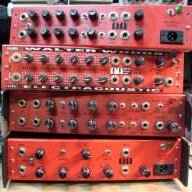
Walter Woods - Scematic diagram

I know nothing about Walter's amps that I've not read on this site. Walter seems to be a somewhat unique character who likes to do things his way. There are many folk out there just like him. If you love what one of his amplifiers can do for you then you'll accept that fact. If you disagree with his way then shop elsewhere.

There is a vast difference in how a huge corporation conducts business and the way that a "cottage" industry works. If you are a one man operation you are responsible for every facet of the business from ordering parts to sweeping the floor. How much such a person charges others for his/her time is entirely up to him/her. If you don't like that, then spend your hard earned money elsewhere.
 
  • Like
Reactions: Hubert
I have no problem paying for a service or product. The pro recording world is as boutique as it gets, in some cases. I have sixteen 20 year old hand made mic pres that I pay to have serviced/maintained every 5 years or so - by the man who made them. Three years of trying to get in touch and get a definitive answer on what turned out to be a $75 repair is what turned me off to WW, so yes, I take my hard earned money elsewhere.
 
  • Like
Reactions: AlexanderB
In my world you either manufacture without structure, with "ad hoc" changes to design, do not share drawings, but take full responsibility in providing first class support, quickly and at a very low cost, taking full ownership in the design.
That, or run serialized production, adhering to design and layout while making drawings and schematics widely available to whomever needs to service a unit down the road.
 
Walter don't like, or don't have time to maintain his amps, it's true. It is an error due to the fact he wanted since the begining, to protect his designs. Okay, he has been the first one to propose on the market a D Class amp for bass powered by a switching power supply. ....

Out of curiosity, when did Walter Woods first market his Class D amps? Peavey's Databass was a PWM Class D with a SMPS and it hit the market in 1989. Peavey filed a patent on its design in 1987.
 
Slightly off topic, the swedish company LabGruppen had a regulated SMPS developed already in 1986, in a PA amp used by big touring acts like Roxette. (The DECA seems to have a big, honking toroid and weighs 30 pounds.) By 1990 LabGruppen was making 2 Ohm compatible PA amps with both SMPS and class TD output stage. 2x1000W into 8 Ohms, 2x1400W into 4 Ohms...
 
Last edited:
  • Like
Reactions: pjhandlin
Out of curiosity, when did Walter Woods first market his Class D amps? Peavey's Databass was a PWM Class D with a SMPS and it hit the market in 1989. Peavey filed a patent on its design in 1987.
I don't know exactly when he did, but I know a guy owning the WW # 050389 - 2H bought in january 1989, it is a MI 400 D Class. Also, I have maintained the WW # 121490 - 2H. In this D Class one, capacitors are dated from 1990 and there is a date (january 1991) written inside, on the chassis by Walter. This date indicates probably a maintenance operation date.
I have seen a picture of an unknown model which the box size is bigger than the current series, the # 101684 - 1H. I cannot date it, but the technology used inside looks like middle of 80's. It sems to be a D Class with full discrete components (pionners age!), but I have not verified it by measurements.
So to answer to the question, the begining for WW D Class was in 1989, maybe earlier.
 
Last edited:

Latest posts