• TalkBass has been independent since 1998. Add your voice.
    Create a free account to reply to discussions, view embedded media, and browse with fewer display ads.
    Join freeLog in
    Want zero display ads or expanded classifieds tools? Compare plans.

Warped / Bent Head Stock.

59jazz

Infinite Rider on the Big Dogma
Supporting Member
Feb 27, 2003
2,645
2,265
67
From Aptos CA to North Liberty IA
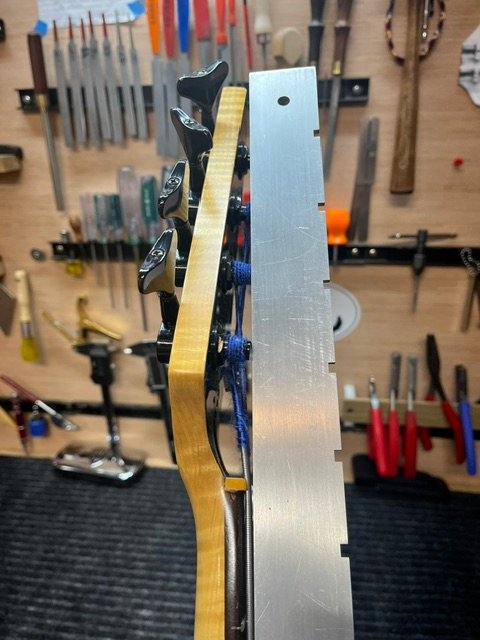
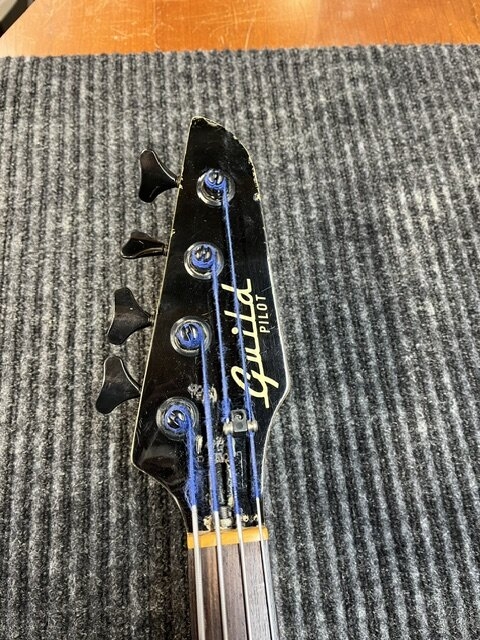
I just purchased an '86 Guild Pilot bass with a few known issues; I dig on saving the unwanted. The neck has an 1/8" shim and the action at the bridge is set high. The truss rod works and I can flatten the fret board with the DA Medium Chromes on it; I prefer lighter gauge strings. It looks to me like the HS has warped, so what's next?
Perhaps heat treating the the neck with my diy heat bar to straighten out the head stock then routing in 2 splines from the back of the neck. Thoughts?
IMG_8864 2.jpeg
IMG_8869.jpeg
 

Attachments

  • IMG_8859.jpeg
    IMG_8859.jpeg
    123.3 KB · Views: 9
I've dealt with that a few times in the past. I've not tried heat on it, that's an interesting idea. It might work, but also might be challenged by the small distance that needs to be heat-bent (length of headstock). Although it can look weird, as long as you have good breakover angle past the nut, it should be perfectly playable. This may take the addition of a bar string retainer just past the nut, or adding another string retainer for the E/A strings.

If you go the heat route, please document it here as I'm sure folks would be interesting in seeing how it goes. :thumbsup:
 
I've dealt with that a few times in the past. I've not tried heat on it, that's an interesting idea. It might work, but also might be challenged by the small distance that needs to be heat-bent (length of headstock). Although it can look weird, as long as you have good breakover angle past the nut, it should be perfectly playable. This may take the addition of a bar string retainer just past the nut, or adding another string retainer for the E/A strings.

If you go the heat route, please document it here as I'm sure folks would be interesting in seeing how it goes. :thumbsup:
This may also require removing the fretboard and adding splines from the top. Doing that would prevent me from going into that beautiful grain on the back of the neck; might as well replace the truss rod too.
 
I've dealt with that a few times in the past. I've not tried heat on it, that's an interesting idea. It might work, but also might be challenged by the small distance that needs to be heat-bent (length of headstock). Although it can look weird, as long as you have good breakover angle past the nut, it should be perfectly playable. This may take the addition of a bar string retainer just past the nut, or adding another string retainer for the E/A strings.

If you go the heat route, please document it here as I'm sure folks would be interesting in seeing how it goes. :thumbsup:
Would heat alone be effective on a piece that thick? Steam might be needed, and that would probably cause a lot of problems.
 
  • Like
Reactions: Beej and 59jazz
Would heat alone be effective on a piece that thick? Steam might be needed, and that would probably cause a lot of problems.
Good question - I know heat can straighten a warped neck, I've done it, but it was a long warp over a long distance that was more easily clamped into position. While heating, it also needed adjustment as the wood became more pliable, until it eventually was in the right position and held there until it cooled. I'm curious as to how this would work and want to see the OP try!
 
Yeah, the string retainer should accomplish what's needed. Trying to bend the headstock is one of those "juice ain't worth the squeeze" type situations (IMHO).
I'm not seeing how it will be possible without tweaking the neck in a negative way. I will be happy to be wrong, but at this point, my mind isn't grasping it.

But I do love watching a cool project come together.
 
  • Like
Reactions: 59jazz
I'm not seeing how it will be possible without tweaking the neck in a negative way. I will be happy to be wrong, but at this point, my mind isn't grasping it.

But I do love watching a cool project come together.
If I were to try heating and correcting the bend (which im not convinced is a warp, would want to A/B with other examples), I think I'd make a u shaped caul and clamp the neck face up to a bench with the headstock hanging off. That would hopefully protect the playing legnth from any movement. I'd then hang a couple lbs of weight from the end of the headstock, and gently heat the transition from neck to head.

But again, all you need is break angle and string retainers do exactly that, are cheap, easy to install, and have next to zero risk of destroying the neck.
 
I would also recommend tweaking the string retainer setup. There are roller variations out there, at least for guitars. If this doesn't work for, say tuning stability, then consider straightening and reinforcing it.

If you choose to straighten it, heating and slowly forming it back to the original shape might very well work. Steaming would help, but needs bare wood. And therefore a refinish.

Heat and steam could both be bad for the fingerboard gluejoint. Or other gluejoints, but I guess the neck is made of a single piece of wood. So they need to be applied carefully.

Simply removing the strings and leaving it be might take it back close to the original shape. But this can take months and might never work. The process can be assisted by clamping it to a rigid beam and very, very slowly tightening the clamps as the neck adjusts to it's new (old) shape.

In any case, if you choose to straighten it, you need to strengthen it as well. Splines work, but they need to be stronger than the original material. They will also be visible, at least from the back.

Good luck. And please keep us posted.
 
Last edited:
  • Like
Reactions: 59jazz
I would also recommend tweaking the string retainer setup. There are roller variations out there, at least for guitars. If this doesn't work for, say tuning stability, then consider straightening and reinforcing it.

If you choose to straighten it, heating and slowly forming it back to the original shape might very well work. Steaming would help, but needs bare wood. And therefore a refinish.

Heat and steam could both be bad for the fingerboard gluejoint. Or other gluejoints, but I guess the neck is made of a single piece of wood. So they need to be applied carefully.

Simply removing the strings and leasing it be might take it back close to the original shape. But this can take months and might never work. The process can be assisted by clamping it to a rigid beam and very, very slowly tightening the clamps as the neck adjusts to it's new (old) shape.

In any case, if you choose to straighten it, you need to strengthen it as well. Splines work, but they need to be stronger than the original material. They will also be visible, at least from the back.

Good luck. And please keep us posted.
Great advice Bonkersville. Typically I would just build a new neck for it, but I love a good challenge & the look and feel of this well worn neck is worth it to me. IMO it would be best to remove the finish, the fret board and start the heat press process slowly; I'm in no rush. Once it's straightened out, I'll add 2 splines and install a new truss rod. It may not look pretty after I'm done with it, but it'll be stronger than an LP head stock LOL.
 
Here's a relatively recent thread on the same issue, but it doesn't demonstrate a resolution.

 
  • Like
Reactions: 59jazz
If I were to try heating and correcting the bend (which im not convinced is a warp, would want to A/B with other examples), I think I'd make a u shaped caul and clamp the neck face up to a bench with the headstock hanging off. That would hopefully protect the playing legnth from any movement. I'd then hang a couple lbs of weight from the end of the headstock, and gently heat the transition from neck to head.

But again, all you need is break angle and string retainers do exactly that, are cheap, easy to install, and have next to zero risk of destroying the neck.
I would do this backwards. Clamp the headpiece to the bench with a flat heat blanket underneath, then you have the whole length of the neck to use for leverage. You can draw it slowly towards the bench with long clamps.

BUT: I would not propose this repair as it is a high risk/low reward scenario. Adding a string retainer bar near the nut is a perfectly viable functional solution, and that is what I would recommend if this instrument came to me.
 
Did you say what result you got when you removed the shim and dropped the action? Like others, my first thought was just a string tree tweak, but you said "thick shim, high action at the bridge, but I can get the board flat" So I'd be curious what the state of the setup is with no shim, very light relief, and the bridge saddles in a reasonable place. That's where I'd start.
 
I've seen bending like this on various Fender-style necks, but never to this degree. Wonder if necks with TR adjustment at the nut (and 5/16 hex) are more susceptible to this. Yeah, a string retainer(s) will make the neck usable, but this would still bug me.
 
  • Like
Reactions: 59jazz
So while I’m waiting for my new heat blanket to arrive, thought I would experiment with my worn out diy heat bar; it tops out @ 120 degrees. Attached the neck to it and heated it for 4-6 hours for two days. I’m surprised it flattened out. Today I’ll build a router jig for the neck splines, headstock to the neck shaft, for extra strength.
IMG_8890.jpeg
IMG_8881.jpeg