My first build was unique for a few reasons. Firstly, it was not solely my own, as I was thirteen years old and my dad, a skilled woodworker by trade, helped me build it. Despite his knowledge of the material, though, I knew little about bass, as I had been playing less than a year, and neither did he (never played an instrument in his life).
We decided on a mahogany body (like a Gibson!) with a bolt on neck (like a fender!) and two small pickups, like a Rickenbacker (based on the fact that it must have been the nicest bass ever- the
Musicians Friend catalog didn't even want to put the price in print!).
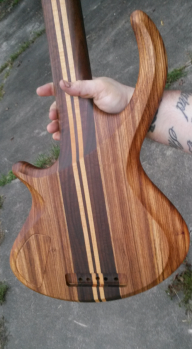
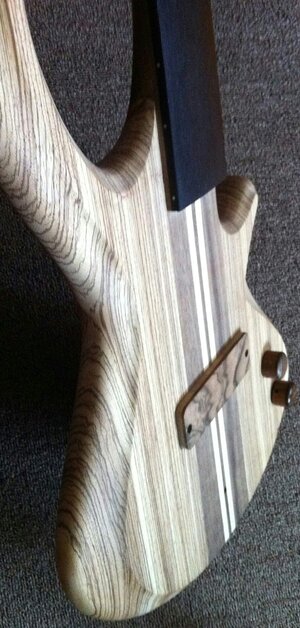
The end result was interesting. The two pickups were guitar humbucker size and spaced unconventionally, the headstock kind of looked fender-y but had an angle like a Gibson, and the five-piece-maple-and-sapele-bolt-on neck with unfinished ebony fretboard was unique to be sure. As a final touch, we sprayed it with a few thick coats of clear poly- automotive grade. To sum if up, we had no idea about the principles of bass design.
It had high action and a thick neck, and we strung it with EB Slinky 50-110 and didn't bother to intonate the damn thing for a week. But I played the hell out of it- at least to the meager extent of my abilities. It was my first "real" bass- up until that point I had been playing a rogue beginners bass with year old dead strings and a rattly bridge.
To be sure, this bass did not play well or sound particularly good, but it taught me so much about bass playing and the instrument itself.
I learned that you can change the strings on a bass to make it sound better.
I learned that lighter strings make the bass easier to play, but not before I had superman calluses and strong fingers.
I learned that the screwy bits at the butt end of the bridge are for intonation and how to adjust them.
I learned that the truss rod is an integral part of the bass and how to adjust the neck relief with it.
I learned that not all pickups are created equal, and swapped my EMG Selects out for some SGD Lutherie pickups.
I learned that not all pickup builders are created equal, or at least their business senses aren't.
I learned that different woods and pickup configurations make different sounds, and why my bass sounds so unique.
I learned that nut slots are a big part of a bass' playability.
I learned that once nut slots are deep enough to get low action, frets need to be level and even.
I learned that a bridge can be moved to accommodate proper intonation.
And I learned that a proper setup and the right strings can transform a bass.
I learned all of those things and made all of those changes to my bass over a period of five years, and over that one, my bass has become part of me. It's now the best playing bass I've ever held in my hands and it feels like an extension of me as a player and as a person. Maybe because it's a labor of love, even after the final coats of finish have been applied. Maybe because I've played it nearly every day for over five years.
But I can tell you that my first build, although not my last, will be my number one for the rest of my life, and has been the best thing I've ever done as a player.
Finally, here's my Número Uno, in all of it's glory: