
Enjoy the benefits of a premium membership!
Upgrade Account
-
TalkBass has been independent since 1998. Add your voice.
Create a free account to reply to discussions, view embedded media, and browse with fewer display ads.
Join free Log in
Want zero display ads or expanded classifieds tools? Compare plans.
You are using an out of date browser. It may not display this or other websites correctly.
You should upgrade or use an alternative browser.
You should upgrade or use an alternative browser.
Double Bass Weidler endpins
- Thread starter LouisF
- Start date
More options
Who Replied?
Matthew Tucker
Commercial User
- Aug 21, 2002
- 2,686
- 387
- Disclosures
- Owner: Bresque Basses, Sydney Basses and Cellos
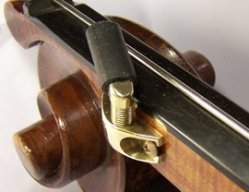
a) its for a cello
b) cannot see benefit of the bent tip
c) looks like tin and plastic crap to me
but I may be wrong
b) cannot see benefit of the bent tip
c) looks like tin and plastic crap to me
but I may be wrong

a) its for a cello
b) cannot see benefit of the bent tip
c) looks like tin and plastic crap to me
but I may be wrong
So... not a fan?

- Aug 1, 2005
- 3,546
- 1,421
- Disclosures
- Private Inventor - Bass Capos
I have tried a bass with a plastic socket similar to the one pictured, but it had a CF rod. I found the clamping system totally unusable. Slipped like (insert clever simile here). I am always amazed that such failures in design can sometimes make it to production and market.
My local guy has been exploring angled tips as well. I am with Matthew. Just don't see the point
My local guy has been exploring angled tips as well. I am with Matthew. Just don't see the point

Greg Clinkingbeard
Commercial User
Interesting. I've had two of the plastic socket endpins like that which came hollow CF pins. Trying drumsticks in them, one slipped badly, even though it seemed to fit well. The other holds a drumstick that fits quite loosely when it isn't clamped tightly. Taking both apart I never could tell why one works and the other didn't. With a cane tip it has turned out to be the best endpin I've used and will not slip even on slick floors. So why the angle?
Buy CVS Small Base Quad Cane Tips 1/2 Inch online at CVS.com
Buy CVS Small Base Quad Cane Tips 1/2 Inch online at CVS.com
Ok, serious answer: perhaps it helps shift the centre of gravity towards the front of the cello so that in the seated cellist position the weight hangs towards the back to make it a little less prone to body-roll?
Well, since I started this...
I did use one of these Stahlhammer angled endpins on the very wide-bouted Swanson bass I had. It helped getting over the top without worrying about drilling for a Laborie pin. If I were to do it again today, I might go for one of the KC strings "Pegleg" pins instead.
Louis
Invalid Link Removed
I did use one of these Stahlhammer angled endpins on the very wide-bouted Swanson bass I had. It helped getting over the top without worrying about drilling for a Laborie pin. If I were to do it again today, I might go for one of the KC strings "Pegleg" pins instead.
Louis
Invalid Link Removed
- Aug 1, 2005
- 3,546
- 1,421
- Disclosures
- Private Inventor - Bass Capos
Ok, serious answer: perhaps it helps shift the centre of gravity towards the front of the cello so that in the seated cellist position the weight hangs towards the back to make it a little less prone to body-roll?
I don't think so. Changing the angle of the entire pin affects balance and skating risk, but just changing the angle of the tip wouldn't affect center of gravity at all. Perhaps it would be less prone to skating, however. I can see it with a rubber tip, but not a sharp point.
robobass said:I don't think so. Changing the angle of the entire pin affects balance and skating risk, but just changing the angle of the tip wouldn't affect center of gravity at all. Perhaps it would be less prone to skating, however. I can see it with a rubber tip, but not a sharp point.
Sorry, I should have been more specific; I meant the line (from endpin tip to left hand, or whatever the uppermost pivot point is) along which the cello pivots/rotates, not a change in the central point of mass of the instrument itself. So, yes, better balance as the endpin tip is moved towards the front of the instrument. Kind of like a hammock (ignoring the wide end bars and the fun they create for getting in & out of the damn thing); once in safely, the lower you/your weight is in relation to the straight line between the two end pivot points, the less body roll/rotation you can experience compared to lying directly along that line (does that make sense?).
Matthew Tucker
Commercial User
- Aug 21, 2002
- 2,686
- 387
- Disclosures
- Owner: Bresque Basses, Sydney Basses and Cellos
does that make sense?.
Not really as far as a bass is concerned ... bent bass endpins usually tilt backwards, doing the opposite of what your "hammock" analogy suggests.
The endpin in question has only a bent TIP which is not going to do anything, I would have thought. And doesn't a cello player sit down an hold the instrument between the knees anyway?
Not really as far as a bass is concerned ... bent bass endpins usually tilt backwards, doing the opposite of what your "hammock" analogy suggests.
The endpin in question has only a bent TIP which is not going to do anything, I would have thought. And doesn't a cello player sit down an hold the instrument between the knees anyway?
I was only referring to the cello-application; and I was thinking that a diminished tendency to body-roll may ease the degree to which cello-players have to clamp the body with their knees.
I agree that only bending the tip doesn't make a big change to the shift in the aforementioned pivot-line, but don't subtle changes sometimes make a surprising difference in terms of playing? Not being a cello-player, I'm only guessing, of course; it may make virtually no difference whatsoever.
Re the angled bass-pins; I'd never looked that closely at them before and never realised that they angled back, not forwards. I can see how this would benefit the left hand by making the bass lean forwards into the fingers; pretty cool...
Matthew Tucker
Commercial User
- Aug 21, 2002
- 2,686
- 387
- Disclosures
- Owner: Bresque Basses, Sydney Basses and Cellos
swingingoodtime said:I can see how this would benefit the left hand by making the bass lean forwards into the fingers; pretty cool...
Doesn't really work like that though
Matthew Tucker said:Doesn't really work like that though
I didn't get it either. Could you please point out the way it works?
Matthew Tucker
Commercial User
- Aug 21, 2002
- 2,686
- 387
- Disclosures
- Owner: Bresque Basses, Sydney Basses and Cellos
The angled tip on the cello endpin discussd in this thread is not a "bent" or "angled" endpin.
There are lots of threads about bent/angled endpins and if you search "Laborie", "bent end pin, "stahlhammer" etc you will find a raft of information.
Suffice to say that when you hold a bass, you (usually) hold it at equilibrium, it (on average) falls neither backwards nor forwards. A bent endpin moves the balance point so that the bass is angled back at equilbrium. Some players find this an advantage.
There are lots of threads about bent/angled endpins and if you search "Laborie", "bent end pin, "stahlhammer" etc you will find a raft of information.
Suffice to say that when you hold a bass, you (usually) hold it at equilibrium, it (on average) falls neither backwards nor forwards. A bent endpin moves the balance point so that the bass is angled back at equilbrium. Some players find this an advantage.
Latest posts
-

-

-

-

-
 Misled by Talkbass Seller on Recent Trade
- Latest: 5StringBlues