• TalkBass has been independent since 1998. Add your voice.
    Create a free account to reply to discussions, view embedded media, and browse with fewer display ads.
    Join freeLog in
    Want zero display ads or expanded classifieds tools? Compare plans.

Wenge Neck with Maple Fretboard?

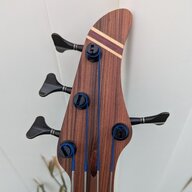
I have three basses with wenge neck construction. The first is a wenge board on a maple neck, the second is wenge/wenge, and the third is a maple board on a maple neck with wenge stringers. Each is great, but the tone profile really is significantly different. The all wenge neck is unbelievably stable and provides classic growl, while the maple board is very snappy. The most balanced/traditional is the wenge on maple.

All that is to say, maple and wenge make a nice combo and wenge is indeed a special wood.
 
  • Like
Reactions: SuperTheBass
I made a Tele last year with a wenge neck & Birdseye maple board. Lovely combo!
View attachment 7384848
That's a pretty cool chunk of wood! Is it heavy? I would have to believe a tree's core would be the densest part! Good sustain I imagine -
 
Last edited:
As long as you sand/finish it properly, finished Wenge is no more splinter creating than other woods.
Now raw Wenge you definitely want to work carefully on it.
Once you get a Wenge splinter, you will not forget it.
Also I had a Wenge splinter surface 6 months later!
I agree - I've had a couple Wenge necks made and they were both awesome in feel and sound/tone. Coupled with an ebony fb - a killer combo.
 
  • Like
Reactions: SharpCat
I love the finished product with Wenge. It looks and feels great with just a little tung oil. I hate working with it. You have to be very careful shaping or even handling it to avoid splinters. As much as I hate working with Wenge, I have a nice piece in my stash that I'll probably use for my next build.
Ebony can be like that too, and it's my favorite fb wood.
 
I've had a bunch of necks with different wood combinations, and discovered (probably known by lots of other folks) that having the same wood on the neck and fretboard makes for a much more stable neck when the humidity changes. I have a bunch of roasted maple necks, and the ones with roasted maple fretboards don't need tweaking when the weather changes, but those with other wood for fretboards do. Turns out that Indian rosewood is a decent (though not perfect match) for roasted maple but some other woods (bubinga in particular) wasn't a good match.

Anyway, from that experience, I'd highly recommend that, if you're using Wenge for the neck, you use it for the fretboard as well - it's properties are very different from most woods, and I'd guess that a neck built with it and something like maple would be less stable than an all Wenge neck.
 
  • Like
Reactions: SuperTheBass
I've had a bunch of necks with different wood combinations, and discovered (probably known by lots of other folks) that having the same wood on the neck and fretboard makes for a much more stable neck when the humidity changes. I have a bunch of roasted maple necks, and the ones with roasted maple fretboards don't need tweaking when the weather changes, but those with other wood for fretboards do. Turns out that Indian rosewood is a decent (though not perfect match) for roasted maple but some other woods (bubinga in particular) wasn't a good match.

Anyway, from that experience, I'd highly recommend that, if you're using Wenge for the neck, you use it for the fretboard as well - it's properties are very different from most woods, and I'd guess that a neck built with it and something like maple would be less stable than an all Wenge neck.
Interesting comments here, thanks for sharing.

I'm curious about the issues you've had with stability. It makes sense that different woods would expand and contract differently. When you say "less stable", how big of a problem are we talking about? Do you anticipate playability issues, or just more frequent adjustments? Also, how thick are the necks on the "less stable" ones? Did they have reinforcing rods? Were they all 1-piece necks?

I have a handful of basses where I tweak the truss rods periodically and that has never bothered me. Can't say I've ever kept track of which ones need to be adjusted more or less often.
 
Interesting comments here, thanks for sharing.

I'm curious about the issues you've had with stability. It makes sense that different woods would expand and contract differently. When you say "less stable", how big of a problem are we talking about? Do you anticipate playability issues, or just more frequent adjustments? Also, how thick are the necks on the "less stable" ones? Did they have reinforcing rods? Were they all 1-piece necks?

I have a handful of basses where I tweak the truss rods periodically and that has never bothered me. Can't say I've ever kept track of which ones need to be adjusted more or less often.
As to stability, every neck I'm talking about for comparison purposes is the same model - same shape (including thickness), same roasted maple neck material, same truss rod, same graphite reinforcements, same frets, all 2 piece construction (neck itself and the fretboard), etc - literally the only thing that is different is the fretboard material. A neck that is Roasted maple for both the neck and fretboard wood, after a couple years, they settle in and don't really need truss rod adjustments, even living in the Midwest where we go from very humid to very dry. Necks with Indian rosewood fretboards are a little fussy the first couple of years, and after that, they settle in, and it's a minor tweak twice a year. A neck I have with a Pau Ferro fretboard is nice and stable - pretty close, after a couple years, to how the all roasted maple ones perform. I had two necks - with Goncalo Alvez and Bubinga fretboards, that needed a lot of attention and that took a LOT of truss rod tension to get then straight - after a few years, I replaced them with all roasted maple necks, as I didn't want to mess with them anymore. I don't have a lot of basses, and I don't mind spending some effort to keep them all in top shape, but there comes a point when spending some money to get something that doesn't require constant attention makes more sense than always having to futz with it. I want to spend more time playing my basses, not maintaining them.