• TalkBass has been independent since 1998. Add your voice.
    Create a free account to reply to discussions, view embedded media, and browse with fewer display ads.
    Join freeLog in
    Want zero display ads or expanded classifieds tools? Compare plans.

Wet Leg / Short scale bass

I have around a dozen short scale basses. They all sound different. I still have a number of classic 34 in basses. I mostly play the short scales these days.
And being quite familiar with a number of various short scale basses I would never make a blanket statement like long scale basses sound better.
 
  • Like
Reactions: FretRiff
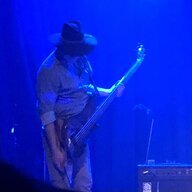
I heard the band Wet Leg playing live on a late night talk show recently. It looked like the bass player was using a (Mustang?) short scale bass, it sounded great. His amp rig appeared to be an older Fender tube set up. I have frequently heard that short scales don't sound as good as long scale basses. Any thoughts?
Great band. He plays a JMJ mustang with flats, into a Bassman, from the looks of it.
 
  • Like
Reactions: bulldean
I see it in predominantly YOUNG men who have chronic debilitating self consciousness. They post here almost every day about how people make them feel about this or that, judging them, and more experienced people tell them they are cosmic dust and can make up their own rules. There comes a time when if you really look, you see that everyone has an opinion, and it's just their opinion, man. "It aint necessarily so" (an old song).

IMG_2840.jpeg
 
I have around a dozen short scale basses. They all sound different. I still have a number of classic 34 in basses. I mostly play the short scales these days.
And being quite familiar with a number of various short scale basses I would never make a blanket statement like long scale basses sound better.
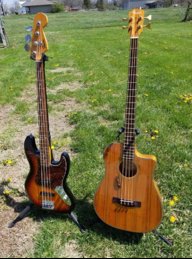
I have a half dozen including an Epiphone Allan Woody, a Dan Electro Longhorn, a Sterling mini Stingray, Reverend Dub King, but I keep coming back to the Squire Rascal lately. with steel High Beams. Any of these are gigable, capable basses.
 
I exclusively record these days so in theory what I'm doing should expose the subtleties of long versus short scale more relative to a live environment. But ultimately, when you slap your effects set up on and put the instrument in the mix with all the other stuff swirling around, the difference between long and short-scale fades pretty quick, so these days, I think more about what's playable.
 
One thing I haven’t seen mentioned here is relative pickup position. I’m a short scale player and the biggest tonal difference I’ve noticed is that the shorties with precision pickups don’t always have the pup in the same relative spot as a long scale, which can affect the tone. I’ve played a handful of short scale P’s and only one I’ve gotten a great tone from is my Squier Jaguar, which I think is due to placement. YMMV.
 
  • Like
Reactions: bulldean
I heard the band Wet Leg playing live on a late night talk show recently. It looked like the bass player was using a (Mustang?) short scale bass, it sounded great. His amp rig appeared to be an older Fender tube set up. I have frequently heard that short scales don't sound as good as long scale basses. Any thoughts?
I like both. I like playing shortscales, because they are easier to play (less string tension, closer fret spacing, less weight). But they deliver a rounder, tubby note. This can be cool. But if you want a really clean, well defined note - the longer the scale the better. Listen to McCartney's work with the Hofner, compared to his recordings with the longscale Fenders and Rickenbackers. His notes with the longscales are much cleaner and more defined, less wooly. A lot of guys, like Jack Bruce and Phil Lesh end up dumping their shortscales in search of more definition.

Side note, if you are a tall guy, like me, you might look odd with a shortscale strapped on. They look like a toy on me. I'd be too self conscious to play them on stage. But they are great for little guys, like Bill Wyman.

Finally, don't let Stanley Clarke fool you. His shortscales are piccolo basses through active electronics. That's a different beast altogether. The thin piccolo strings up the tension, and thereby up the clarity and piano-like definition.
 
Side note, if you are a tall guy, like me, you might look odd with a shortscale strapped on. They look like a toy on me. I'd be too self conscious to play them on stage. But they are great for little guys, like Bill Wyman.
I can't come to think of a sillier reason to not play a shortscale bass. :bag: Almost any electric guitar will be smaller than a shortscale bass, so that makes no sense what so ever.

 
I like both. I like playing shortscales, because they are easier to play (less string tension, closer fret spacing, less weight). But they deliver a rounder, tubby note. This can be cool. But if you want a really clean, well defined note - the longer the scale the better. Listen to McCartney's work with the Hofner, compared to his recordings with the longscale Fenders and Rickenbackers. His notes with the longscales are much cleaner and more defined, less wooly. A lot of guys, like Jack Bruce and Phil Lesh end up dumping their shortscales in search of more definition.
If you are judging all short scales by the tone of a Hofner, you are missing much. I assure you, a short scale StingRay sounds nothing like a Hofner violin and you kind of have to work at it to get what I'd call a tubby tone.
 
I can't come to think of a sillier reason to not play a shortscale bass. :bag: Almost any electric guitar will be smaller than a shortscale bass, so that makes no sense what so ever.

Oh, the old "who cares what you look like" argument.

I know people think it's cool to say that. I used to tell myself that. But the large majority of people care what they look like on stage, and they very much care what their instrument looks like. I've come to accept that some vanity is normal for most of us.
 
Last edited:
If you are judging all short scales by the tone of a Hofner, you are missing much. I assure you, a short scale StingRay sounds nothing like a Hofner violin and you kind of have to work at it to get what I'd call a tubby tone.
The Hofner comparison was only used to highlight the drastic difference in McCartney's tone with passive shortscales vs. his longscale passive sound.

I've owned a shortscale StingRay. I've owned/own a load of shortscales, many of them active. The roundness and and lesser definition are related to string tension.

Does an active shortscale sound brighter than a Hofner? Of course. Does a shortscale Ray sound as defined and piano-like as a longscale Ray? No.
 
Last edited: