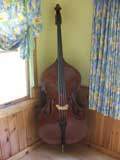
While I'm extremely happy with my bass, one disadvantage of having a powder-coat finish on an aluminum bass is that it's very slippery.
While practicing today I noticed that my bridge (Deuce D1) had worked it's way up the bass's table about 1/4" (6.35mm). I hadn't been keeping track of it so it was sort of a surprise. While the Deuce bridges won't easily flop over, they do slip on a slippery surface.
Soooo, that discovery brought out a number of measuring tools and I got the bridge back in place... And then I noticed the action was a little lower than I prefer, so I also adjusted that to my preference of 3/16" (4.76mm) at the G to 1/4" (6.35mm) at the E. And when that was adjusted I double-checked my sound post, happily it had not moved.
Once done, I got back into a practice mode. And wow, the volume was up noticeably! Maybe 15% to 20% by my perception...
Now from other instruments I'm aware that often if you change even the most subtle thing in the way of bridge setup, you get different sound results, but I hadn't seen this on my bass before. I'm very glad I stumbled into this. I'll be watching the bridge more carefully from here on!
While practicing today I noticed that my bridge (Deuce D1) had worked it's way up the bass's table about 1/4" (6.35mm). I hadn't been keeping track of it so it was sort of a surprise. While the Deuce bridges won't easily flop over, they do slip on a slippery surface.
Soooo, that discovery brought out a number of measuring tools and I got the bridge back in place... And then I noticed the action was a little lower than I prefer, so I also adjusted that to my preference of 3/16" (4.76mm) at the G to 1/4" (6.35mm) at the E. And when that was adjusted I double-checked my sound post, happily it had not moved.
Once done, I got back into a practice mode. And wow, the volume was up noticeably! Maybe 15% to 20% by my perception...
Now from other instruments I'm aware that often if you change even the most subtle thing in the way of bridge setup, you get different sound results, but I hadn't seen this on my bass before. I'm very glad I stumbled into this. I'll be watching the bridge more carefully from here on!