I don't have any pedals right now, I only own 1 bass and 1 amp. My questions are: Are there any must have pedals? What are they?And can you get by without any pedals if you wanted to (someday) do sessions?
There really aren't any pedals you
absolutely have to have as a bassist. Many help, but none are strictly necessary. That's especially true in session work, where the producer is the one calling the shots as to the bass tone he wants to hear in the mix, and is working at least as closely with the engy on his side of the glass as with you in the booth. You might own some signature piece of equipment that the producer heard you use on your last album for some other pop star, and wants you to bring it in for this one, but in general the average commercial recording studio is going to have a wealth of resources in equipment that beats yours by an order of magnitude. It's not unheard of for session bassists to not even be playing their own bass, because the bass they showed up with, while it sounds beautiful soloed, does something that doesn't sit, and the engineer can't shoehorn it into the track, so the bassist ends up re-tracking with a vintage P from the equipment locker.
All that said, the better you
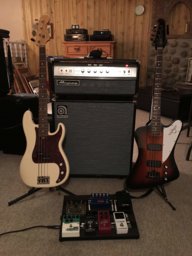
and your equipment are at crafting a useful, mixable tone, the more you'll be asked to use the stuff you're familiar with, and the more you can put a personal stamp on the sound you bring to a track, which gets your name out into the industry as someone producers want for more than your fingers. That signature sound still may not include pedals; you might well end up with a shockmount rack containing an amp head and a few choice rackmount processors like a multiband compressor, parametric or graphic EQ and IR loader, and your sound comes from your fingers on your bass into that rack and from there to the board or a set of cabs. Or, you can go the pedalboard route; it tends to be a little cheaper, in large part because the equipment is simpler in design, but if it works it works. Either way, bassists tend to have a few more "always on" effects, and far fewer "color" effects that are switched on and off, so whether your effects are on the floor or in a rack, more of your rig will have its lights on than your guitarist's board.
The effects, in pedal form or otherwise, that are most often used on bass are EQ and compression. Yes, they are effects; they change the sound of your instrument in noticeable ways. They are usually applied subtly, as "tone-shaping tools" instead of recognizable "hey, they're doing something cool to their sound" changes that you may call an "effect", but they are nevertheless doing something to your tone that you want to have happen. Both tools help make the bass sit in the mix.
EQ can emphasize frequencies within the "slice" of the full spectrum where the bass is supposed to be, and de-emphasize frequencies that clash with other instruments. Bass typically owns the spectrum from about 40Hz to about 600Hz, sharing the very lowest frequencies with the kick drum and starting to blend into the guitar's fundamental range beginning at 100Hz. Meanwhile, the midrange, 600Hz to about 4kHz, is usually a big mess that has to be carefully managed as virtually every instrument has significant "color" frequencies here, and many sound engineers make their lives easier by just taking the bass guitar totally out of that slice.
Compression is a volume-leveling tool. The plucked strings of bass produce a high-volume attack that decays over time. Reducing the volume of the peaks and bringing up the volume of the decaying tone produces a more even volume that keeps you in place in the mix, and that's what compression does. It is by nature a subtle effect, even when taken to extreme like in the "chicken-pickin" style of country/bluegrass guitar. On bass, it's usually used in two ways; to accentuate note attacks by delaying the onset of compression to increase the relative volume of these transient frequencies before "clamping down" on resonant tone, and to otherwise level out the dynamics of your playing to keep a solid foundation to the band's harmonies.
Beyond these two tools, other effects typically seen on guitar are possible and useful on bass as well, but they are typically applied more sparingly for a specific color to your sound. Generally speaking, there's no effect you just absolutely can't use on bass, but there are some common pitfalls.
- Many modulation effects, specifically chorus, vibrato and tremolo, work by generating a wave at a slightly different frequency from that of your dry signal. It doesn't take much of a frequency change to sound very out of tune on bass (the difference between open E and the F one fret above it is just 2.4Hz), and the last thing you want to do as a bassist is sound out of tune. Phasers work differently from these modulation effects, producing a similar moving sweep to the tone without changing pitch; consider a subtle slow phase effect instead of chorus to produce that three-dimensional shimmer.
- Other types of effects, mainly gain effects like distortion/fuzz and wahs but also flangers, can take your low end out of the mix, either directly by cutting everything not in the wah's band filter, or indirectly by clipping the peak levels of the fundamental frequency, or by phase-cancelling your lower notes with too severe a flange setting. Bass-specific versions of these effects commonly give you a blend control, mixing some clean tone back into the output to preserve your low end while still giving you the effect.
- Lastly, many time-based modulation effects, like reverb, can destroy the clarity of your sound by drowning your attack in the decay of your previous note. Consider using delay on bass instead of reverb; the echoes are a cleaner copy of your tone than the smeary wash of reverb, and you can very commonly adjust the tone of the decaying echoes to roll off the bass frequencies, giving you the percussive, rhythmic effect of delay without blurring your low end.
The most common solution to these problems with these types of effects is simply not to use them; the second most common solution is to use them very sparingly and subtly. Bass as used in a band setting is not typically a "color" instrument used for ornamentation. It can have some color, but the more color you add, the less the bass is doing its real job of being the harmonic foundation of the band. Truly effected bass is most commonly found in groups or songs where the bass isn't really doing that job anyway; some other instrument is anchoring the ensemble rhythmically and tonally, and the bass is stepping out in front to do something cool. You'll see this in jazz, funk, and other fusion-y, experimental styles where the classical rules of "bass = foundation, treble = ornamentation" are commonly broken.