• TalkBass has been independent since 1998. Add your voice.
    Create a free account to reply to discussions, view embedded media, and browse with fewer display ads.
    Join freeLog in
    Want zero display ads or expanded classifieds tools? Compare plans.

What Are The "Must Have" Pedals?

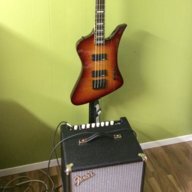
I have a Rumble 100 also and there are a ton of tones you can get from that amp! That onboard distortion is pretty good and combined with the 4 band EQ and 3 presets you can get lost in the possibilities!

That said I did end up with a few pedals: tuner, compression, OD, distortion and EQ. All are fun to play with and useful in their own way, but there is still more sounds/effects I would like to try...

A multi effect will likely be my next purchase...;)

So if I had to start over again, I would get a separate tuner pedal ( there are some good and cheap options ) and a multi effect pedal to help me find what I really like and make life simpler at same time.

So thats my recommendation: Tuner and multi effect!
Enjoy your Rumble, I love mine!
 
Last edited:
  • Like
Reactions: Mr Cheese
I don't have any pedals right now, I only own 1 bass and 1 amp. My questions are: Are there any must have pedals? What are they?And can you get by without any pedals if you wanted to (someday) do sessions?
What sound do you want that you're not getting? Get the pedals that produce that sound. Or just buy random pedals spending hundreds or thousands of dollars hoping you'll find one you like. It's really just that simple. I don't need any pedals to get a sound I like. YOU might need a whole pedal board full of pedals to get the sound you want. There is no right or wrong. Do what you need to get your sound.
 
I suggest starting simply with tone-shaping pedals and forego effects. I'd recommend (1) a decent compressor (see the long thread about what is good. I like my Keeley.) and (2) a nice preamp pedal like a Darkglass Vintage Deluxe or something like it. That one happens to come with some dirt you can apply. A preamp pedal also gives you an XLR-out to use as a DI when recording or playing live and going into a board if the amp you're using doesn't have the capability or doesn't do it well.
 
I guess the conventional wisdom would be: compressor, overdrive, modulation, outside of a tuner which I don't consider an effects pedal, as your starting points. Like others I would recommend a Zoom MS-60b as a good place to start from. There is a slight learning curve but once you figure it out it is not hard.

The benefit with the MS-60 is you get multiple versions of each type of effect so you can really see what you like. For example as a modulation effect there are generally three camps: chorus, flanger, and phaser. Though my use with the MS-60b I've learned I'm a phaser type of guy. It has been an excellent learning tool and it is fun to just set up things I would never use otherwise. Plus it has a tuner.

On economy pedals, Joyo is a pretty good brand. I've got three of their pedals. Two of them are really good and one is a little noisy when engaged. I've got a couple of Behringer pedals and they aren't that great. The knobs are pretty loose and the quality is meh. One cheap line to check out is the Danelectro Fab pedals. The chorus gets a lot of love. I've got the delay which is fun to goof around with.

Long story short: If you don't have a specific need a multi effects unit can help you figure out what you like and you can go from there.
 
When playing live I never leave home without AT LEAST:

-Compressor: EBS Multidrive if I want to keep it simple, MXR M87 if I want more control. Both are great.

-Some kind of Russian-style Muff (meaning a Muff with more mids than the scooped sounding current USA-style Muff). The cheap EHX Green Muff is GREAT for bass. Easily as good as far more expensive boutique offerings IMO. It also sounds better than any of the EHX "bass" Muffs IMO. The Green doesn't have a clean blend but it doesn't need one because unlike many other Muffs it doesn't destroy the lows.

-Some kind of "warmth/light dirt" preamp (preferrably with tubes). Especially if I'm not bringing my own amp. Usually this means the EBS ValveDrive. Great for warming up the sound if I end up with some sterile sounding amp or DI only. And not just for the sound. I like it for the feel/response too. That slight hint of softening the transients makes playing a cheap sterile amp more bearable to me. The ValveDrive is not that great beyond light dirt though, it gets kinda muddy/flabby when pushed. Definitely more of a "warmth" than "dirt" pedal.

Usually I bring a couple more dirt pedals too, particularly fuzz. If there's one thing I've learned over the years it's how much dirt you can actually get away with in the mix and how much better the bass will sit in the mix because of it. Just make sure it's the right kind of dirt (meaning not the muddy, farty kind). Even just cranking the inputs on the mixing console can sound GREAT if it's a proper old school analog, transformer based console (which realisticly isn't the case when playing live these days...).

I sometimes use an octave pedal too (EBS)... at least if I playing with my prog band. Not a fan of chorus/flanger/phaser or reverb on bass and rarely find any real use for delay.

In the studio I use FAR less pedals. For compression I use rack mounted stuff, typically 1176 into LA2A. For dirt it's more about choosing the right tube amp and driving it as hard as required. Usually this means some British vintage tube amp for edgy, aggressive dirt and some American vintage tube amp for a warmer, fatter kind of dirt.

To me pedals are more like convenient and less expensive alternatives to the heavy/expensive studio gear that I can't use when playing live. I kinda think of pedals as comparable to a keyboard player bringing a Nord digital keyboard instead of a B3+Leslie+Rhodes+grand piano.

The exception is vintage style fuzz pedals. I use them a LOT in the studio. I just LOVE vintage fuzz on bass and the nastier the better. It never ceases to amaze me how much fuzz I can get away with in the mix. The bass can sound totally insane when solo'ed but still seems almost clean but somehow hotter in the full mix. Original vintage fuzz pedals can be insanely expensive (and in poor condition) these days but most classic fuzz pedals are extremely easy to build, with a huge selection of clone kits available, and a great place to start for anyone getting into soldering/electronics. Vintage style fuzz pedals usually have to be blended with a clean signal when used with bass though, most of the classics EAT the lows.
 
I could absolutely do without pedals, I like having some to augment things in different ways though. I'll tell you what I have and why and let you draw your own conclusions as to what you need though.
First, I have a tuner. Aside from the obvious, it can mute your signal between songs while the singer talks to the crowd or something. I then have a compressor to even out note volume. Yes, you can do this manually, but I like to jump around and really move on stage so it helps keep things consistent for me. I then have an overdrive for when I want to make things a bit more aggressive sounding. I then have a chorus for when I want things to be a bit prettier sounding, in my last band I used it for literally two measures in our entire set to make a little soloet thing really pop. I then run into Sansamp DI. I send this straight to the board, and I use the parallel out to go to my amp. The only other two things I've considered getting are an always on mild overdrive because I tend to go for an aggressive sound and maybe a HPF/LPF. People on Talkbass have really sold me on it, I'm just between bands and in college right now so I don't know that I can justify it.
 
  • Like
Reactions: matty1039
Full disclosure: I love pedals. They are little instruments in themselves.
That said, you should strive towards sounding great (great tonal balance, well-controlled dynamics) with just your bass and fingers direct to amp.
I would recommend, in parallel to that process, to get some basic pedals to keep things fun. Pedals on bass are oh-so fun.
My top picks would be: tuner, overdrive, compressor and EQ (I like 10-band graphic).
 
I would look for a used Line 6 HX Stomp. I saw the older M3 mentioned, but would recommend avoiding that one. I've had two and they died at the most inconvenient times. Anyways, a multi effect unit will give you an idea of what a large number of effects can do and you'll be able to decide what works or doesn't work for you. Then you can decide if the emulation is good enough or if you want to buy the real world version of those 3-4 must haves.
 
I played any genre for quite a number of years with zero pedals. But, then I felt I was missing out on all the fun. So, I have a Darkglass Alpha Omega and X Ultra for varieties of driven tones, a volume, chorus, and reverb for ambience/texture, and an octave and envelope filter for funky stuff. An FEA Labs DB-CL to provide compression to low and high bands separately, and limiting to low freqs if needed. I do not own a HPF. When I first started many moons ago, I picked up a Zoom multieffects unit, just to see what different effects were, and what I liked. Have also owned phasers, flangers, delays, synths in the past.
 
As far as your question about doing sessions, I've very rarely brought any pedal to a session. If a track calls for an effect, between the engineer and I, we can usually find a plugin that does the job. If it absolutely called for outboard effects (physically controlled wah or volume swells, rather than automation, for example), I have those. What you do is up to you and whoever may be working with you on the session.
 
  • Like
Reactions: Mr Cheese
I used a Boss GT6B for about a decade; it’s built really well and sounds good - and it has just about everything you could need.

They were $500 new, and you could probably score a used one for $125 now.

Use that until you figure out what YOUR indispensable effects are...
 

Latest posts