I've been studying that for the past year. I have a few personal conclusions. Hope I don't get beat up too bad for sharing them. HAHAHA.
- My issues with a B string is not being able to distinguish which note it is. I its just a low freq rumble (to me). I can't tell one note from the other and/or a billowing tone that blossoms slowly.
- I've tried a few (34 inch) and lotsa strings. It's not a "string" thing so much as it is the instrument. Whether that's in the EQ or the physical characteristics I dunno. Example:
- Fender Jazz Ultra 5 just aint right when it comes to a B string. I've tried 4 types of strings now and the "B" is still not my favorite. Sure it works.... but there are better sounding....
- EBMM B string sounds fine, right out of the box. Why is that? Is that the pickups.... the EQ? Dunno, but it is.
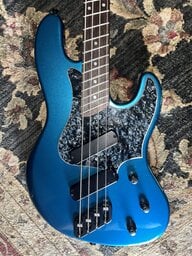
- G&L has a very nice, thick, rich B string (that doesn't sound like an EBMM). The best of this bunch (to me).
- I do believe a longer (35 inch) scale would be better. I don't have experience with those (yet).
- B strings typically need a little more room (raising the saddles) to eliminate buzz (from floppy strings)
- B strings typically sound better as you shift the balance back towards the bridge pickup
- B strings often need a little "touch" and don't take well to being played "hard"
- I pay attention to the beak angle over the bridge. Some B strings need to have the saddle pulled WAY back to get the intonation right. For those, I wouldn't string thru the body. I avoid sharp angles over the saddles. Long story.... no I don't wanna bicker about it. That's just my opinion.
- My G&L came to me with La Bella Super Steps TAPERED strings installed and that eliminates the saddle - break angle issue really. They sounded so good I put a set on the ULTRA V last week .... It helped considerably and was the best B string that I've tried on that bass. I have a .118 "B" on one bass and a .128 dia. on the other. If it is a "string thing" then I'd say I'd prefer these types.
- My issues with a B string is not being able to distinguish which note it is. I its just a low freq rumble (to me). I can't tell one note from the other and/or a billowing tone that blossoms slowly.
- I've tried a few (34 inch) and lotsa strings. It's not a "string" thing so much as it is the instrument. Whether that's in the EQ or the physical characteristics I dunno. Example:
- Fender Jazz Ultra 5 just aint right when it comes to a B string. I've tried 4 types of strings now and the "B" is still not my favorite. Sure it works.... but there are better sounding....
- EBMM B string sounds fine, right out of the box. Why is that? Is that the pickups.... the EQ? Dunno, but it is.
- G&L has a very nice, thick, rich B string (that doesn't sound like an EBMM). The best of this bunch (to me).
- I do believe a longer (35 inch) scale would be better. I don't have experience with those (yet).
- B strings typically need a little more room (raising the saddles) to eliminate buzz (from floppy strings)
- B strings typically sound better as you shift the balance back towards the bridge pickup
- B strings often need a little "touch" and don't take well to being played "hard"
- I pay attention to the beak angle over the bridge. Some B strings need to have the saddle pulled WAY back to get the intonation right. For those, I wouldn't string thru the body. I avoid sharp angles over the saddles. Long story.... no I don't wanna bicker about it. That's just my opinion.
- My G&L came to me with La Bella Super Steps TAPERED strings installed and that eliminates the saddle - break angle issue really. They sounded so good I put a set on the ULTRA V last week .... It helped considerably and was the best B string that I've tried on that bass. I have a .118 "B" on one bass and a .128 dia. on the other. If it is a "string thing" then I'd say I'd prefer these types.