• TalkBass has been independent since 1998. Add your voice.
    Create a free account to reply to discussions, view embedded media, and browse with fewer display ads.
    Join freeLog in
    Want zero display ads or expanded classifieds tools? Compare plans.

What do you do when you're flying blind?

So Anyway, I played in a church band for 10+ years. The band was very good. The sound support....not so much.
We had a board 'in the loft' with about 24 channels. Band mics and direct boxes, pastor wireless mics, choir mics. Lots of buttons, mutes, knobs, sub-mixers and sliders as well as a power amp and graphic equalizer. I'm sure it was overwhelming.
Rotating volunteer sound people for 3 services. None of them had live sound mixing experience. Every group (band, choir, handbells, drama) wanted a different setup.
I'm surprised it ever worked, and too many times it simply didn't. We had 15 minutes from one service to the next and it was always a struggle. In a place where love and cooperation were supposed to be important, we often got ego bordering on Dunning-Kurger, attitude, sabotage, grudges and hurt feelings.

I'd recommend mixing everything on stage and sending one signal to the sound booth. The sound person then has one level to bring up for the band.
 
We are not a big church and it's all volunteers, and there's not really any way to count on who's going to be back there one week to the next.
So you have zero control of the level of competence of the person running the FOH?
sounds like a nightmare to me


I'd recommend mixing everything on stage and sending one signal to the sound booth. The sound person then has one level to bring up for the band.


Yeah that would be your best bet. Give Joe Noob a single fader for the band. Use your already decent IEM signal. Get a second board if needed.
Are they not using mute groups?
It sounds like there is a good chance the person behind the board has zero clue what those are
 
I felt silly the last time I was up, because in the second service I was muted both in the house and in the monitors even though the other instruments weren't, and the sound guy didn't notice. Bass seems like it can be an afterthought to novice sound guys, I guess? I couldn't get his attention so I was playing but was playing nothing. I didn't know what else to do but that :laugh:
You should have done your best imitation of Flea (or your favorite 'expressive' bassist) and see if your sound guy notices there's no sound coming from you or your antics:laugh:. Don't forget the bass face.

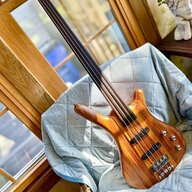
IMG_9804.jpg
 
  • Like
Reactions: Hurricane Jimmie
what is heard of the bass in the house is often random. Sometimes good, sometimes just barely there or nothing audible at all.
Yup, the struggle is real Bro.
I've been a church bassist for a while now. I don't know exactly, but lets say somewhere over 10 years, but less than 20...
In my case it's volunteers at the mixing desk. A few Sundays ago I was so far in front of the mix I considered having my name legally changed to changing my name to Marcus Miller. It didn't happen until half-way through the first song, so only so much you can do from the stage. I did get eye contact with the guy with his hand on the fader. He just looked at me with the cheezy grin and gave me the thumbs up. I think he was thinking all was going well and I wanted him to acknowledge that or something. I played super soft and also rolled back vol. but my bass was super hot.
Next Sunday, same tech, same thing. Next Sunday, same tech, I'm not in the mix at all.

I'm blessed that these folks are here and willing to give their time, so I don't ever scold anyone, just look for a way to make it a teachable moment. It's tricky because you need what you need, but you don't want to run anyone off. - Also you are subject to what they consider to be a good mix. A few years back I was completely buried in the mix my someone our church paid. - On that one I asked they guy to give me some pointers on mixing bass for my own home studio mixes. I was told that the "trick" is to have the bass barely there. A good mix has the bass so non-present that you don't really hear or notice it at all, but if you were to momentarily mute the bass channel you'd be able to tell it's missing.

Wish I had a good answer for you. Play as competently as you can and be a good person. It's your best plan for being heard when you suggest your part of the mix could use a little "love:"
 
Its a performance and everyone needs to be able to do it properly.
You can not be second guessing what someone may or may not mix..its not negotiable, imv.
If they can't do the gig..they can't do the gig.
Get someone in who can.
Its a waste of time and effort otherwise.
IMO.
 
I could have written this. I am about to volunteer for sound duty, even though I haven't run band sound in 35 years. The problem is most FOH guys mean well, but few of them are musicians so they don't even know what things should sound like. After the service, I ask my daughter who is a musician, "how did the bass sound?" and usually she says it was barely audible. "All I could hear was the piano, the drums, sometimes the lead guitar, and the lead vocal." The second guitar, if any, and the bass are usually absent. It can be discouraging sometimes.
35 years? Does this mean you have no experience running digital boards? If the site is running one, and all you've been exposed to is analog, may I suggest you spend the first few shows standing next to the sound tech, taking notes, and asking questions after the show (not during the show, because a sound tech will typically always be thinking ahead to the next instantaneous change he has to make). Also note that the workflow differences among various board brands/models can be significant, so the skillset you grow from running, say, an Allen & Heath, may not be directly portable to, say, a Behringer.

Once you find out which digital board the site is running, download the manual and bury yourself deep into it, watch training videos on Youtube, and so on.

If the board at the site is analog, you've got a much better chance of success going in cold.
 
  • Like
Reactions: GypsyBilly
35 years? Does this mean you have no experience running digital boards? If the site is running one, and all you've been exposed to is analog, may I suggest you spend the first few shows standing next to the sound tech, taking notes, and asking questions after the show (not during the show, because a sound tech will typically always be thinking ahead to the next instantaneous change he has to make). Also note that the workflow differences among various board brands/models can be significant, so the skillset you grow from running, say, an Allen & Heath, may not be directly portable to, say, a Behringer.

Once you find out which digital board the site is running, download the manual and bury yourself deep into it, watch training videos on Youtube, and so on.

If the board at the site is analog, you've got a much better chance of success going in cold.
Yes, definitely would spend a month watching and suggesting adjustments from a musical perspective. That's a good idea to find the manual and read it through. The last board I operated with any consistency was Peavey 701R run to a power amp & a pair of peavey SP2's when my band (back in the day) ran it's own sound from the stage. And that was in the late 80s-early 90s.

I suggested bringing in a professional sound tech to give a class on running sound, but that hasn't happened as of yet.
 
Yup, the struggle is real Bro.
I've been a church bassist for a while now. I don't know exactly, but lets say somewhere over 10 years, but less than 20...
In my case it's volunteers at the mixing desk. A few Sundays ago I was so far in front of the mix I considered having my name legally changed to changing my name to Marcus Miller. It didn't happen until half-way through the first song, so only so much you can do from the stage. I did get eye contact with the guy with his hand on the fader. He just looked at me with the cheezy grin and gave me the thumbs up. I think he was thinking all was going well and I wanted him to acknowledge that or something. I played super soft and also rolled back vol. but my bass was super hot.
Next Sunday, same tech, same thing. Next Sunday, same tech, I'm not in the mix at all.

Similar. When the one who's good is there he makes it all perfect and saves the scene, but with the others it varies week to week. I have learned to anticipate when there is going to be a problem and try to point it out in the proper way, and I show up earlier on those weeks.

I'm blessed that these folks are here and willing to give their time, so I don't ever scold anyone, just look for a way to make it a teachable moment. It's tricky because you need what you need, but you don't want to run anyone off. - Also you are subject to what they consider to be a good mix. A few years back I was completely buried in the mix my someone our church paid. - On that one I asked they guy to give me some pointers on mixing bass for my own home studio mixes. I was told that the "trick" is to have the bass barely there. A good mix has the bass so non-present that you don't really hear or notice it at all, but if you were to momentarily mute the bass channel you'd be able to tell it's missing.

Wish I had a good answer for you. Play as competently as you can and be a good person. It's your best plan for being heard when you suggest your part of the mix could use a little "love:"
The last part is what I do, I'm just wondering if there is anything more I could do. Some of the suggestions here like bringing in a pro or buying a new board aren't going to happen, I just want to know how I can kindly help the sound folks when I don't know anything about their job either... such as when I am told the bass was mute in FOH even when I had it in monitors, or when one of these situations happens that I know is going to be a problem (there was a midweek event where everything was changed, they had to troubleshoot something in the first service and I know it'll be wrong in the second)

Music is about relationships and not just music, and being able to constructively discuss it all with volunteers and to more than anything else be kind AND successful is important.
 
  • Like
Reactions: Wfrance3
I just want to know how I can kindly help the sound folks when I don't know anything about their job either... such as when I am told the bass was mute in FOH even when I had it in monitors, or when one of these situations happens that I know is going to be a problem (there was a midweek event where everything was changed, they had to troubleshoot something in the first service and I know it'll be wrong in the second)
i think you literally can't unless you learn to mix on that board well enough that you can quickly fix the problems, or unless you have enough pull with somebody in charge to convince them make changes

otherwise your choices are either to play bass in the midst of this mess, or don't
 
Reading this thread I'm starting to realize what some of you church players are struggling with.

First let me stress that I have never played churches except at secular events/concerts with a hired crew of professionals, so I don't really know what would be acceptable or appropriate in a more religious setting. I'm sure this could also vary between different congregations However, it seems like the situation for many of you regular church can be extremely challenging and that problem is caused by totally clueless, amateur "sound guys".

If the situation is really as bad as some of you are describing there is a another option: Don't mic anything that doesn't need mic'ing. Play straight from the backline.

Of course there are a couple of issues with this:

-There's a limit to how large the room can be. In the OPs case it's a "small church", so maybe it could work? In a very large church this won't be an option of course.

-Some things, like vocals and keys, will still typically need to go through the PA system (unless you have some form of suitable amplification). Getting the balance right may still be a problem if the sound guy is totally clueless, but at least there will be less things to worry about at the mixing desk and less things to potentially mess up.

-The sound will (in theory) be less polished when playing straight from the backline, but then again, if these so-called sound guys are as useless as you're all saying, maybe it won't.

-You will need a good backline. If it's all modelling preamps straight to DI this will obviously not be an option at all.


Some of the best, and most fun concerts I've ever played was straight from the backline with PA for vox only. In my experience, audiences tend to love, and respond better to a band playing straight from the backline. The experience gets more raw and authentic in a way. You're actually hearing THE BAND without the slick "larger than life" sound that a PA system typically adds. Whether this would work, or be appropriate in a church is a different matter of course, but it sounds to me like it couldn't possibly get much worse. At least in some of the cases mentioned in this thread. I mean, if instruments are inaudible in the mix, and the "sound guy" forgets to un-mute channels... This tells me that if these "sound guys" as much as LOOK at any eq/compression settings, the sound is far more likely to get WORSE than better.

Another option would be to help the sound guy at the soundcheck, do a "set and forget" mix and not let the sound guy anywhere near the mixing desk after the sound check. It's not ideal, but based on what I've read in this thread, it would probably be better than allowing the sound guy to ruin the sound later on.

Basically, when a problem has been identified, the only logical solution is to eliminate the problem. If the sound guy has been identified as the problem, removing or reducing the involvement of the sound guy is the only logical solution.

If the sound guy is willing to make an effort to learn and improve it's a different matter of course. But based on what I've read in this thread, this doesn't seem to be the case. I don't see why these "sound guys" should be treated any differently than the musicians on stage? I mean, would a guitar player who can't actually play guitar and doesn't have any intention of learning the songs be allowed in the band? I think not. And yet, these seemingly clueless "sound guys" are allowed to keep ruining the sound. The situation some of you are describing doesn't make sense to me at all. Learning basic live sound isn't any harder then learning to play a musical instruments. If these "sound guys" don't at least make an effort to improve they shouldn't be allowed anywhere near the mixing desk. It's disrespectful towards both the musicians on stage and the audience.

But like I said, I don't have any experience playing religious services so maybe I've got it all wrong...?
 
  • Like
Reactions: Stylee Mousse
My $0.019 is that in most cases it isn’t worth more than a friendly discussion with the SE. Either keep the gig if you like it or don’t.

People hear music in their own ways. On today’s FoH dominated stages, the SE is more than just a knob twiddler; rather they act somewhat like the conductor of an orchestra, in terms of dynamics and mix. Most SE’s know their way around the non-trivial routings on today’s digital consoles; but, they may or may not know their way around the musical content the way a studied conductor would. FoH mixes reflect that individual’s understanding of how they think the music should sound. Those who have not taken the time to critically study original recording performances / mixes are unlikely to reproduce mixes close to the reference.

This is not only true in P&W mixes. Just being a bass player, I am often stunned by the differences between live mixes I hear out front compared to the pre-recorded intermission material on the same FoH. It is common for the SE to set their own interpretations of mixes. The bass voice is often diminished from just below the vocal or solo level and snare back beat, as on the studio recording, to well beneath the chordal instruments. Hey, everyone listens to the guitar, right? The snare backbeat is likewise relegated to the shadows in favor of the kick drum; no wonder people are dancing less; who the heck dances to the 1 and 3?

It’s an old and all too common story. There certainly are acts out there, who get it all right. Finding one of those, with folks who are good to work with is the objective. Don’t give up. It’s hard to find, but much easier than shifting people’s predilections / prejudices. IME, YMMV.
 
  • Like
Reactions: GypsyBilly
I would also add an amusing story about IEM’s; which are a technical marvel, but likewise put control where it can be mishandled.

One of my gigs some years back performed the tune Blurred Lines; one of very few tunes I dislike quite intensely, due to my inability to find anything close to creative to do with that repetitive bass line. I actually tried to put my part on the Looper, let it run and do something slightly more interesting, like clapping on the backbeats.

Didn’t work. The drummer was used to playing along with his guitar father; and as it turned out, he had all the other instrumentation zeroed out in his IEM mix, aside from his father’s channel. Since he couldn’t hear the bass part, his tempo followed the rhythm guitar; and quickly lost tracking with the looper. In hindsight, it was fairly comic.

We are just people. Things get done differently by different people. Try to surround yourself with good ones.
 
Somewhere here it was mentioned about a sound booth. Some sound booths I've seen are in the most horrid location to attempt to run sound
from, stuck in a back corner of the room to up on a second floor with a small opening looking into the room below,
Those can be hard for anyone to get an idea what the mix really sounds like and for someone who is does not really have experience running sound..........

Digital mixers let you carry the mixer with you to where the people are actually seated at.

Just installing a new shiny digital mixer will not fix the issues of the operators, yes you can have preset "perfect mix" scenes but that only
goes so far.
With a full live band there is really no such thing as a set and forget mixer setting.
 

Latest posts