

Enjoy the benefits of a premium membership!
Upgrade Account
-
TalkBass has been independent since 1998. Add your voice.
Create a free account to reply to discussions, view embedded media, and browse with fewer display ads.
Join free Log in
Want zero display ads or expanded classifieds tools? Compare plans.
You are using an out of date browser. It may not display this or other websites correctly.
You should upgrade or use an alternative browser.
You should upgrade or use an alternative browser.
What exactly is a "walking" bass line?
- Thread starter KingRazor
- Start date
More options
Who Replied?Thanks guy, I stand corrected.
And KingRazor:
I have a feeling my instructor is limiting me to the triad tones only "FOR NOW" just so I internalize them and we will be looking at including other scale tones once my foundation is solid.
-eSmith.
And KingRazor:
Also, it is perfectly acceptable to play notes outside of the chord but within the scale.
I have a feeling my instructor is limiting me to the triad tones only "FOR NOW" just so I internalize them and we will be looking at including other scale tones once my foundation is solid.
-eSmith.
Probably a good idea when you're just starting out. I'm trying to move beyond that level and actually get to the point where I'm coming up with my own bass lines instead of just playing 8th note roots all the time.Thanks guy, I stand corrected.
And KingRazor:
I have a feeling my instructor is limiting me to the triad tones only "FOR NOW" just so I internalize them and we will be looking at including other scale tones once my foundation is solid.
-eSmith.

I have a feeling my instructor is limiting me to the triad tones only "FOR NOW" just so I internalize them and we will be looking at including other scale tones once my foundation is solid.
Yup, it's a good way to start. Later, I'm sure he'll introduce scale tones, passing tones, chord substitutions, and all that fancy stuff - at which time, just remember that playing the root counts too.

One of the reasons I ask this question is that when I'm playing songs at my church I'm generally playing 8th note roots. It sounds fine, and it's usually what they play on the recordings too. But it's kind of boring just sticking to roots. I want to learn how to come up with my own bass lines.
Please, correct me if I'm wrong. To my knowledge, a walking bass line is, in its most basic form, a series of notes played in order to lead a song from one chord to the next. If this is true, then would this be considered a "walking" bass line?
In a chord progression moving from the C chord to the F chord, playing the notes:
C, E, F
Obviously this is over simplifying it, but in essence, this is what a walking bass line [could] consist(s) of, right?
Again, correct me if I'm wrong.
I've been tring to understand what exactly it is.
The other thing to keep in mind is that "walking bass line" generally implies some degree of rhythmic regularity. In its most basic form, a walking bass in jazz, for example, is straight quarter notes, four to the bar. It gets deeper than that, naturally, but that's the starting point.
The thinking is that when you walk on your feet, your stride is fairly regular: you don't do a big jump, then four tiny steps, then stop dead, and so forth. You walk with a fairly steady stride. Conceptually, a walking bass line typically is based on the same fundamental sense of regular rhythm, even if it doesn't maintain absolutely strict regularity.
The linearity other posters have referred to is the other part of the idea. Generally, when you walk, either on foot or on the bass, you're trying to get somewhere, not just moving your feet up and down in place. So on the bass, part of "walking" is moving to other notes besides the first one you hit for a given chord. To me, playing the root on all beats for all chords isn't really "walking" even if you're playing four quarter notes to the bar; but clearly there are those who feel differently.
Listen to Moondance by Van Morrison. That's a great walkng bass line that continually evolves instead of repeating the same walking progression.
One of the reasons I ask this question is that when I'm playing songs at my church I'm generally playing 8th note roots. It sounds fine, and it's usually what they play on the recordings too. But it's kind of boring just sticking to roots. I want to learn how to come up with my own bass lines.
If the recordings are simple, you might not want to vary the basslines too much, or your bandmates might give you the ol' fisheye ... However, you could start with simple variations - octaves and fifths will do - see how they respond, and then go from there.
As far as learning to walk, there are quite a few decent books out there that will get you started in the right direction (though there's nothing quite like a good teacher). The Total Jazz Bassist is good, and there are a couple of Mel Bay books, the exact titles of which I forget at the moment (something about walking ... ). Ed Fuqua (TB member) has a book published through Sher that has a good reputation, as I understand it.

- Dec 13, 1999
- 11,736
- 8,941
- 70
- Disclosures
- Chuck Sher publishes my book, WALKING BASSICS:The Fundamentals of Jazz Bass Playing.
Ed Fuqua (TB member) has a book published through Sher that has a good reputation, as I understand it.
A link to which he has thoughtfully provided though, like the advice he offered in the same post, seems to have been drowned out by the spinning of little wheels....
A link to which he has thoughtfully provided though, like the advice he offered in the same post, seems to have been drowned out by the spinning of little wheels....
Now, now, Ed - you sell more books with honey than vinegar ...

Listen to Moondance by Van Morrison. That's a great walkng bass line that continually evolves instead of repeating the same walking progression.
Good suggestion. There are several other songs out there, popular, obscure, in differnt genres, on electric or DB. Do some research, (a simple youtube search is a good start) ask other players for examples and enjoy listening.
The one walking bass line that got me hooked as a kid and still does it for me is the Beatles, "I Saw Her Standing There." It might be considered a bit cliche by some, and there are other, better examples - but somehow, particularly in a rock'n'roll context, this one just grabs me.
- Dec 13, 1999
- 11,736
- 8,941
- 70
- Disclosures
- Chuck Sher publishes my book, WALKING BASSICS:The Fundamentals of Jazz Bass Playing.


Just a quick thump on this dead horse...
You can "walk" (up and down) without it being a "walking line". But I feel that what you are looking for passing notes.
Specific to church music, check out some of the Chris Tomlin stuff, Jesse, his bass player often will play notes that aren't the root as well as some nice passing notes. If you are playing contemporary stuff, it might sound a little hokey to walk all over the place.
Specific to awesome note selection give Tony Levin a listen.
One last little thing, if you want to hear more of a hybrid line (walking to not) Lee Sklar on James Taylors "your smiling face"
You can "walk" (up and down) without it being a "walking line". But I feel that what you are looking for passing notes.
Specific to church music, check out some of the Chris Tomlin stuff, Jesse, his bass player often will play notes that aren't the root as well as some nice passing notes. If you are playing contemporary stuff, it might sound a little hokey to walk all over the place.
Specific to awesome note selection give Tony Levin a listen.
One last little thing, if you want to hear more of a hybrid line (walking to not) Lee Sklar on James Taylors "your smiling face"
If you haven't seen that "I want to buy an iPhone 4" cartoon, you really should do yourself a favor and check it out.
Anyway - "walking bass" generally relates to, but is not exclusive to, playing jazz. There are any number of note choices that one can make, but what the "walking" part refers to is playing a quarter note on every beat of the bar, and, again very generally, a different pitch per note. They call this "walking" because that's what it emulates, your gait when you put one foot in front of the other in a regular, walking, getting from here to there motion.
For me (and although I'm no world class talent, I have been doing this for a minnit) there are three distinctive "functions" of a walking bass line - harmonic definition, harmonic propulsion and melodicism. Harmonic definition is just what it says, defining the harmony/chords, the easiest way to do this is by outlining the chord, or arpeggiating it. Harmonic propulsion means moving the chords forward. And melodicism means having your lines be a musical response to your immediate aural environment.
If all you do is arpeggiate the chords, you don't get much forward motion. Even using voice leading/guide tones/common tones can sound "static" if overused. If you use scale tones alone, you get forward motion, but you lose the sound of the chords. Not just thinkingbut hearing your walking line as a melodic response can help get you using chord tones, scalar passages, chromatic leading tones, interval jumps etc. in the same way melodies do to get your line to be a MUSICAL response, not an intellectual one.
BigEgoHead would like to recommend hs book as well as a thread he started here called REALLY learning a Tune as these are all exercises and approaches he has found helpful on his journey.
You have it right there and there is no need to add more to this !
+1

Let's talk a little more on Harmonic Propulsion in the bass line. I'm thinking this would be the dominant interval of the next chord as my 4th interval in the present measure. Counting on this being the harmonic propulsion needed to move me to the next chord.
Having a little problem doing this on the fly. Few words on remembering which harmonic propulsion note to use in the midst of the song, i.e. on the fly with no sheet music in front of me. Bound to be a memory peg, trick, forumua, something.
Should mention on the fly I think in chord tone interval numbers, i.e. R-3-5 b7
Having a little problem doing this on the fly. Few words on remembering which harmonic propulsion note to use in the midst of the song, i.e. on the fly with no sheet music in front of me. Bound to be a memory peg, trick, forumua, something.
Should mention on the fly I think in chord tone interval numbers, i.e. R-3-5 b7
- Dec 13, 1999
- 11,736
- 8,941
- 70
- Disclosures
- Chuck Sher publishes my book, WALKING BASSICS:The Fundamentals of Jazz Bass Playing.
Not neccessarily and here's the problem with approaching this as an intellectual non AURAL exercise. Note choice is not micro, it's macro. The line needs to be a melodic arc you hear from the first note through the last note. No tricks, formulas etc. Because anything that gets "plugged in" because of an intellectual construct will not communicate the intent of the arc. Anymore than plugging the word "phantasmagorical" in every sentence right before the period will make your sentences more meaningful phantasmagorical. See what I mean phantasmagorical?
There's no "quick fix", all the formulas just make it sound like you can't hear what the compers and soloists are doing. Use the chord line (REALLY LEARNING A TUNE) to get the sound of the changes in your ear, work on ear training to hear triads and intervals with clarity and then let your ear do the driving. When you HEAR the changes, your ear will make you respond to those changes in a way that makes all the notes you play relate not only to the tune, but to EACH OTHER. It's not that you're 'picking' notes out of a hat, trying to get something that hopefully works. It's that THIS note goes HERE, after THAT one and before THAT one because your ear is hearing the tune move forward in that fashion.
There's no "quick fix", all the formulas just make it sound like you can't hear what the compers and soloists are doing. Use the chord line (REALLY LEARNING A TUNE) to get the sound of the changes in your ear, work on ear training to hear triads and intervals with clarity and then let your ear do the driving. When you HEAR the changes, your ear will make you respond to those changes in a way that makes all the notes you play relate not only to the tune, but to EACH OTHER. It's not that you're 'picking' notes out of a hat, trying to get something that hopefully works. It's that THIS note goes HERE, after THAT one and before THAT one because your ear is hearing the tune move forward in that fashion.
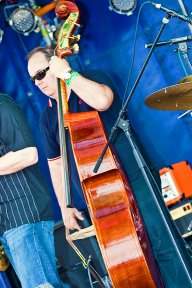
The other thing is about responding to the rest of the band - so I was at Jazz Summerschool a couple of weeks ago and played with some good front line players, who were different to the people I play with normally - one was a trombone player from Sweden who really picked up on what the rhythm section did.
It really changes your perspective when you can feel that interaction and that's another reason why you can't pre-programme your walking lines - so it depends on what's going on around you...?
It really changes your perspective when you can feel that interaction and that's another reason why you can't pre-programme your walking lines - so it depends on what's going on around you...?
It may help to listen to Ray Price recording of CRAZY ARMS.
He developed the famous "Ray Price Shuffle" 4/4 arangement of Honky Tonk with a walking bassline.
Really worth a listen
He developed the famous "Ray Price Shuffle" 4/4 arangement of Honky Tonk with a walking bassline.
Really worth a listen


