• TalkBass has been independent since 1998. Add your voice.
    Create a free account to reply to discussions, view embedded media, and browse with fewer display ads.
    Join freeLog in
    Want zero display ads or expanded classifieds tools? Compare plans.

What happened after I practiced this for a week... [Long]

Apr 18, 2015
3,137
3,495
65
Disclaimer: This is a long, long thread opener. So if you're like me with ADHD, just jump to the bottom where it's bold to see if it interests you enough to read the whole thing.

First a shout-out and thanks to @SteveCS who created the attached exercise. It started off in another thread in regard to how to play across strings on the same fret. So Steve attached this file later into the thread. It looked interesting, and informative, so I began working on it. I use exercises like this to better acquaint myself with strategies/tactics and fingerboard identification. And this exercise certainly addresses this. But for me it had residual benefits.

It took me about two days to get the whole etude under my fingers. Initially the exercise was posted without tab. It is all over the fingerboard. And what I mean by all over, it goes from the 18th fret down to open! Who actually plays up near the 18th fret, especially on the inner strings???? I guess I do now. Once I got the etude down the pattern became apparent.

What I didn't realize before is how tired my left hand could get doing this, especially my thumb. After 2 times through the etude I had to put the bass down and let my hand recover. and the stretch? A four fret stretch isn't usually a big deal, but when the 4th finger is on a lower string and the 2nd finger on an upper with the index still in position on a different string, the stretch becomes more challenging- and tiring. Again, two times through and I was done. In fact a few bars toward the end of the etude, especially up between the 15th and 18th frets, it became hard to play clean.

Being required to play all over the neck made me very conscious of the bass height on all my basses. I practiced the etude on all my basses, 4, 5 and 6 string and initially found varying levels of difficulty on each bass. Adjusting the strap height seemed to make a significant difference. There is no way I could play this without a strap. All my bass straps seemed to need a 1" shortening to make it more comfortable. Any higher and my left hand felt like it had to be held up too high, though I didn't have any issues with my right hand at any height level.

The surprise of the week was how fascile I became with my 6 string bass. Initially the stretch was harder than my other basses, but the 4's and 5's without that C string requires the 2nd finger to "crunch" a little more. At first I liked my 6 string the least. But as I practiced on it, it became my favorite for thie exercise (I used the same fingers on the tab and didn't initially use the 1st string, though incorporated it later). I found that playing the 6er made it easier for me on the 4er and 5ers. At the beginning of the week the stretch up near the nut was tough, especially on the 6...

... But now, a week in, not only have i become more familiar with the entire fingerboard, some additional tactics, but my left hand seems to have "broken in" considerably. Initially I was afraid I would develop a RSI, but now I have no trouble stretching where I need to stretch and can play this etude five or six times in a row without needing a break. I'm now using the exercise for speed development and while 90bpm as indicated is very comfortable, I'm starting to push 120bpm. I'm not fully clean at that tempo yet, but it's getting there. Thanks for taking time to read this. [Both small jpg and full size pdf attached]. And, thanks again to Steve CS
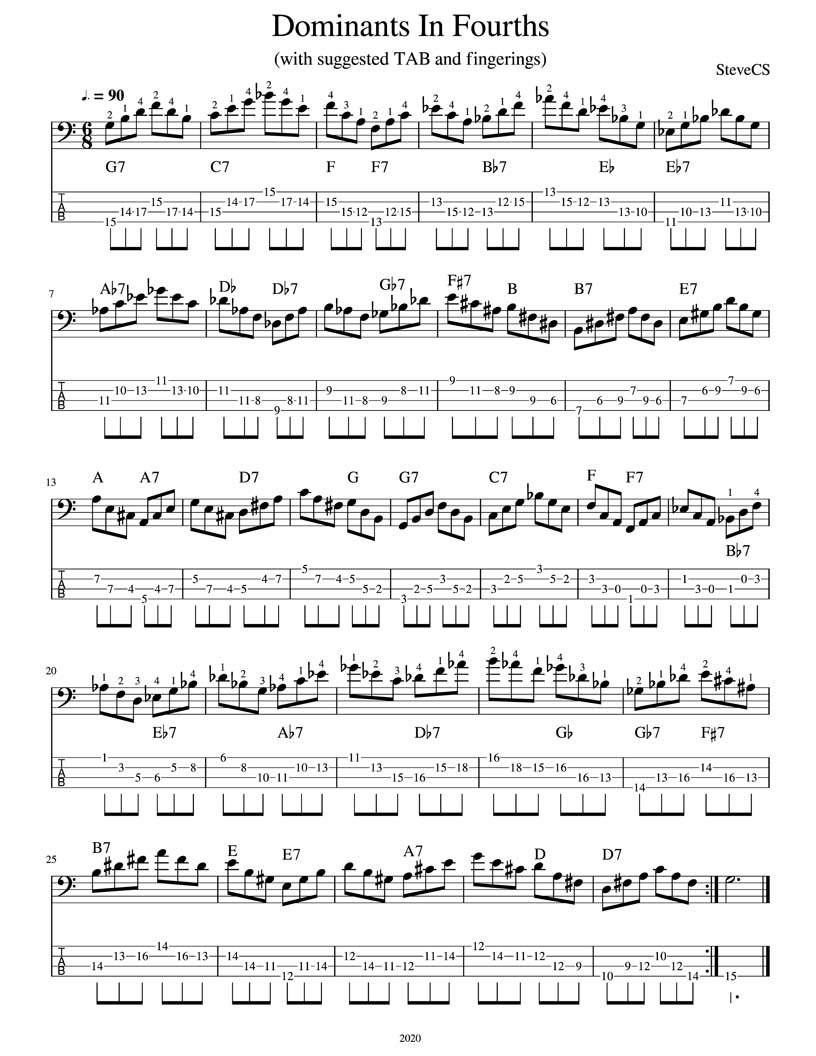

DominantsWithTAB_SM.jpg
 

Attachments

Congratulations! Practicing all over the fingerboard opens up extra notes to play.

For example, sometimes the guitar player and I switch playing the lead melody because we are a three piece. Like in the 9th wave by the Ventures.

At one time, I would have played the E melody starting on the open string. It makes more sense to play up on octave starting on the 7th fret. Now, it sounds better yet another octave higher, starting on the E on the 14th fret.

The higher notes were not available to me until I started practicing all over the fingerboard.
 
(Rushes off to look up the meaning of etude).

I've been enjoying playing it too. Certainly nowhere near that kind of tempo yet though - a few reasons. General playing ability, having to look down at the music then back to the fret and losing my place. So I need also to work on playing without looking at the board so much, and this will help that.
 
  • Like
Reactions: SteveCS
(Rushes off to look up the meaning of etude).

I've been enjoying playing it too. Certainly nowhere near that kind of tempo yet though - a few reasons. General playing ability, having to look down at the music then back to the fret and losing my place. So I need also to work on playing without looking at the board so much, and this will help that.

Keep at it. Your fingers will start to recognize a pattern. The way it is constructed, there are two ascending dom7 chords where the second 7th ends up on the G string. That is the signal to shift down. The baby finger will shift to the same fret where the 2nd finger previously was and there is a 3 note descending group. Then repeat the two ascending patterns on that set of frets. Rinse and repeat until you come back to the Bb Eb Ab Gb sequence, then comes the "coda". Once you crack the code of the pattern you can develop speed on this.

One tip that I found helpful that is different than the tab; In measure 19, instead of playin the Bb7 in 1st position, I play the third note of m19 (A) open and use the time to slide to 5th position to play the Bb with my 2nd finger. I found it cleaner and smoother than playing the Bb7 and Eb7 in first position. It is also easier to build speed as the ascending pattern seems to start with that Bb7, so you set yourself up that way for the return up the neck. That's one thing I learned in previous face-to-face private lessons; Use the open strings to buy time for position shifts. Just my thoughts on this.
 
Last edited:
  • Like
Reactions: Spidey2112
Yes, thank you, I get what you mean by that. I have started to notice an improvement over the last day or so - like you say the recognition of the repeating pattern is starting to kick in and I can play large parts of it without having to refer to the sheet. Which is good because at the moment I resemble that dog who played the piano in the Muppets, always looking up/down.

The only bit I really still struggle every time with is in 20-22, the three sets of three in the first part of the bars that basically get you from the first fret to the fifteenth, and ready to carry on with the pattern again. A great little shift in emphasis there by Steve, just when I'm starting to go into cruise control with it, makes you pay attention again!

But the reach is quite big so I'm fingering it 1-2-4, which means I've nothing else to move up to the next fret with unless I slide onto it. Of course I can do that, but I sense the point of the exercise is to finger it better that you have one left. So I'm trying to get 1-2-3, then start the next note with my little finger. Hard but I'm getting there.

Take care everyone

Steve
 
  • Like
Reactions: SteveCS
Yes, thank you, I get what you mean by that. I have started to notice an improvement over the last day or so - like you say the recognition of the repeating pattern is starting to kick in and I can play large parts of it without having to refer to the sheet. Which is good because at the moment I resemble that dog who played the piano in the Muppets, always looking up/down.

The only bit I really still struggle every time with is in 20-22, the three sets of three in the first part of the bars that basically get you from the first fret to the fifteenth, and ready to carry on with the pattern again. A great little shift in emphasis there by Steve, just when I'm starting to go into cruise control with it, makes you pay attention again!

But the reach is quite big so I'm fingering it 1-2-4, which means I've nothing else to move up to the next fret with unless I slide onto it. Of course I can do that, but I sense the point of the exercise is to finger it better that you have one left. So I'm trying to get 1-2-3, then start the next note with my little finger. Hard but I'm getting there.

Take care everyone

Steve

The thing with that section, that type of run, is there is no need to stretch more than 2 frets at a time, and the hand movement is more of a continuous morph than a set of discrete shifts. And it is certainly not one big stretch/shift.

Play the Ab with '1'. As you prepare the stretch between '1' and '2' for the F, pivot your hand up on your thumb to assist the reach. As you place '2' on the F, release 1. Whilst the F is sounding, relax the stretch between 1 and 2 and bring your thumb up between 2 and 3. Maintain just enough pressure to keep the F note clean whilst allowing the thumb to slide up. As you place your thumb, place 3 on the D and relax the stretch between 1, 2 and 3. Pivot in the thumb again to get to the Eb with 4, and at the same time bring your thumb into position just behind 4. If you've relaxed the stretches enough, just moving your thumb should have drawn the rest of your hand up into position ready to play G with 1 on the 5th fret...
 
  • Like
Reactions: lucas303 and LexD
Thanks Steve, yes that's something I need to work on. I think when I started around Christmas I thought that you had to try and reach everything you could, until the point where you hand had to move. God knows why.

I asked a question along that line a while back about how everyone played the opening riff in Back In Black, because I couldn't make the reach from 7th fret to 4th, especially at the speed required. But the sound advice at the time was similar to yours here, and I've since learned to play it as a very quick "slide", if that makes sense, from 7th to 4th and back then I can reach 7th to 5th and so on. That's now happening fairly consistently so I'm happy with that.

But this, in your exercise, also needs to be a bit cleaner than that I think. So yes, not a slide this time, I'll work on moving the hand - I get the continuous bit you mention, just to work on getting a clean transition.

Thanks again

Steve
 
  • Like
Reactions: SteveCS
The only bit I really still struggle every time with is in 20-22, the three sets of three in the first part of the bars that basically get you from the first fret to the fifteenth, and ready to carry on with the pattern again

As I said earlier, there are some tactics that you can use to make the transition back up the neck smoother and more musical. Below find a tab with one or two strategies. Note the open A and shift in measure 19 with continuation in measure 20. In measure 21 you can play it as the tab as originally noted, or alternately on beat 3, play that G on the 5th fret, or even play it open. The way I think of the positions going forward is to target the 11th, then 16th frets with my 2nd finger to continue the pattern.

I hope this helps a bit from my experience with this. Of course there are multiple ways of playing this but this is what works for me.
Dominants_wTabHelp_v2.jpg
 
... I'm now using the exercise for speed development and while 90bpm as indicated is very comfortable, I'm starting to push 120bpm. I'm not fully clean at that tempo yet, but it's getting there.
...

That's quite a decent pace. Don't forget, each beat is a dotted crotchet, so 120bpm is 360 notes per minute. Although part of the point is to deliberately train the various parts of the hand in co-ordinated movement, upping the pace is also a worthy goal.

...
One tip that I found helpful that is different than the tab; In measure 19, instead of playin the Bb7 in 1st position, I play the third note of m19 (A) open and use the time to slide to 5th position to play the Bb with my 2nd finger. I found it cleaner and smoother than playing the Bb7 and Eb7 in first position.
...

I love the fact that you guys are exploring the possibilities and finding different ways to make this work for you. Here's another possibility for 19/20, that breaks the shift down into smaller chunks:
upload_2020-5-7_17-16-4.png
 
Last edited:
  • Like
Reactions: lucas303
Edit from previous post.
In regard to my previous post with suggested strategy, upon further examination I realized that I learned the etude without the tab and didn't pay much attention until the suggestions above. As I reexamine my notations and the original tab fingering. What I realized upon working with the SteveCS suggested fingerings, there is some wisdom musically. I was shifting on the 4th beats (as noted), but if one shifts on the 3rd beat as per Steve it make a different, perhaps better musical sense as the earlier shift musically creates the effect of a pickup note, and perhaps that 3rd beat, if grouped musically as per revised tab section.
Dominants_wTabHelp_v3.jpg


That's quite a decent pace. Don't forget, each beat is a dotted crotchet, so 120bpm is 360 notes per minute. Although part of the point is to deliberately train the various parts of the hand in co-ordinated movement, upping the pace is also a worthy goal.

I love the fact that you guys are exploring the possibilities and finding different ways to make tjis work for you. Here's another possibility for 19/20, that breaks the shift down into smaller chunks:
View attachment 3818882

It's difficult to play every figure properly at 120bpm, but when attempted in practice, it makes anything less much more doable. Imagine if every Little League baseball player had batting practice with 90mph pitches, 60mph pitches at gametime would seem like underhand softball :).

"Dotted crochet"? I have never heard that term before. My 3 year old granddaughter just peed in her pants in the park. Is that the same thing :woot:? Only recently was I aquainted with "quavers". I don't think those terms are ever used in the US. We don't use a "fixed do" system either, as some European countries do. Interesting how similar and different, no?

 
360 notes a minute? I'm understanding that right - as read, 6 notes a second?

I don't think Talkbass would be happy if I typed my initial reaction when I read that, so I'll go for Gosh, or even Wow. Well done, that's really impressive.

One last question then, is it acceptable for seconds per minute to be a higher figure than notes per minute? Does such a time signature exist, outside of the Funeral March.☺
 
Last edited:
360 notes a minute? I'm understanding that right - as read, 6 notes a second?

I don't think Talkbass would be happy if I typed my initial reaction when I read that, so I'll go for Gosh, or even Wow. Well done, that's really impressive.

One last question then, is it acceptable for seconds per minute to be a higher figure than notes per minute? Does such a time signature exist, outside of the Funeral March.

At the written tempo of 90bpm, it's 270 8th notes per minute, since there are 3 8th notes in each beat.
 
360 notes a minute? I'm understanding that right - as read, 6 notes a second? I don't think Talkbass would be happy if I typed my initial reaction when I read that, so I'll go for Gosh, or even Wow. Well done, that's really impressive.

I don't know you, so forgive me if I make presumptions.

It sounds like you're freaking out at the tempo. Don't. It is an exercise that has multiple levels of growth. Take your time. It's not a race. The first level of growth is fingerboard/note identification. The second level is fingerboard tactics and strategies. If you started off playing each NOTE at 90bpm that would be ok at first, even ideal if you can do it without mistakes. If you can't take it down to one NOTE=60bpm or even 40bpm. Speed is built from accuracy. Work in small chunks which make it all manageable. Then proceed to link those chunks together. ARE YOU PRACTICING this etude 100% OF THE TIME WITH A METRONOME? A metronome is critical.

One way to build speed is to start at a ridiculously low bpm. If you play it perfectly 5 times in a row with no mistakes, bump the speed up 5bpm. Keep going until you make a mistake. Once at that threshold, if you play it perfectly 5x in a row bump the speed 1bpm. 5x in a row bump another bpm. If you make a mistake, back off 1bpm. Eventually you'll be flying. Hope that helps.
 
Sorry mate, just my (poor) sense of humour.

I'm not freaking out over it, just a bit in awe of that sort of ability really. It''s sometimes hard to understand how someone''s doing what they are, but when you're attempting the same thing yourself it's easier. And that is very impressive playing.

I'm happy enough trundling along at the moment, and that I'm improving my technique at the same time. I'll get quicker as I go, but consistent speed (whatever speed that my be) throughout the whole piece hasn't been my forte so far.

So, I take your point about the metronome. I don't have one, and I should. I've been looking for online ones, time to start looking harder!

Edit - I've got one now.

Thanks again for your time and advice, it is a great help.

Steve
 
Last edited:
The thing with that section, that type of run, is there is no need to stretch more than 2 frets at a time, and the hand movement is more of a continuous morph than a set of discrete shifts. And it is certainly not one big stretch/shift.

Play the Ab with '1'. As you prepare the stretch between '1' and '2' for the F, pivot your hand up on your thumb to assist the reach. As you place '2' on the F, release 1. Whilst the F is sounding, relax the stretch between 1 and 2 and bring your thumb up between 2 and 3. Maintain just enough pressure to keep the F note clean whilst allowing the thumb to slide up. As you place your thumb, place 3 on the D and relax the stretch between 1, 2 and 3. Pivot in the thumb again to get to the Eb with 4, and at the same time bring your thumb into position just behind 4. If you've relaxed the stretches enough, just moving your thumb should have drawn the rest of your hand up into position ready to play G with 1 on the 5th fret...

An interesting exercise.

For that part, the suggested fingering seemed a bit unnatural to me (personally). Staring on measure 19, I would play that part on the bottom two strings only, alternating major and diminished arpeggios by sliding up the neck, like so:

A --0-3-6-3---|--5-8-11-8---| ...
E 1---------5-|6----------10| ...


...shifting positions between triplets. The shifts seemed less forced that way and seemed to flow better specifically because of the minor and diminished triads starting and ending on the pinky finger) but each to their own. I think that if I were to play the way you suggested, I'd want to play the major triads in pinky position (essentially, using my shift pattern).

D ------1-----|----3-6-----| ...
A --0-3---3---|--5-----8---| ...
E 1---------5-|6---------10| ...


Either way, the shifts are smoother in my opinion. But I guess the two approaches practice different things.
 
  • Like
Reactions: SteveCS
