Actually, due to the drag of the strap on your shoulder, it still puts the vast majority of the weight on the body end of the strap. And the strap is not at all in your way. It's just unfamiliar. I meant this for an instrument that you love, can't bear to get rid of, but can't stand the neck dive. Another alternative is to put an extension on the body horn. Look where the body horn lines up - 12th fret, great balance, below 12th, starts to "dive" quickly. The length of the horn matters - really.Holy thread resurrection!
I think having the strap attached to the headstock would be bad for the neck.

Enjoy the benefits of a premium membership!
Upgrade Account
-
TalkBass has been independent since 1998. Add your voice.
Create a free account to reply to discussions, view embedded media, and browse with fewer display ads.
Join free Log in
Want zero display ads or expanded classifieds tools? Compare plans.
You are using an out of date browser. It may not display this or other websites correctly.
You should upgrade or use an alternative browser.
You should upgrade or use an alternative browser.
What is neck dive?
- Thread starter Oliver
- Start date
More options
Who Replied?
If you have an instrument you really like but it has bad neck dive, consider hooking the end of your strap to the headstock, right above the nut. It looks old-school, but works very well. run a nice piece of sturdy nylon twine/rope(thin) under your strings and around the headstock, tie to a good strap and quit complaining. Millions of guitarists did this before the advent of two-buttons-on-the-body.
Usually one can fix or at least reduce neck dive by moving strap buttons around. My Carlo Robelli 8 string was by FAR the worst neck dive bass I ever saw. I moved the strap buttons and it helped but it still dived. Eventually I had to put a 2 1/2 inch extension on the horn to move the button out toward the 12th fret. Fixed it. Looks a bit hokey but hey it's just a Carlo Robelli...
Poster above is so right - if you are willing to make an additional hole in your guitar body you can tip the balance a little. I have a Vester where someone put a second strap button about 2" off-center, toward the player, on the bottom end of the bass. Only one I use on that one(which has an extremely short upper body horn).
Forgot to mention two(obvious?) ways to work on neck dive I've used recently: replace your tuners with something lighter like Hipshots made of aircraft aluminum and replace your bridge with something heavier.
Forgot to mention two(obvious?) ways to work on neck dive I've used recently: replace your tuners with something lighter like Hipshots made of aircraft aluminum and replace your bridge with something heavier.

My Warwick Corvette 5'er is a pig and neck dives pretty badly. A 4.5" wide Levy's leather strap should distribute the weight more evenly over my shoulder and wearing the bass up higher will cure most of the neck dive. Doesn't look cool but it works. Luckily I find it more comfortable and it allows easier upper fret access.
I may give my Warwick back to GC because of the neck dive, though. My Fender Jazz doesn't dive at all and feels more comfortable.
I may give my Warwick back to GC because of the neck dive, though. My Fender Jazz doesn't dive at all and feels more comfortable.

Here are some thoughts I have about neck dive:
- It's as much about the bridge end of the bass being pulled up as the neck being pulled down.
- Think of your left shoulder as a pulley and the strap as the cable over the pulley. The weight on the left side of the strap pulls it down, which pulls up the right side of the strap. The right side of the strap pulls up on the body of the bass, and the neck rotates downward.
- The strap button closest to being vertically in line with the center of mass (center of gravity) carries most of the weight of the bass. On my Jazz, the center of mass is around the 19th or 20th fret, so the left strap button carries most of the weight. The right strap button is farther away from the center of mass has less weight pulling it down.
- On many basses, if you tilt the neck of the bass up, the left strap button moves closer to being in line with the center of mass (on my Jazz, it moves closer to being directly over the 19th fret). This causes more of the weight of the bass to pull down on the left side of the strap. If you move the bass neck to horizontal, there is less weight pulling down on the left side of the strap.
To stop neck dive, you can:
1 - Equalize the weight pulling on each side of the strap.
You can do this by moving the left strap button farther away from the center of mass (longer top horn, connect strap to headstock). You can move the center of mass closer to the right strap button and farther from the left strap button (lighter tuning keys, a heavier body, a heavier bridge). Or, you can move the right strap button closer the center of mass (move the right strap button closer to the center of the body).
2. - Have some force to keep the weight on the left side of the strap from pulling up the right side of the strap.
You can do this by wearing a wide strap that grips your shoulder. There is also this solution.
I use a wide suede strap to tame the neck dive on my Jazz, but I find the pulling on my shoulder can make it pretty sore after a couple hours.
There is often a trade-off between getting a light bass and a balanced bass. A heavier body will move the center of mass closer to the right strap button, and therefore hold down the body side of the bass. But, this would make the bass heavier as a whole. A lighter body would make the bass lighter overall, but also make it easier for the weight of the neck to pull the body up. This can cause pulling on your shoulder from the strap trying to slide over it.
- It's as much about the bridge end of the bass being pulled up as the neck being pulled down.
- Think of your left shoulder as a pulley and the strap as the cable over the pulley. The weight on the left side of the strap pulls it down, which pulls up the right side of the strap. The right side of the strap pulls up on the body of the bass, and the neck rotates downward.
- The strap button closest to being vertically in line with the center of mass (center of gravity) carries most of the weight of the bass. On my Jazz, the center of mass is around the 19th or 20th fret, so the left strap button carries most of the weight. The right strap button is farther away from the center of mass has less weight pulling it down.
- On many basses, if you tilt the neck of the bass up, the left strap button moves closer to being in line with the center of mass (on my Jazz, it moves closer to being directly over the 19th fret). This causes more of the weight of the bass to pull down on the left side of the strap. If you move the bass neck to horizontal, there is less weight pulling down on the left side of the strap.
To stop neck dive, you can:
1 - Equalize the weight pulling on each side of the strap.
You can do this by moving the left strap button farther away from the center of mass (longer top horn, connect strap to headstock). You can move the center of mass closer to the right strap button and farther from the left strap button (lighter tuning keys, a heavier body, a heavier bridge). Or, you can move the right strap button closer the center of mass (move the right strap button closer to the center of the body).
2. - Have some force to keep the weight on the left side of the strap from pulling up the right side of the strap.
You can do this by wearing a wide strap that grips your shoulder. There is also this solution.
I use a wide suede strap to tame the neck dive on my Jazz, but I find the pulling on my shoulder can make it pretty sore after a couple hours.
There is often a trade-off between getting a light bass and a balanced bass. A heavier body will move the center of mass closer to the right strap button, and therefore hold down the body side of the bass. But, this would make the bass heavier as a whole. A lighter body would make the bass lighter overall, but also make it easier for the weight of the neck to pull the body up. This can cause pulling on your shoulder from the strap trying to slide over it.

I've always though wide straps were the coolest(love them Levys too!), but I'm an old dude, so what do I know.A 4.5" wide Levy's leather strap should distribute the weight more evenly over my shoulder and wearing the bass up higher will cure most of the neck dive. Doesn't look cool but it works. Luckily I find it more comfortable and it allows easier upper fret access.
Wearing a 5 or six stringer high generally will force you to get your fretting arm's elbow a little more up and out into the air, leading to more comfort and better hand position. A bent wrist means bent tendons, means irritated carpal tunnel, leading to CTS(carpal tunnel syndrome).
Ric5
Inactive
- Jan 29, 2008
- 29,772
- 30,452
- Disclosures
- I like 5, 8, 10, and 12 string basses
What is neck dive?
Go play a t-bird with a strap and you will find out. Every time you let go of the neck it takes a dive to the floor.
My solution for neck dive pictured below.
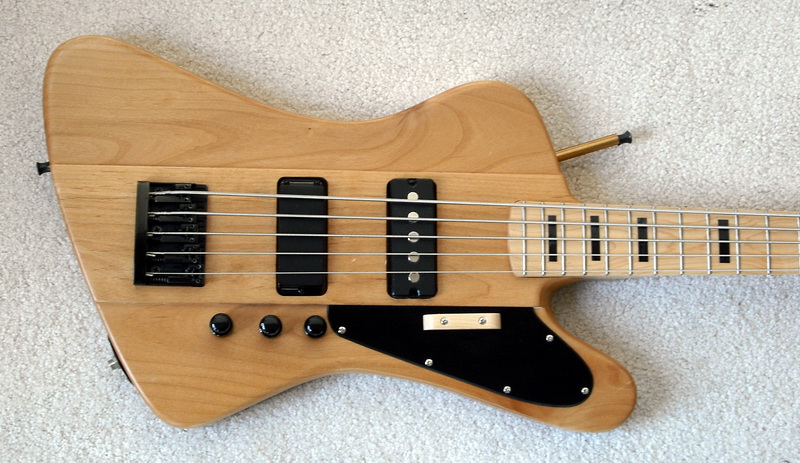
Go play a t-bird with a strap and you will find out. Every time you let go of the neck it takes a dive to the floor.
My solution for neck dive pictured below.

I have an Epiphone EB-3 (SG Style), and although I like the bass, I never played it because of it's major Neck Dive issue. However, having a bit of an engineer's brain, I got to thinking about how I could fix this issue. My Bass had a through neck with the strap button right behind it. I just designed a bracket made out of aluminum that attached through the strap button hole,and I drilled on other hole. (see photos). The bracket extends the location of the strap button forward and up so that it not only changes the balance (eliminated the neck dive issue) but also is not in the way of my left fretting hand. I'm actually considering making\marketing these as a fix for this issue.
Link Removed


Link Removed
Attachments



The trick I learned was to get some sticky motorcycle wheel weights and stick them in the back control cavity. Works wonders for balancing and doesn't permanently alter the guitar/bass as they can be removed with no issue.


 It depends on who you ask. Some people think that any bass that won't stay exactly where you put it - regardless of how you move or jump around - is neck heavy. And, for them, I suppose it is. Some people think that a bass that likes a position that they don't want it to be in - like hanging parallel to the floor when they want the headstock pointed up - is neck heavy. My Ricks like to do this. Personally, I like them like that. But, again, for those folks, those basses are neck heavy. And, finally, some people think that only a bass whose headstock actually heads for the floor when you take your hands off it, is neck heavy. In this case, there's no getting around it; that bass really is neck heavy. Personally, I'm in this last camp. That first bass - a Kramer 450B - is infamously neck heavy. It's mine; with a grippy strap, it will actually pull my shirttail out of my pants, and try to pull it over my head. I don't use a grippy strap with that bass... And yes, holding up the neck is a pain; but, the tone is worth it... The next one - a Rogue VB-100 - is in the "won't stay where I want it" category. Yes, I have to hold the neck up; but holding up something that weighs about the same as a Snickers candy bar isn't much of a strain - even for an old fart like me. I prefer to think of this kind of bass as "forward biased"... The third bass? That's a headless Kramer Duke. It's actually butt heavy - which took some getting used to...
Last edited:

Neck dive is when your bass is here........
....when you want it here!
This bass,by the way,is not neck heavy.
I had to make it "dive"for the pic.
....when you want it here!
This bass,by the way,is not neck heavy.
I had to make it "dive"for the pic.
Last edited:

Gaolee
Official leathers tester and crash dummy
This thread must be pretty close to a record for resurrections.
There is one that was inactive for seventeen years!This thread must be pretty close to a record for resurrections.


I've seen this video probably 500 times and I still love it! Oh, neck dive. Rogue Basses. Wood neck and very light particle board body. The tend to point directly to China.
Hey gebass6, when this post comes around again in 6 or 7 years, the link to the video will probably be broken. So please re-attach it. I love this clip.

I have a second definition of neck dive, but it would be against forum rules for me to post it here ...
OMG.

If that was a test for dirty minds, I passed.
This thread must be pretty close to a record for resurrections.
New guy sucked us back in. It was worth it.

my peavey fury has the strap button over the 12th front and dives.a lot of times, neck dive is cause by stupid upper strap button placement.
my warwick corvette pro 6 would be my perfect bass if the headstock didn't insist on sniffing my toe jam all the time...
good luthier books will talk about how to design bodies that will balance
EDIT: Sorry, i just had to run outside; a marching band just marched down the street. they march to City Hall every year for the Chili Bowl
when it comes to balance, nothing balances better than my jazz. if you notice, the strap buttin is right up with the 12 fret mark.
i think Melvin Hiscock (or Hercock - i don't remember his name) in his book talks about the simple rule that if you have the upper strap button close to the 12 fret, it will most likely balance well.


