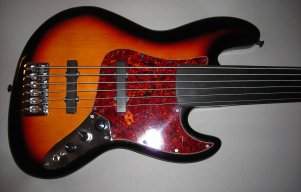
There are so many factors yadda yadda and yes that's true wood is only one of them, and certainly not the biggest one. I've found that with whatever electronics, pickup placement, pickguard color etc. I can get the sound 90% there with any wood, but whenever I hear 100% gasm tone it's a bass made of a few favorite woods.
Having said that many of my favorite sounding basses have had maple bodies. A Peavey T-40 and various Rickenbackers. Spector Euro also sounds great, it has an Alder/Walnut body (with whatever top wood) and a rock maple neck.
What do all these have in common? A really dense hard wood that won't soak up the vibrations like a sponge. Maple, and Walnut. I surmise that the highs and high mids get soaked up more easily by softer woods. This is also borne out if you listen to some Aluminum basses. They are very present (too present?) in the high-mids and highs.
I read a post earlier in the thread saying Fodera luthier in the early days would hang body & neck blanks and ping them with a marimba hammer. If they didn't ring for 15 seconds he wouldn't use them. Well, when it rings that means it isn't soaking up the vibrations. So I think the idea about soft woods losing tone definition (or sounding "warmer", if you prefer that tone goal) is somewhat evidenced.
So what do I like about them, tone-goal wise? Tight strong low mids between 150-250Hz, a little scoop around 400-500Hz, and a tough high-mid "nose" to carry the dirt around 600-1000Hz. Anything above that just emphasizes fret noise and how much my technique sucks

Does the "nose" get lost behind the guitars? Yes, most of the time. That's why the tight low-mids are necessary to provide balls most of the time. When there's space for a fill or a little solo, the dirty nose gets heard. Actually even when the high-mids get lost behind the guitar the dirt on them implements some band-specific compression that helps things sound smoother and fatter in a non-obvious way so it's all good.
What I've found is I can EQ for this all day long but the maple basses respond to it like a sportscar, and the mahogany/agathis/so-called "warm" sounding woods respond like a school bus. They don't quite get all the way there no matter how hard I try.
Mahogany is great, it works very well for softer music, but when I want the audience to fear my bass, I keep coming back to the hardwoods.