• TalkBass has been independent since 1998. Add your voice.
    Create a free account to reply to discussions, view embedded media, and browse with fewer display ads.
    Join freeLog in
    Want zero display ads or expanded classifieds tools? Compare plans.

What is your preferred 5 string configuration? (Pickup Config, Active/Passive, Scale length, Bolt on/Through neck, String Spacing, type and gauges)

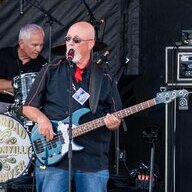
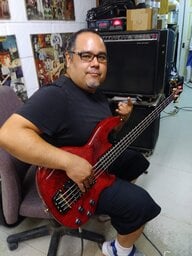
I like Music Man basses, it's a 34 inch scale, I like the narrow neck, like the active electronics. I sometimes find myself playing octaves at the 3rd and 5th fretts with my middle and pinky fingers, also I do a long stretch from the E string to G string on one song so the 34 inch scale is good. I do a lot of singing in a duo now so I need something that is playable while I focus on singing. I also play some unison octaves to fill during guitar solos. I usually set the bass EQ at the same spot on the bass and adjust the amp or pedals as necessary. I tweak the mid and treble a bit, sometimes adjusting them to the song. Mostly using the Rotosound Swing Bass with 130 B. Lighter gauge strings work fine, but you get a little more solid tone with the heavier gauge.
20241021_201911.jpg
 
  • Like
Reactions: Moving Pictures
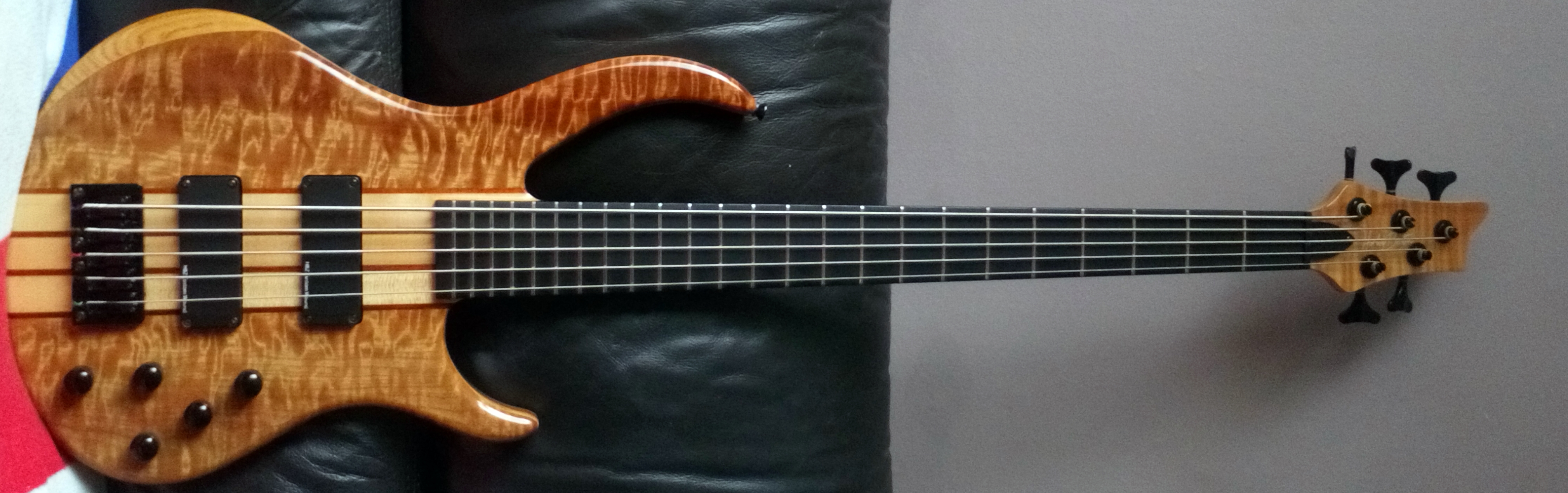
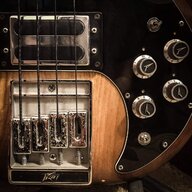
I've played fives since the late 80's, owned more than a few, and while I can't recommend a brand, I can tell you what I found works , , , for me. This is totally One Man's Opinion from close to 40-odd years experience, Utterly subjective and opinionated.

I prefer 24 frets on a neckthrough instrument. I like having the extra maneuvering room 'up there', and with a neck through, playing 'up there' gets a lot easier:

First, there's no $^*$*@#&*!~~~!~!!!! neck block for the screws on Fender-Shaped-Objects. I HATE those. With a neck through, you have a very smooth transition into the body on the backside.

And Second, there's always a much deeper cutaway on the treble side which helps as well. One of my pet gimmicks is to zoom up there and double a vocal line or lead lick, and that layout makes doing that a breeze. I also love playing bass with acoustic guitars in a no drums setup, and if I need to be an octave up to complement them better, again, much easier to do that. I don't want the bass' backside in my way.

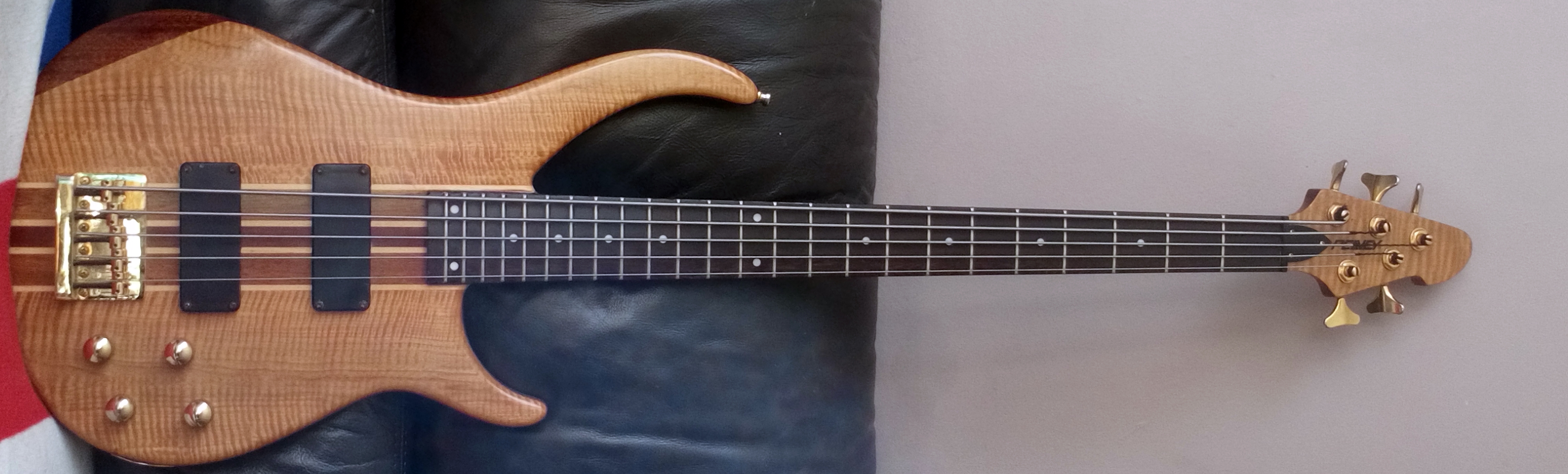
For that neck through axe, I prefer harder/stiffer woods than softer ones: In my experience this helps focus and tighten up the notes, especially in the deep end on the E and B. So timbers like maple, ash, ebony fingerboards, these sorts of hardwoods worked better for me. My first was a Peavey Dyna Bass Five, and that poplar body did me no favors, believe me. The Yamahas were alder which was fine as well. I prefer ebony fingerboards for their hardness and strength, it's like having the fingerboard do the work of stiffening rods. The Alembics ran full 1/4" ebony boards and let's just say the necks were very well behaved. As long as I'm south of 10 lbs. I'm good. String spacing like a Precision is fine. And a flatter than rounder neck profile.

I prefer sealed keys, and a good bridge and Dunlop strap locks. String through the back is a non-starter for me, I don't need one more way to buy the wrong (2 short) strings, and I don't feel much difference to top load.

I prefer active pickups (the real low-impedance ones like EMG or Alembic) and active tone, though bass and treble is enough, I don't need mids. And ALWAYS a balancer instead of individual volumes: I prefer to set the blend then raise or lower output on one knob not two. I'm a big EMG fanboy, I could run them on any and everything I own and be tickled. Great tone, and quiet as a granite block, I HATE electronic noise.

I'm not a big fan of active-electronics-with-a-bypass-switch: These are high-impedance pickups hooked up to a powered tone network. Done right (like the 7-series Yamaha BB's), they're pretty transparent. Poorly considered, you take noisy pickups and amp up the noise. Nope. And I'm not worried about having an EMERGENCY switch to go passive.

9v batteries are NO BIG DEAL. I always changed mine every 4th of July and at Christmas, they were never a problem, and you always take a spare with you. Nothing to it.

I have yet to try a 35" that I could say with no reservations felt and sounded better than a 34" five. I stick with 34" as it offers the most choice for strings.
The 'floppy' B-string is a result of the physics involved to cram that pitch into that scale length, so it is what it is. Do some basses or strings feel 'tighter'?
Sometimes, but never in my experience, again, enough to make me think THAT's the one I got to play. I made my peace with the B-string years ago, and I just play it along with the other four.

I have yet to play a fanned fret instrument, and can see where this could be a great idea, but no experience yet. Yes, strings on a piano harp are different lengths (longer as you go deeper) and is the standard. Does it work on a bass guitar? I'd love to find out.

These are the things I prefer, and hopefully explained why. These things are utterly personal, so I'd urge you to think what would work for YOU.

PS: I prefer a good, padded gig bag to a hard case for non-traveling, no bus, no truck, work.
Very detailed - sounds like an Alembic - again? :D

Single Cut
Neck Through with compound wood sandwich
35" scale
19mm string spacing
Soapbar Quad coil with switching options like Barts or Delano - Better yet EMG TW low impedance
Active Filter pre-amp Lusihand et al plus a passive tone option i.e progressive hi-cut with a useable wide Q
Ebony fretboard
Hipshot Ultralites
Resonance vs Weight on the body. Natural amd stain only

I do not have such a bass but the specs are spread to some of my basses
 
I'm in the market for a 5 string. People seem to be pickier about 5 string basses due to the low B. There's a lot of discussion about what makes it pop and I'd like you're opinions on the specifics.

What is you're preferred 5 string configuration and why? (Pickup Config, Active/Passive, Scale length, Bolt on/Through neck, String Spacing, type and gauges, Etc.)

String spacing 1st, then neck thickness.. then everything else. (tho I prefer 2 Pickups over 1).
(Why Yes, I do play IBANEZ 5 strings). :bassist:
:thumbsup:

T$
 
I'm in the market for a 5 string. People seem to be pickier about 5 string basses due to the low B. There's a lot of discussion about what makes it pop and I'd like you're opinions on the specifics.

What is you're preferred 5 string configuration and why? (Pickup Config, Active/Passive, Scale length, Bolt on/Through neck, String Spacing, type and gauges, Etc.)
P/J pickups, Active/Passive set-up, 32" scale, Bolt-on and prefer lighter gauge strings.
 
I'm in the market for a 5 string. People seem to be pickier about 5 string basses due to the low B. There's a lot of discussion about what makes it pop and I'd like you're opinions on the specifics.

What is you're preferred 5 string configuration and why? (Pickup Config, Active/Passive, Scale length, Bolt on/Through neck, String Spacing, type and gauges, Etc.)
I had 2006 MIG Warwick STD Active 5 string. Very well made , neck was rock solid and played very well. Had the stock MEC P/Us, and VBT controls. The bridge, while more complicated than say a stock Fender bridge, it an allows for a lot of flexibility with string spacing. It has a separate tail piece. It's a great series of basses with current street values in the $800-$1,000 range. new the retailed for over $2,000.

I recently bought a Fender AM Pro V passive with VVT controls, to be used mainly for recording. To me it's not as comfortable to play as the Warwick, but on the "tape" it has "the voice" in spades!! Nicely made, nice finish. This was a return at GC used gear in pristine condition, came with an ATA case and got it for a twitch under $1,800.
 
I have zero plans to buy anymore 5 strings. I have two and both are Fender Jazz basses. My first 5-string was this MIM Deluxe Active Jazz V. It's meh...at least to me.

View attachment 7066457

I never could get that one to sound like I felt a Jazz should sound like. I think it is the pickups, possibly the preamp. I want to put some single coils in it and see if that helps it out.

I got this Am Pro II a few years ago and LOVE it. It fills my 5-string desire perfectly and I see no reason to do anything different with it.
View attachment 7066458
I bought an AM PRO just like yours a couple of month ago. Awesome instrument.
 
  • Like
Reactions: JC BASS 91
How picky are you about the split coil. I find it's a weird subject with 5s because the coils are frequently asymmetrical unless you you're paying attention and find one with symmetrical coils but only two pole pieces on the bass end. Not to mention reverse P or standard configuration.
I guess I am fortunate in that I am just not that particular. As long as the thing sounds like a P bass and plays like a P bass, I do not car about how the pikcup is split. I've never felt the need to have a reverse P pickup before. A standard P works well enough that most changes to it appear more as marketing hype than improvements for the most part.
 
There is either more variation amongst basses with more than 4 strings or players seem more concerned with these spec difference. I haven't done the looking to know which it is and I haven't owned or played a 4 string in quite a long time.

For me, my preferences are:

Passive humcancelling pickups
Active electronics (minimum of a buffer onboard)
33" or shorter scale
Bolt-on or neck through doesn't matter, fret access is important to me
16.5 to 17.5 mm string spacing works
I like nickel-plated roundwounds and I've played a number of them that I live. DR Pure Blues are my current favourite.
 
Harley Benton BZ-5000 NT
53251300563_36a80498b4_o.jpg

I have the six string version of this Harley Benton. Had been considering buying the five as well but it feels weird to basically buy two of the same bass even if they have different pickups. Plus, the only complaint I have with the six is that the neck is too this back to front. I deal with it and love the thing otherwise but I worry it'll be the same on the five
 
Last edited:
I currently have two fives, a G&L USA M-2500 and a Sandberg TT-5 Superlight (J bass). They're both fantastic, and even though they're quite different beasts, they share some traits that I want in fives.

1. Bolt-on, 34" scale, like all my basses have been. I just don't feel as comfortable on 35" scale.

2. String spacing tighter than 19mm. The Sandberg is adjustable, while the G&L is fixed at around 17.5mm. I like the narrow spacing because I play mostly with a pick and almost never slap. It's also easier on my fretting hand.

3. Relatively flat fretboards of 12" radius on the G&L and 14" on the Sandberg. I prefer flatter fretboards generally, but this is essential on fives for less of a "hump" to reach over to access the E and B strings. I've owned two J5s with 9.5" radius fretboards, and I didn't like them.

4. Rigid necks. I think neck rigidity is important generally, but even more with fives due to the extra string tension. The G&L has a quartersawn neck that is incredibly great, and the Sandberg's is excellent too. I've had some fives that couldn't hold a good setup, and I think a lack of neck rigidity contributed to this.

5. Two pickups. I think a bridge pickup is helpful for definition on the B string. This is largely why I chose a J as my first five instead of a P. (I still want a five string P, but with a reverse pickup.)

6. Active electronics. I normally prefer passive, but active works well on fives, partly because, at least in my experience, fives are useful in circumstances in which active electronics are also useful, like musical theater. Plus, if the B string is boomy, it's nice to have a bass cut. The Sandberg is ideal: active/passive operation with a passive tone control.

7. Lightweight tuners. Again, this is good generally, but with the extra tuner it's more important on fives. My Sandberg's tuners are incredibly light.
 
I've only just dabbled into 5 string world, with a squier Dimension V in crimson red/maple neck & board. Upgrading the hardware from chrome to black (replaced the fender high mass 19mm spaced bridge for a wilkinson bent plate/brass saddle 18mm spaced bridge), & honestly looks better/less "cheap". Neck is comfortable, although still getting used to it having been a 4 string exclusive my whole playing life since young. & Mine is strung with GHS high C set 30-100, as i didn't find myself in creative mode with the Low B string. However I will say, if i were to design my own 5 string bass, it'd probably be spec'd as:

- 3 + 2 headstock type. I don't dislike the 4 + 1, but just feels larger than needed.
- Dual Humbucker type pickup, perhaps capable of split coil option. Preferably Blades instead of pole pieces for evenness.
- Active 2 band EQ (spector type), or Wal Filter preamp. Depending on the pickups, if they perform passive, i'd have an active/passive switch. Or a simple on/off to kill signal thus saving battery power. Would run 18V for more clean headroom.
- 34" works for me given i use a High C, but if i were a low B player, maybe 35" for the tension.
- Bolt on for ease of set up/working on if need be. As long as the neck & body are firmly secured, would probably do like Yamaha's 6 bolt where two are set on an anchor angle.
 
having owned Ibanez SR905, Fender American Deluxe JBV, EBMM SR5, LAKLAND 55-94, LAKLAND SL 55-94 (made in Japan), LAKLAND 55-02, LAKLAND Dual ChiSonic 5 passive fretless, LAKLAND LOG LE II 55-64 (retrofitted at LAKLAND with a bridge J and stacked VT/VT knobs), Edwards by ESP E-T-170BD (Japanese inner market clone of the LAKLAND Tetsuya signature), Sire V3, Sire V5, I denfinitely prefer:

- ash/maple combo;
- passive pickups, 3EQ active pre with a passive mode;
- MME/J or MME/MME switchable to 'linear jazz / humbucker' modes;
- 35" scale (the only exclusion so far being, quite unexpectedly, the 34" Sires). I also adore the balanced sound throughiut the strings of fanned Dingwalls, but can't cope with them playing;
- I found that neck construction is really not an issue, it is up to the overall construsction and build quality. My neck-through 24-fret Ibanez SR had a worse upper fret access and a worse sustain than my 22-fret bolt-on Laklands;
- string spacing - definitely larger than the 16mm I hd on the Ibanez and Fender. 19mm is fine, somewhere in between would be perfect I guess;
- strings - rounds. Preferred material - steel, stainless steel. Whatever excess highs there may appear, it is easier to cut them when necessary than to add unexisting highs, especially on passives;
- gauges - 40-45 to 125-135, it depends. Definitely not high tension like Elixirs (BTW, I hated their constanty flaking off coating as well when playing with a pick. Looks like dandruff on your bass! and - what's the point paying extra for the coating that flakes away?). EB Slinky is fine, LAKLAND (arguably wound by GHS) is pretty good. DR HiBeams - perfect.
 
IMO a good 5 string bass isn't defined by the scale, number or placement of pickups, pre amp or string spacing.

I have passive, active, 34, 35, flats and rounds and they all sound great.

The quality of the components and materials makes or breaks a 5 string for me. So cheap pickups and electrics, soft or non resonant wood and poor materials are not going to get you a good sounding 5er.
 
  • Like
Reactions: Moving Pictures