
Enjoy the benefits of a premium membership!
Upgrade Account
-
TalkBass has been independent since 1998. Add your voice.
Create a free account to reply to discussions, view embedded media, and browse with fewer display ads.
Join free Log in
Want zero display ads or expanded classifieds tools? Compare plans.
You are using an out of date browser. It may not display this or other websites correctly.
You should upgrade or use an alternative browser.
You should upgrade or use an alternative browser.
What Microphone for bass cab recording?
- Thread starter 0260n25
- Start date
More options
Who Replied?


Ribbon mics can be cool if the room sounds great, but be careful with the mic placement. Many ribbon can be blown by blasts of air.
I will admit that one of the best bass sounds I ever got in the studio was achieved with a vintage RCA BX44 ribbon mic on a late 1960s Ampeg flip-top amp ...but holy crap did we have to be ultra-careful managing levels into that mic, and the assistant engineer was handling it with kid gloves and protecting it like a helicopter parent at an after-school playdate.

I agree, as most of the time the DI is the meat of the bass sound in a mix, with the amp channel just there for a little color, amp sim plug-ins can work great, and simply hassle-free, super flexible, etc. They're certainly used on many "big" major label-type recordings these days, heck, probably by now at least as much as an actual amp track, it's just so easy. But if the amp sound is gonna be more prominent, man, sure is cool to mic the real thing. I just did a session where we used my GK rig instead of the B15 the studio had, set to a rather clean setting, not even for grind, and in the mix it ended up working as the dominant part of the bass sound, over the DI. Even clean it had that "thing" that a modeler still doesn't get you to (which some people would call "soundstage").Sims can be good enough if not too forward in the mix IMO, but the stuff I’ve tried in Ableton and Logic doesn’t pass the test when soloing, IME.
Sim FX like verb, chorus, and flanger I think work well, but overdrive, distortion, and saturation are lackluster IMO.
For bass I use external DI and dirt, no cab micing, daw EQ and comp.
For me the be all end all of bass cab mics is the venerable U47FET. If you want a lower fidelity mic than the RE20 gets the nod from me with the SM7B following not too far behind.
+1, I got a deal on one of these, and it's incredible:
https://www.sweetwater.com/store/de...et47-large-diaphragm-fet-condenser-microphone
My favorite recorded tone I've gotten was with that mic + an SM57 in one of these:
guitaRF - sE Electronics
Also like the RE20, SM7B, and MD421, but not quite as much
Last edited:

Thank you, everyone for the excellent recommendations! I see a couple in the lists that are consistently recommended and I'll likely try.
The level of consensus here for the EV RE20 is surprisingly high for TB. Probably a reason.
Lately I've been using a WA 47 or a Twinfinity 87.
Earlier in the year I've liked a MD421II, RE320, or SM7B.
I'm kinda liking the MD421II or RE320 best for band mixes.
My typical amp set-up is a PF50t into a 1x10" (VHT bass cab, Rumble speaker).
Lately I sometimes use that little Dark Glass 200 head into a TC 2x8"cab.
I like the mic either right on the grill or a cuppla inches back.
The rigs are about 2' from my recording position, so I'm not playing too loud (~ 85dB onna meter at position).
Earlier in the year I've liked a MD421II, RE320, or SM7B.
I'm kinda liking the MD421II or RE320 best for band mixes.
My typical amp set-up is a PF50t into a 1x10" (VHT bass cab, Rumble speaker).
Lately I sometimes use that little Dark Glass 200 head into a TC 2x8"cab.
I like the mic either right on the grill or a cuppla inches back.
The rigs are about 2' from my recording position, so I'm not playing too loud (~ 85dB onna meter at position).
The level of consensus here for the EV RE20 is surprisingly high for TB. Probably a reason.
must be available in tort.

If you are recording in a bedroom setting, you may not want to go with a dynamic unless you can crank the volume up high. Dynamic mics are not very sensitive and will need a bit of volume. For this kind of application, you don't need particularly expensive microphones. I'd say that a good microphone for the purpose, if you really want to spend, is something like an sE 4400a. It's easily studio-grade, will come in handy on a wide variety of sources and its relatively flat response and variety of pickup patterns (cardioid, figure-8 and omni, if I'm not mistaken) makes it very handy. (An omni microphone placed very near the source and possibly with a baffle behind it can yield a very nice, uncoloured response). Keep in mind that with cardioid (and, increasingly, hypercardioid and figure-8) pickup patterns you have what's called a proximity effect, basically an emphasis of the lower frequencies the closer you get to the source. The RE20 is designed to avoid it (sort of) if you decide to go with a dynamic. A bit of proximity effect is not bad, but if you are dead set on capturing the tone of your cabinet and you also capture the DI tone you might want to avoid it.
Also "what are your tonal aspirations". If you want vintage sounds you can use an SM-57 as long as you aren't within the proximity bass boost distance (although when I started playing in the 90s, no one cared). And although it's not considered standard, an SM-58 also works.1st step. What is your budget?
In general, I suggest avoiding bass drum specific mics as they have a strong built in EQ curve. I
Before buying a mic, I suggest trying whatever spare dynamic mic you may have access to. Many like a Shure SM57.
Common recommendations in no particular order:
1. Audix D4
2. AKG P2
3. EV RE20
4. Sennheiser MD421
5. Sennheiser MD441
6. Beyerdynamic M88
7. Heil PR40
I'd start with stealing the mics the vocalist or guitarist use and seeing how close that is to the sound you want.
If there's a tweeter involved, welcome to additional complexity.
I've had good results with an SM-57 and a distant Crown (well, RadioShack) PZM as a distant microphone on the floor for ambience and also a PZM on a board and stand as a medium distance mic. Not the standard, but I read of it in one of my books. I also tried the McCartney option of distance micing when I had a house with a roughly 20ft, carpeted corridor and an old Traynor valve amp. It sounded vintage.

I would choose Neumann U47FET as my first choice too. Many may be in second place... AKGD112 for exampleI was going to say U47FET. All the typical dynamic mics have been previously mentioned.
D
I will admit that one of the best bass sounds I ever got in the studio was achieved with a vintage RCA BX44 ribbon mic on a late 1960s Ampeg flip-top amp ...but holy crap did we have to be ultra-careful managing levels into that mic, and the assistant engineer was handling it with kid gloves and protecting it like a helicopter parent at an after-school playdate.
Today I would NEVER use a valuable, vintage ribbon mic on a bass cab! There as lots great sounding, reasonably priced NEW ribbon mics to choose from these days.
I bet it sounded great though! Ribbon mics can be fantastic for that "old school" bass tone. Flip top + BX44 sounds like a fantastic match!

D
To avoid any confusing for anyone without detailed insight into classic mic models, I just want to clarify that the mic you're referring to isn't an actual U47FET.+1, I got a deal on one of these, and it's incredible:
https://www.sweetwater.com/store/de...et47-large-diaphragm-fet-condenser-microphone
My favorite recorded tone I've gotten was with that mic + an SM57 in one of these:
guitaRF - sE Electronics
Also like the RE20, SM7B, and MD421, but not quite as much
This is a U47FET:
https://www.sweetwater.com/store/de...da36e2158dd0dbdffd&_index=production_products
Of course there are also lots of used, vintage U47FETs out there, but they are generally even more expensive than Neumann's own "reissue".
The mic you're referring to is of course a U47FET clone. I've never tried it myself. I've heard good things about it though, and I'm sure it's a great mic, but a real U47FET is in a totally different price range. For most people a real U47FET would be total overkill, and a good clone will be "close enough". But then again, even a good U47FET clone might be overkill for most people. At least if you're only gonna use it to mic a bass cab.
There are several other U47FET clones in different price ranges out there too of course, and also some other large diaphragm condensers that aren't specifically U47FET clones but can, at least to some extent, do "the U47FET thing" in a pinch.
Last edited:
D
I think it's worth mentioning that these two mics are VERY different sounding! If the U47FET was my first choice, I could probably name 100 mics that would be tonally closer than the D112 (and vice versa).I would choose Neumann U47FET as my first choice too. Many may be in second place... AKGD112 for example
The baked-in, mid-scooped character of the D112 can definitely work for bass cabs with SOME styles of music, but it's a very poor allrounder. It's not a mic I would recommend for bass cabs unless someone are specifically looking for that kinda tone. And in my experience, most bass players aren't.
After mentioning Neumann (as a higher price range), I wanted to mention some of the cheaper options as well.I think it's worth mentioning that these two mics are VERY different sounding! If the U47FET was my first choice, I could probably name 100 mics that would be tonally closer than the D112 (and vice versa).
The baked-in, mid-scooped character of the D112 can definitely work for bass cabs with SOME styles of music, but it's a very poor allrounder. It's not a mic I would recommend for bass cabs unless someone are specifically looking for that kinda tone. And in my experience, most bass players aren't.
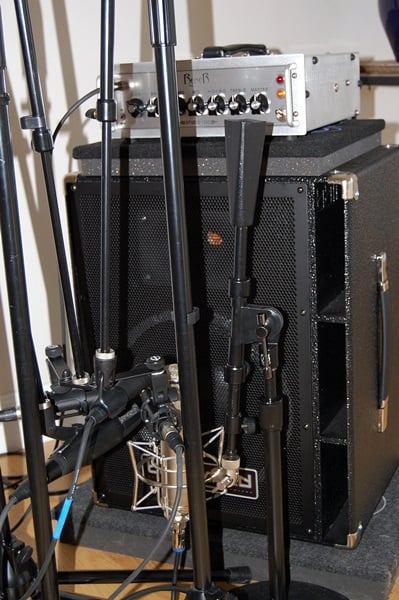
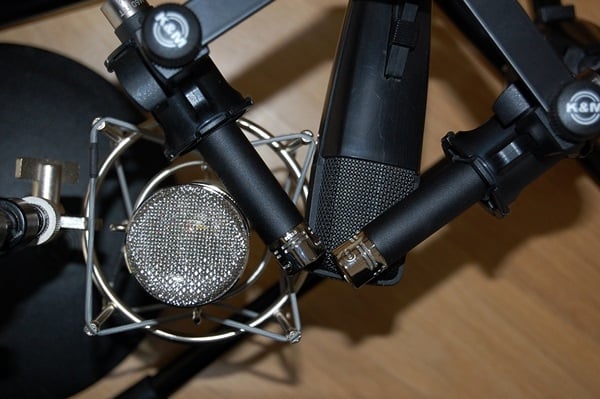
It's not just the mic selection -- placement is also important, and one mic may perform better than another depending on how close or far it is from the cab. Room acoustics are also a factor. If you want to dive down this rabbit hole (like I did!), you might try borrowing or renting different mics and trying combinations until you discover what you like. Frankly, after all is said and done, you're probably good to go with a DI.
D
It's not just the mic selection -- placement is also important, and one mic may perform better than another depending on how close or far it is from the cab. Room acoustics are also a factor. If you want to dive down this rabbit hole (like I did!), you might try borrowing or renting different mics and trying combinations until you discover what you like. Frankly, after all is said and done, you're probably good to go with a DI.
View attachment 7295132
View attachment 7295133
Good post! The mic placement is EXTREMELY important, and so is the room. If the room isn't great I would definitely go with a dynamic mic, as these tend to me more forgiving in this respect.
If you don't have nice sounding room, an ISO cab can actually work great. I honestly didn't think an ISO cab would work with bass at all until I tried it, but I've made some of my best bass recordings using an ISO cab. Of course, finding the right bass speaker element for an ISO cab is a rabbit hole of it's own... I had a couple of misfires before I found one that worked nicely in such a small box.
And yeah, you're not wrong about DI either. A clean DI is often all I use for recording. When I use an amp it's usually combined with a DI, with the mic'ed amp signal severely high-passed (to avoid phase issues in the lows) and mostly used to add some mid presence, where a DI alone can sometimes be a bit lacking.
Then again, sometimes the song calls for the tone you can only get with a mic'ed amp. But it needs to be a GOOD amp, or it's not really worth the hassle over a DI in my opinion.
Last edited:

Sexy!Not concerned with price then it would have to be the Telefunken U47 Tube Condenser Mic.
View attachment 7295188


