• TalkBass has been independent since 1998. Add your voice.
    Create a free account to reply to discussions, view embedded media, and browse with fewer display ads.
    Join freeLog in
    Want zero display ads or expanded classifieds tools? Compare plans.

What would you call this chord?

Apr 18, 2015
3,142
3,500
65
I'm not sure what to call this chord. On a guitar it is essentially the E major chord slid down one fret. The low E and high B and E don't change from an E major, but the B, E and G# slide up a minor second. Should the B have gone up to a C I could have called it a F maj7 4th inversion. But what would you call this...

We have ACE, for Am, with a 2nd (B) and F, the sixth. Would this be an Am6 sus2 2nd inversion?
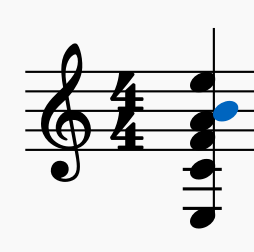

upload_2022-11-16_8-49-3.png
 
I'm not sure what to call this chord. On a guitar it is essentially the E major chord slid down one fret. The low E and high B and E don't change from an E major, but the B, E and G# slide up a minor second. Should the B have gone up to a C I could have called it a F maj7 4th inversion. But what would you call this...

We have ACE, for Am, with a 2nd (B) and F, the sixth. Would this be an Am6 sus2 2nd inversion?


View attachment 4875476
With two Es in the chord on top and bottom, yes, that's where I'd lean, but only if the suspension resolves in the next chord. It's all about the progression: what chord preceded it and what comes next? How does it function in the key?
 
I'm not sure what to call this chord. On a guitar it is essentially the E major chord slid down one fret. The low E and high B and E don't change from an E major, but the B, E and G# slide up a minor second. Should the B have gone up to a C I could have called it a F maj7 4th inversion. But what would you call this...

We have ACE, for Am, with a 2nd (B) and F, the sixth. Would this be an Am6 sus2 2nd inversion?


View attachment 4875476
No, I wouldn't say so. First, it can't be any kind of Am6, because that would require F#, not F natural. Second, "sus2" has no meaning here, because the actual 3rd of the Am triad is present; you only use sus2 or sus4 when those tones are standing in for the 3rd.

I'd be more likely to call it an Fmaj7#11/E. Analytically, you could call that 4th inversion, but if you're writing a chart, no one needs you to specify the inversion, just the bass note, and use of the slash is great for that. Some people I know would just say "E phrygian" and call it a day.

(And that would be slid UP a fret from E, not down. Guitarists think of moving to higher pitches as going up the neck, even if it's down as visualized in relation to the floor.)
 
Last edited:
I just pulled up the lead sheet for the music and interestingly it goes from Emaj to F/E (F with E in bass). But that's now how we're playing it. The first chord is Emaj, but then slid up to the second fret without changing any fingerings, leaving the E, B and E still open. On the second chord the guitars are playing ECFABE. On bass I slide down to the F, but then the second chord goes back to Emaj. I suppose the guitars could play a straight Fmaj and leave the low E open or even do an Fmaj7. I'm just trying to figure out how to notate what is actually being played. The old school theory from 45 years ago is so different than even when my daughter took music theory in the early 2000's.
 
I just pulled up the lead sheet for the music and interestingly it goes from Emaj to F/E (F with E in bass). But that's now how we're playing it. The first chord is Emaj, but then slid up to the second fret without changing any fingerings, leaving the E, B and E still open. On the second chord the guitars are playing ECFABE. On bass I slide down to the F, but then the second chord goes back to Emaj. I suppose the guitars could play a straight Fmaj and leave the low E open or even do an Fmaj7. I'm just trying to figure out how to notate what is actually being played. The old school theory from 45 years ago is so different than even when my daughter took music theory in the early 2000's.
I think the clearest way to write it is what I just said. Alternatively, you could just (a) write out the exact notes, as you did in the OP, or (b) pick up a guitar and show them the chord.
 
  • Like
Reactions: TigerInATrance
I just pulled up the lead sheet for the music and interestingly it goes from Emaj to F/E (F with E in bass). But that's now how we're playing it. The first chord is Emaj, but then slid up to the second fret without changing any fingerings, leaving the E, B and E still open. On the second chord the guitars are playing ECFABE. On bass I slide down to the F, but then the second chord goes back to Emaj. I suppose the guitars could play a straight Fmaj and leave the low E open or even do an Fmaj7. I'm just trying to figure out how to notate what is actually being played. The old school theory from 45 years ago is so different than even when my daughter took music theory in the early 2000's.
The only way to notate “what is actually being played” is with a staff notation (in your initial post) or a fretboard diagram. If you name it, e.g. Fmaj7#11/E, that indicates the notes, but doesn’t give the order of the pitches beyond the fact that E is the low note.

The other question I have is, in the song, should you be letting the two high strings ring or should they be muted somehow. Ringing creates a very Flamenco sound to me.
 
  • Like
Reactions: Bob_Ross
That is an E Phrygian chord, which in this case is a G7 with a 9 and 13 over an E bass note. You could write it as G13/E.
You could indeed call it an E phryg if you wanted, but I don't think G13/E really works, for a couple of reasons. (1) That nomenclature doesn't explain why there's a C (and why it's voiced where it is), and (2) it doesn't explain why there's no G (and why it would be meaningful in this instance to call something a G chord that has no G). I think that if you told a guitarist G13/E, they'd be very unlikely ever to come up with that chord. I'd still say that something like Fmaj7#11/E, or maybe F lyd/E, works better to explain what's going on here. Especially since the center of the chord is simply an E triad moving up to an F triad.
 
I'd call that chord stupid. It's an Emaj7 but with the BASS note being an extra maj7, which OBLITERATES the entire structure and function of that tone in forming that chord.

PSA: In chord construction, you can't just stick any old note of the chord in any voice, like way too many people think. PLACEMENT matters, ESPECIALLY with the lowest tone. SMH...
 
F lyd/E is what I would call this to play it on keys and understand it better on my own, in so doing I would probably omit the A note in the middle there or voice it an octave lower on the left hand to avoid it rubbing with the B.

For guitarists, I would probably ask to play F Lyd or Fmaj7 and have them mute the low e, then play that low E note on bass.
 
what chord preceded it and what comes next?

This is the most important consideration IMHO
When chords get ambiguous ( i.e. no neatly stacked thirds) my first impulse is to understand what they are doing in context. "weird" chords often show up sandwiched between more vanilla chords with oblivious functions , and generally exist for the purpose of voice leading.

ECFABE without context gives us no hint as to voice leading.

“Just play the bottom note.”
The other most important consideration. if this notation was handed to me I would play what was written as the bass note, the composers clear intent.
 
  • Like
Reactions: MonetBass
Hi, slightly different point of view - trying to analyse this chord in the framework of functional harmonic analysis is possible, but does not reflect what's happening here. Effectively it is an instrument specific technique where you slide part of the chord shape up keeping open strings as they were. This chord happens e.g. in spanish guitar music of the malaguena type. (Just saw the post above: The Flamenco Chord. Nailed it :)) I would simply call it a cluster chord, or, if at all necessary F/E (The B would then be a tritone from the F (#4 or b5), in close proximity - a lot of tension, with the high E a major 7th) So if really pushed to do so Fmaj7add#11/E, but it feels awfully contrived.
 
  • Like
Reactions: bassGtar and fig
I'd call that chord stupid. It's an Emaj7 but with the BASS note being an extra maj7, which OBLITERATES the entire structure and function of that tone in forming that chord.

PSA: In chord construction, you can't just stick any old note of the chord in any voice, like way too many people think. PLACEMENT matters, ESPECIALLY with the lowest tone. SMH...

Luckily, music theory is descriptive and not prescriptive.

Function is something a chord has in a context, not an intrinsic property of that chord. If it doesn't fulfil the function you expect a maj7 chord to have, it's because it doesn't have that function in that particular concept. The fact is, people have been sticking any old note in any voice since forever, and some voicings work better than others for certain contexts, but not in all of them.
This particular voicing of an Fmaj7#11/E is THE flamenco chord. It works perfectly and is not by any means stupid in that context. And it can function just as good in any musical style that calls for that distinctive harmonical flavor.
 

Latest posts