
Enjoy the benefits of a premium membership!
Upgrade Account
-
TalkBass has been independent since 1998. Add your voice.
Create a free account to reply to discussions, view embedded media, and browse with fewer display ads.
Join free Log in
Want zero display ads or expanded classifieds tools? Compare plans.
You are using an out of date browser. It may not display this or other websites correctly.
You should upgrade or use an alternative browser.
You should upgrade or use an alternative browser.
What would you call this chord?
- Thread starter vindibona1
- Start date
More options
Who Replied?
You could indeed call it an E phryg if you wanted, but I don't think G13/E really works, for a couple of reasons. (1) That nomenclature doesn't explain why there's a C (and why it's voiced where it is), and (2) it doesn't explain why there's no G (and why it would be meaningful in this instance to call something a G chord that has no G). I think that if you told a guitarist G13/E, they'd be very unlikely ever to come up with that chord. I'd still say that something like Fmaj7#11/E, or maybe F lyd/E, works better to explain what's going on here. Especially since the center of the chord is simply an E triad moving up to an F triad.
G doesn't need to be played. Everything around it is implying it. Chordal instruments constantly omit root notes. You could omit the G or play it in the voicing, it doesn't change the function of the chord. Which, by the way, is a dominant chord. You would use this chord in II-V reharms, which gets you into McCoy Tyner comping territory. Calling it some kind of Maj7 chord is misleading because of how the chord actually functions.
Oh, and this isn't a guitar chord, at all. There's no good way, as far as I can tell, to voice this chord on guitar and get all the tensions that are written. You can simplify, though, by omitting the higher 13, or even omitting the 9. The chord, as voiced, is really a piano chord. But, if a guitarist doesn't come up with these notes when he sees this chord symbol, regardless if there exists a playable voicing on the guitar, he just hasn't studied enough harmony to understand what's being conveyed.
By the way this is literally the chord voicing that is discussed in Mark Levine's "The Jazz Piano Book" in the chapter on sus and phrygian chords. It's on page 25 and then a harmonic context is discussed on page 26. The voicing looked so familiar that I went to the book and looked it up, and yep, there it was. Levine gives three chord symbols that could be used for this chord: Esusb9, E Phryg, and G7/E. I used G13/E because I felt it was a little more complete, because there is a 9 present, and the 13 is repeated in the upper structure. Chord symbols also have to be easy to quickly interpret, and everyone can play a G7 chord and throw an E in the bass real fast, and get the sound that is prescribed.
EDIT: I completely forgot about the C. That does change things, my apologies for missing that. Let me play with this for a sec.
Edit2: See my next reply, I was incorrect.
Last edited:


I think the Moody Blues predicted, by name, the coming of this chord back in 1968.
Between the eyes and ears there lie
The sounds of color and the light of a sigh
And to hear the sun, what a thing to believe
But it's all around if we could but perceive
To know ultra-violet, infra-red, and x-rays
Beauty to find in so may ways
Six notes of the chord, that's our full scope
But to reach the chord is our life's hope
And to name the chord is important to some
So they give it a word, and the word is OM

Between the eyes and ears there lie
The sounds of color and the light of a sigh
And to hear the sun, what a thing to believe
But it's all around if we could but perceive
To know ultra-violet, infra-red, and x-rays
Beauty to find in so may ways
Six notes of the chord, that's our full scope
But to reach the chord is our life's hope
And to name the chord is important to some
So they give it a word, and the word is OM
Okay, after re-reading Richard Lindsey's post and being reminded that there is a C in the voicing (not sure how I lost track of that), I do agree that it's Fmaj7#11/E. If you get rid of that C, it becomes G13/E.
Sorry, I'm not with you on this. Yes, I know the root can be omitted. But in such cases there's usually the context around it that makes you "hear" the G as if it were there. I don't see any of that with the single chord standing alone. It has no obvious dominant function because we don't know what came before or after. There is simply no way to rely on what the chord is actually doing (an approach I try to follow myself) when we have no idea what it's doing. And your labeling still doesn't account for the C.G doesn't need to be played. Everything around it is implying it. Chordal instruments constantly omit root notes. You could omit the G or play it in the voicing, it doesn't change the function of the chord. Which, by the way, is a dominant chord. You would use this chord in II-V reharms, which gets you into McCoy Tyner comping territory. Calling it some kind of Maj7 chord is misleading because of how the chord actually functions.
Oh, and this isn't a guitar chord, at all. There's no good way, as far as I can tell, to voice this chord on guitar and get all the tensions that are written. You can simplify, though, by omitting the higher 13, or even omitting the 9. The chord, as voiced, is really a piano chord. But, if a guitarist doesn't come up with these notes when he sees this chord symbol, regardless if there exists a playable voicing on the guitar, he just hasn't studied enough harmony to understand what's being conveyed.
By the way this is literally the chord voicing that is discussed in Mark Levine's "The Jazz Piano Book" in the chapter on sus and phrygian chords. It's on page 25 and then a harmonic context is discussed on page 26. The voicing looked so familiar that I went to the book and looked it up, and yep, there it was. Levine gives three chord symbols that could be used for this chord: Esusb9, E Phryg, and G7/E. I used G13/E because I felt it was a little more complete, because there is a 9 present, and the 13 is repeated in the upper structure. Chord symbols also have to be easy to quickly interpret, and everyone can play a G7 chord and throw an E in the bass real fast, and get the sound that is prescribed.
And your statement that this isn't a guitar chord is a real headscratcher. It's dead easy to play on the guitar, and in fact it's the very epitome of a guitar chord! It's a cowboy chord where the fretted notes have each been moved up a fret while the open strings are let ring. It doesn't get any more guitarlike than that. The OP wrote out the notes, and they're easily played: open low E string, A string and D string fretted on the 3rd fret, G string fretted on the second, open B and high E strings.
Totally agreed that chord symbols need to be easy to interpret quickly. Along those lines, I maintain that calling the chord spelled out in the OP a G13/E is very unlikely to get a guitarist to play that spelled-out chord--almost impossible. And no, it's not because of lack of knowledge either (or not necessarily so, anyway), it's because of how chords are usually constructed and played on the guitar.
I guess we just crossed posts! All good. And I agree, the C changes things, and without it the answer(s) would be different, as you say.Okay, after re-reading Richard Lindsey's post and being reminded that there is a C in the voicing (not sure how I lost track of that), I do agree that it's Fmaj7#11/E. If you get rid of that C, it becomes G13/E.
Last edited:
Then why has that chord been used in hundreds if not thousands of musical pieces? Listen to flamenco, or indeed any jazz performance where something like an E phryg is used. The thing is, this chord is used, and has been used, all over the place. You might consider it stupid, but a lot of great musicians don't. Clearly, for them, whatever structure or function the chord has hasn't been obliterated after all. So then, a more proper task for analysis, rather than implying the chord should go away, would be understanding how it's working, no?I'd call that chord stupid. It's an Emaj7 but with the BASS note being an extra maj7, which OBLITERATES the entire structure and function of that tone in forming that chord.
PSA: In chord construction, you can't just stick any old note of the chord in any voice, like way too many people think. PLACEMENT matters, ESPECIALLY with the lowest tone. SMH...
I'd call that chord stupid. It's an Emaj7 but with the BASS note being an extra maj7, which OBLITERATES the entire structure and function of that tone in forming that chord.
PSA: In chord construction, you can't just stick any old note of the chord in any voice, like way too many people think. PLACEMENT matters, ESPECIALLY with the lowest tone. SMH...
To have an Emaj7 you would need a G# and a D#. Neither are present in the voicing.
Those bass players who play some guitar will immediately get this chord. It's a very common device to play an open "E" maj chord and move it around the neck while droning the high B and E strings (and sometimes the low E as well, as in this case with the "flamenco chord"). It gives that droning "bagpipes" effect. I like Richard's assessment of the chord. It's definitely an "F major" type chord over a droning "E" tonality.

I'd still say that something like Fmaj7#11/E
Maybe,
Esus - as E A B notes.
Esus (b6) - E A B C
Esus (b6;b9) - E A B C F
Another example of naming that chord.
From here:
Rumba: A Gateway to Flamenco | Berklee
The following example has only Esus4, b9 without C as b6.
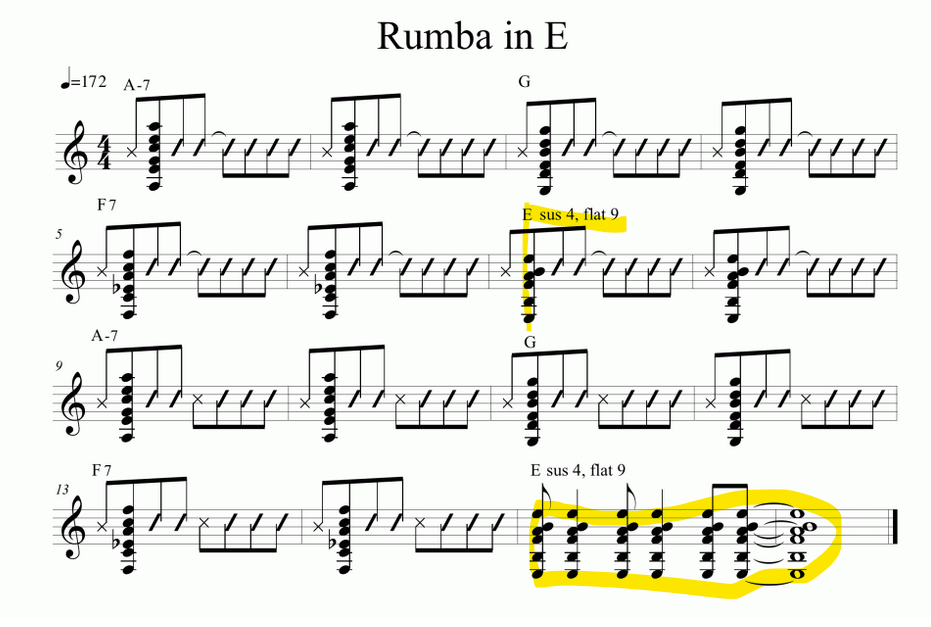
From here:
Rumba: A Gateway to Flamenco | Berklee
The following example has only Esus4, b9 without C as b6.


