For years I recorded bass cabinets with dynamic mikes. Low frequency, not too much demand on the range, and besides I needed to reserve my condensers for sound sources with lots of sparkle, like acoustic guitar, drums, and vocals.
When you think how dominant bass is in so many recordings- almost at the same level as vocal- that implies that attention to bass should be almost as important.
It took me many years of wondering about why my bass sound was uniformly muddy before I changed. I always thought it was a board problem- which I attempted to fix by more eq very low. Or a compressor issue- even more must be better.
I finally sold every dynamic mike I owned- mostly EV 's- 666, 655c, 635a's, RE15, a couple Shures- 546, 545, AKG D200, some old American ribbons. My sound promptly improved by quantum measures when I took the sales proceeds and bought all condensers.
The sound I was looking for was blocked by the loss of transients that dynamic mikes-all dynamics mikes- are simply unable to capture. And when I finally learned about transients, I still thought that transients were primarily a high frequency thing. It took still more time to learn and accept that "punch" is the street name for transient information across the audio spectrum. And bass carries a lot of transients. Further, I was ignoring the fact that while the root tones in bass rarely go above middle A, which is 440 Hz, poor high frequency performance means you don't care about the overtones or, in tech-talk, the harmonics. And there are lotsa harmonics in bass as well as everything else.
The comparative clarity of almost any condenser is what makes them so desirable. That clarity, among other things, is identified by some as transient response, or rise time. That is, the speed and smoothness measured in nanoseconds at which a transducer (microphone in this case) responds to an impulse (spark).
In my altered, re-vamped mode, I first started using an AKG C3000. Pretty good results. Then I went to AKG c414 II, in hyper mode to minimize room ambience. Believe me, if you're getting room sound on your bass channel, you're getting mud.
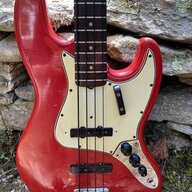
These days, I may use that C414, or more often a Neumann KM185, a hyper for the same reason as the C414. If the track is one I'm playing my 1966 Jazz Bass on and if I'm dubbing in parts after everyone has gone home, I will go through the board either into an A-Designs Catalina pre or a Universal Audio 6176. The A-Designs for SUPER clean, the 6176 if I'm going for tube warmth and want to play with what it will do for sustain. If it's an ensemble session, I'm going through either a G-K head into a Schroeder 1210 cabinet or a Mark bass, and depending what else is going on, possibly going straight in with no bells, whistles, or pre's. Choosing a favorite here is like choosing off the Sports Illustrated swimsuit edition- you can't really go wrong.
There is a reason SM57's and SM58's show up so much on forums everywhere as being used for recording almost everything: they're cheap and durable. I've been around mikes since most of the people who follow this forum were in diapers, and that's the extent of what I can say for them.
Every band has them, usually three or four. Every pawn shop has them. They appear on eBay by the hundreds in every stage of condition and care. It ( and its clones) is no doubt the most used live sound microphone in the world. It's not a great leap to imagine using them when they are as common as roaches in a greasy spoon cafe.
I bought several Neumann KSM105's for the band I play with. It's always fun to watch a sound dude's eyebrows lift when I tell him we'd like to use our mikes. The response is always the same: "you have Neumann's ?"
I never need to ask his opinion.