• TalkBass has been independent since 1998. Add your voice.
    Create a free account to reply to discussions, view embedded media, and browse with fewer display ads.
    Join freeLog in
    Want zero display ads or expanded classifieds tools? Compare plans.

What's driving the shortscale revival?

Most (not all) short scales are narrower. Most are 1 1/2 inch nut width, and also thinner front to back. I don’t know of any short scales with a 1 3/4 inch nut width. And hand size definitely affects how easy it is to span a given number of frets. Hand size has a lot to do with short scales. Reach is important, too, of course, but folks with huge hands are mostly tall as well.

The reason I don’t play short scales is because my fingers get crammed together by everything being smaller. I play faster (and cleaner) on a full scale.

I hear this. On short scales certain passages are easier for me to play than on the long scales, the bass lead in to the Cyrkle's "Turn Down Day" being an example. But I have run into an obstacle I never expected: on such passages my ring finger rides almost on top of the pinkie and is slow to clear when I need to move the pinkie. So for me, what would be the principal benefit of a short scale brings with it a hindrance.
 
Well... assuming the premise is correct, and there actually is a "short scale revival"? I'll have to admit that I have no idea why... I like short scale basses (I have... 8? of them), but with two exceptions, they weren't bought because they were short scale instruments. If, for example, you want a Danelectro Longhorn? Well, sorry; it's gonna be a short scale bass. The only 2 basses I have, simply because they are short scale basses, are the Warmoth Mini-Precision that I had made ("Short Scale Solid Body"), and the Hofner 500/2 Club Bass ("Short Scale Hollow Body"). Most of them fill spots in my herd, where scale length is not a criterion. The aluminum necked, headless Kramer Duke, for example, fills the "Headless Bass" spot; the scale, body type, etc., was immaterial. My basses - long or short scale - simply are what they are...

As for some of the oft-mentioned reasons why short scale basses are so wonderful, and why they are (maybe) having a revival?
-Light. Well, that very much depends on the bass. Yes, some of them are very light; some of them are surprisingly heavy. My Danelectro Longhorn, at 5.1 lbs., is stupid light; lighter than both my violin basses, in fact. My Gretsch Broadkaster, at 8.9 lbs., is... not. It's actually heavier than my Gibson Thunderbird. And, at 7.95 lbs., the Kramer Duke is no featherweight, either. Plus, the fact that the Duke is only about 38" long, makes it seem like it weighs a lot more than it does... So, that short scale bass you're thinking about? It might be light - or, it might not.
-Narrow neck. Again, maybe yes; maybe no. Some of my short scales do have narrow (and thin) necks, and some of them have necks that are among the chunkiest/widest that I own. Being a short scale bass does not guarantee a narrow and/or a thin neck.
-Easy Reach. Yet again, maybe yes; maybe no. I honestly think that this has much more to do with the overall size and shape of the bass than simply the length of the neck. For me, reaching the 1st fret on my Thunderbird is a breeze - compared to trying it on my Broadkaster. And, it's all to do with the size/shape of the whole bass. Being a short scale does not guarantee an easy playing neck.
So, bottom line? A short scale bass might be just the thing for you, but... there's just as many variables in these basses as there are in all other scale basses. "Short scale bass" doesn't guarantee anything - except that long scale strings probably won't fit it (they do fit my Broadkaster, though)...:whistle:
 
Last edited:
  • Like
Reactions: LBS-bass
What's driving the shortscale revival?

- tone
- playability
- less weight
- less neck dive

Every short scale I've tried has more neck dive than my Pbass or Jazz.
Squier Jag SS - dives a bit
1977 Mustang - dives a lot
Gibson SG - dives more than Greg Louganis

I'm sure there are plenty that don't dive but just because it's a short scale doesn't mean the body design is good enough to prevent neck dive.
 
  • Like
Reactions: HelpImaRock
Every short scale I've tried has more neck dive than my Pbass or Jazz.
Squier Jag SS - dives a bit
1977 Mustang - dives a lot
Gibson SG - dives more than Greg Louganis

I'm sure there are plenty that don't dive but just because it's a short scale doesn't mean the body design is good enough to prevent neck dive.

If you take 2 identical bass bodies and put a 30" neck on one and a 34" neck on the other then by the laws of physics the 34" will neck dive more. If you take different basses with different bodies then it is what it is.
 
I built my 8 string bass with a 30" neck. That makes it easier to play.

dscf1183-jpg.jpg
 
While this is true, TB is a relatively small (even with thousands of members) representation of the overall market. Sub-forums even more so. If TB were representative, every church has a bass player with a $3K+ bass, $1,500+ worth of pedals and tube DI's with custom IEM's.

That said, yes, I think there is more talk about short scale instruments and more quality choices of those instruments - for a variety of reasons.
All I can say is that when I worked in a pretty large music store back in the mid '90s, I don't recall ever seeing them stock any short scale basses, nor did I ever recall any guitar department customers or guitar department sales types asking for or talking about them at all. IIRC everything we had in there was standard, and we stocked a fair share of unusual names at the time. There may have been a few of the classics on hand, but by and large I don't remember a lot of interest in anything specifically due to scale. Maybe I'm wrong.

I know that was quite a long time ago, but I think SS must have gained in popularity, at least since those days. When that might have started, I don't know.
 
Last edited:
Interesting comments on whether or not there's actually a "trend" toward short scale basses.

1. Guitar players coming over to learn bass during the pandemic?
2. Weight and size issues?
3. Old farhts with hand/wrist/shoulder issues
4. Easier to wield in a bedroom

I'm also seeing availability of a lot more headless instruments, which solve some weight and size issues.

One more comment while we're doing this. I started as a keyboardist (still doing that), then guitar, then got onto bass just recently with full-size basses. As with a lot of music, however, I've noticed that there's a lot of it NOT using traditional discrete instruments. I recently got hired to work up some bass lines (idiot thought I was actually a bass player, but when they're waving money, it's hard to convince them otherwise if your heart isn't in it). I've really been noticing the bass in Dua Lipa's songs and realized that a lot of it is the producer building bass lines on a keyboard! When I offered up what I'd been doing for the money waver, it was the keyboard bass lines I'd done on a Korg Kronos that he loved. Go figure. Maybe I need a short scale keyboard?
 
As I said earlier in another thread, I have no issues with 34" or 35" basses, but if arthritis comes knocking I'll be ready with a short scale bass.

I guess there are many from my generation who are of the same mind. We're not going to let a little thing like bad finger joints stop us.
 
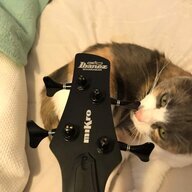
I’ve got a variety of basses (19 total), (2) 30.5 “ scale, (16) 34” and a lone Ibanez Mikro I originally bought for my daughter but I love it-cant believe how big it sounds totally stock.

I just told my bass playing buddy I’ve got a mind to totally trick out this Mikro-Geezer pickups, GOTOH tuners and bridge , etc.
 
  • Like
Reactions: DavidEdenAria
Trends come and go. There was a time when everyone and their mother stripped the finish and put active EMGs in their 1960s Fenders, without a second thought about them no longer being original. That ended real quick.

You're describing the difference being being a player and being an investor.
 
After 35 years drumming, tree throwing, and box throwing, now in brown, my hands had no interest in a full scale bass. I couldn't find a bass player willing to come over as the pandemic waned a little, so I decided the wife could play bass lines on her digital piano so the guitarist and I could jam. To convert bass tabs to notes, I used an old junky Epi on permanent loan. Wanted to learn to play a bit, but the hands just couldn't take the extra work. I knew there are short scales, but didn't know the market at all. I found a Mikro the first time I shopped for a bass, $100 on CR. When my buddy expressed interest in bass three months ago, I brought both to his house, and he ordered his own Mikro the next day. We both are loving learning to play, and I mentioned how cool I though the Squier Jaguar SS is. Next thing you know, he buys one off Reverb. So, I've influenced the sale of three short scales is eight months.
Leo said tremolo, so while 34" may "work" like a Fender tremolo "works", you could say it's just as legitimate.
 
I think as you get older, you gravitate toward smaller lighter basses. Im 59 and i made the jump to shortscales 8 years ago! Imho you need to go for the higher end shortscales if you want great tone and playability. There were several i did not like, the epihone viola & the fender mustang were not for me! Today i have the best stable i have ever had, a gibson SG. a gibson les paul jr. dc, a birdsong short bass & just yesterday i purchased a midscale 32" breedlove acoustic pursuit bass! The only bass i need to round out my stable is a hollowbody!
 
  • Like
Reactions: TN WOODMAN

Latest posts