

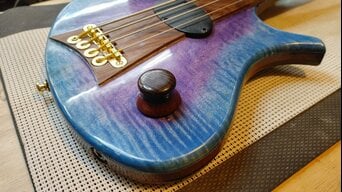
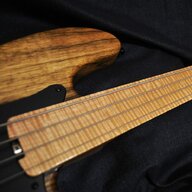
Belly cut is is a full inch deep, as is the forearm contour.
The forearm contour runs from the end of the body to the waist.
Belly contour radius is shallow , pushing it toward the body midline - hugging the player. The deepest radius part of the belly cut is angled from bridge (centerline of body) towards waist (edge of body) so that when the bass is in playing position seated it wraps around the rib cage, while the generous forearm contour allows for less wrist bending .
The rounded edges are @ a 3/4 roundover. Blending these elements while keeping a jazz silhouette was more finicky than I expected it to be.
Lower horn is shortened, and the cut opened and the roundover on the body top is wider, to allow access to the 21 "fret" extension on the fretless bubinga neck this will be mated with.
All hand shaped after roughing on belt sander and spindle.
Thanks to @StereoPlayer allowing me to go the extremes , while still looking traditional at first glance.
The forearm contour runs from the end of the body to the waist.
Belly contour radius is shallow , pushing it toward the body midline - hugging the player. The deepest radius part of the belly cut is angled from bridge (centerline of body) towards waist (edge of body) so that when the bass is in playing position seated it wraps around the rib cage, while the generous forearm contour allows for less wrist bending .
The rounded edges are @ a 3/4 roundover. Blending these elements while keeping a jazz silhouette was more finicky than I expected it to be.
Lower horn is shortened, and the cut opened and the roundover on the body top is wider, to allow access to the 21 "fret" extension on the fretless bubinga neck this will be mated with.
All hand shaped after roughing on belt sander and spindle.
Thanks to @StereoPlayer allowing me to go the extremes , while still looking traditional at first glance.
Last edited:







 Replacing the worn out DMT plates with Shapton Glass Stones.


