• TalkBass has been independent since 1998. Add your voice.
    Create a free account to reply to discussions, view embedded media, and browse with fewer display ads.
    Join freeLog in
    Want zero display ads or expanded classifieds tools? Compare plans.

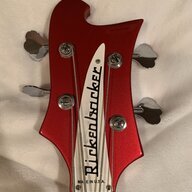
What's so great about the Rickenbacker?

Which one describes your feelings toward the Ric?

  • Greatest bass ever. Superior to all others in every way. The Chuck Norris of basses.

    Votes: 13 3.8%
  • Not the GOAT, but a great bass that ranks up there with the best.

    Votes: 124 36.2%
  • High quality at a high price. You get what you pay for.

    Votes: 23 6.7%
  • Above average, but not "special" in any particular way, especially considering the price.

    Votes: 27 7.9%
  • Not impressed. For that coin, I can get a Stingray AND an MIJ Yamaha BB.

    Votes: 40 11.7%
  • Ugly, overpriced piece of junk. Avoid at all costs. (You're welcome.)

    Votes: 28 8.2%
  • No opinion. Never played one.

    Votes: 54 15.7%
  • Carrots

    Votes: 34 9.9%

  • Total voters
    343
I always had a love/hate feeling with the Rickenbacker 4001 and 4003.

I LOVE the sound of it for some songs but totally hate the ergonomics and weight.

I tried many many different styles of basses over the decades and always came back to a standard precision bass for the sound, the fit in the mix and the ergonomics. Not that I didn't try to fall in love with other types………..
 
Here's a dozen reasons why the Rickenbacker basses are the best:
1. They're some of the most aesthetically beautiful basses in the world
2. They're incredibly versatile in terms of sound
3. They can get more aggressive than a Jazz Bass, particularly when you solo the bridge pickup
4. You can get more dubby, bassy, or McCartney-esque sounds when you solo the neck pickup
5. Both pickups together are incredible, especially with distortion
6. The build quality is top notch
7. There are built in foam mutes in the bridge, which are great for playing Motown (sorry Precision Bass purists!)
8. Stereo outputs / Rick-O-Sound (in the regular 4001 and 4003 models)
9. The 33.25" scale is nice, especially in the lower frets
10. Excellent access to the highest frets
11. They retain their value much better than a Fender does
12. Versatile control layout (V-T-V-T-pickup selector)

The above is a re-post from a similar thread from 2023.

Of course, I voted for "Greatest bass ever. Superior to others in every way. The Chuck Norris of basses." Nothing else feels the same in my hands (though my MIA P Bass is a close third to my two 4003s) or sounds the same to my ears.
 
Last edited:
Never owned one, never played one, and....don't know that I've every actually seen one in real life.
Yet, judging by how many people have played one and loved it, you'd think it was the best bass this side of the Fender Precision.

Geddy Lee
Cliff Burton and Jason Newsted
Lemmy
Chris Squire
etc.

What's so great about the Ric?
Alright, let's take these one a time ... chronologically:

1. Paul McCartney: that vid of All You Need Is Love was his first use of Rickenbacker bass (or so I read). However, he also recorded double bass on this track, so it's not just Rickenbacker. But it was a live world broadcast, so everyone saw the world's biggest pop band using a Rick bass, even if that's not quite what they were hearing.

2. Chris Squire: altered his Rick by having the neck shaved thinner (twice!) and running each pickup to its own amplifier (one a bass amp, the other a guitar amp). Once again: not a typical Rick.

3. Geddy Lee. Strongly identified with the Rick, replaced by a Fender Jazz on Moving Pictures. When asked, he replied that he could get every sound from the Fender that he got from the Rick. As it happens, this was not a typical Jazz: only the neck pickup worked, and reportedly doesn't sound typical. Furthermore he used a lot of compression.

Because of these three, a lot of bassists got Rickenbackers in the 70s, especially players who wanted a that trebly bite. The joke was that the pickup windings were only a couple times around the magnet, making less high-end loss. But few people were still seen with one when I bought mine (used) in the mid-80s.

My experience was colored by moving from a short-scale hollowbody intro-level bass from a lesser brand. So the Rick was different in every way:

-long-scale
-through-the-body neck
-better-sounding pickups
-low action

It was also rather heavier. I didn't have much choice in strings, probably Dean Markley vs Roto Sound, and would have chosen the Markleys as cheaper. I had been using a Peavey TNT 150 with a single 15" but then got a Sunn head with a 2x15" cab, and then a Fender Bassman with 4x10" -- these last two made a lovely combination, which I rarely got to use; mostly I used the Bassman alone.

Evidently the tone I preferred was well-suited to the Rick; I remember one audition where someone reached over and turned up the Low knob when I was using the Peavey, to make a more massive sound. I turned it back down, not wanting the mud. So that may be your biggest clue: the Rick could cut through subpar amplification pretty well, and no doubt through decent gear even better.

OK you say, but how about the Stingray? Well, I never had one, though I was quite impressed by how well Ben T Guy's bass filled out the sound of Snakefinger's Vestal Virgins ... a little too much, really -- but who wouldn't want to, when running bass through an 8x10" cab? A Stingray certainly offers all the sonic complexity and tone-shaping you could want -- if you wanted to -- and a Rick could never match that.

What the Rick does offer, though, that I liked: a pickup switch. One flip and bam! you got a different sound. Evidently this is not a widely-desired feature in the bass world, but I had it on that cheap starter bass, and I had it on the Rick ... and I miss it sometimes. Sure, you can do pedal EQ/boost/etc. but I didn't used to need that, and the pickup-flip meant instant change between thinner-more-bite and smoother-more-full. And the Rick did that, albeit between thinner and fuller rick sounds.

Looking for some other equivalent, I think of (what else?) the Rickenbacker guitar, and its notably jangly signature. Either you want a more bitey sound or you don't. You can, of course, tone it down (and I did) -- and I suppose you could electronically achieve the same with something else. But for me, the Rick was the bass sound I liked best -- even when its long scale meant not playing some run I might have done on shorter scale.

I no longer have it now, but make do with my ESP or Yamaha ... but when I had the Rick, people noticed it, and noticed the sound. And I do notice it, when there's some song going, and the bass has that distinctive character I can't seem to get my current instruments to do: woody, chunky, clear.
 
I wanted a Ric so bad as a teenager in the '80s - my favorite bassists (like Geddy Lee, Chris Squire, Lemmy, Cliff Burton, Roger Glover, Paul McCartney) played them and I thought they looked so cool (and sounded good, even if sometimes they weren't "stock") - I even got a Fernandes Paul McCartney Ric copy, but got rid of it after a while - I was pretty inexperienced still but came not to like it.

It wasn't until about 2002 that I got my first true Ric, a 1976 4001 in Autumnglo, which I still have. I think the wiring was messed up, had it put back to original (as far as I know) and it got shielding. Also have an 8-string and a much more recent 4003. Don't play them all the time - lately been favoring a couple of PJ basses - but when I get the Ric itch, I'm glad I have what I've got!

Oh, and someone mentioned it's hard to know where to put your hand - here's where I learned early on to put mine:


I'll go with this as my reply...


There is one section of that which is fretless Guild (the bit after I get up I get down) but I still like your answer!
 
After I'd been playing bass for a few years, the Rickenbacker basses caught my attention, probably while in high school in the early 1970s. I thought they looked too cool for words, and on top of that they sounded great.

After lusting after one for at least ten years, one day in 1985 I stopped by a local guitar shop in a small country town we were visiting to browse a bit. A pristine used Rickenbacker 4001 in burgundy caught my attention (a rare color I think I've heard) for the unbelievable price of $400. They typically sold in the neighborhood of $800 back in Houston where I lived. Needless to say, I took it home

Much to my regret and sadness, I eventually decided I just couldn't live with the Rickenbacker. The problem was that it was neck-heavy. Playing while standing, the neck would take a dive when you let go of it. In actual use that meant your left hand wasn't just playing the neck, it was also holding it up. After 20 minutes or so, my shoulder would begin to ache, so I'd reposition the strap. And again 5-10 minutes later. Eventually I'd "run out of shoulder" for a new location.

I only had the 4001 a couple of years before trading it – the shortest amount of time I've ever had a bass. It remains a disappointment after all these years because I still love the Rickenbacker look and sound.

Regards,
Wayne A. Pflughaupt

Make Your Own Cables: A How-To Guide Unique Arrangements of Hymns, P&W Standards, and Original Tunes
Official Pedulla Club #45
Administrator, Official Heartfield Club #36
Administrator, Official Tobias Club #133
Administrator, Official Pre-Gibson Tobias Owners Club
Administrator, Fretless Club #943
Big Cabs Club #23
My Basses
My Rig: Stage and FOH Friendly
Make Your Own Cables: A How-To Guide
 
I have played one and all I can say is that I stopped after a few minutes. A friend has a 70's one that he brings in jams. Okay when they asked me to play longer I did play it longer until the jam host told me he had a Yamaha and I immediately switched and did come back to it. My friend kept on pointing at me to play his bass and my excuse was that it is vintage and we should probably not ding it. I probably will tolerate a Gibson/Epi EB-0 longer

I do encourage you to try one.
 
Not the GOAT but great. I sold my first "real" bass in 1997, a CAR MIM P-bass, to help fund a used late-'70s 4001 MapleGlo RIC that was on consignment at the local music store by my house (quick aside - I had no idea at the time that the bass was from my birthyear and born only a month after me). I played it exclusively for the next 5 years until I added a a 4001V63. I can attest to their versatility; I initially played punk and metal but I later transitioned to playing latin/salsa music with them in live bands. I play both pick and fingerstyle and you can absolutely slap on them. It also took me getting a replacement P-bass during the pandemic to realize how good the fret access on the Rics is in the higher register. I've had both for over 20 years now and couldn't part with either. Agree with some of the drawbacks but out of all of my basses (ashamed to admit the number), a Ric always feels like home.
 
Love me a Ric when I want that particular sound. I have gone through a lot of nice basses over the years. I have owned 5 Rics, 4003, 4001, 4003s, toaster, hi-output, thin neck, baseball-bat necks…I have a Smith, a Fodera Monarch with Pope pre, Don Grosh with Fralins…you get the idea. The closest I can get to a Ric is my Wilkins-Lowdown with 1964 Jazz pickups and as much as I love it, it does not do Ric sounds. While I have often used the Wilkins by itself, I rarely play a job with just a Ric.

Just saying. I'm glad I have a choice, but I cannot be convinced that a Jazz sounds like a Ric…not bad and sorta close sometimes but you do you and I'll do me.
 
Before The Music Man Stingray, Alembic and Fodera Rickenbacker's were highly regarded as "something new and improved" when the Fender Precision and Jazz basses. They had a stereo output (unique for basses at the time) . Fast slim necks with unique electronics that cut through the mix. Chris Squire helped to make them famous along with Sir Paul. While their unique in many ways and beautifully finished and exquisitely crafted their are many newer instruments that have a wider variety of sounds. Just my take of course When they were "in vogue" I couldn't afford one.By the time I could Lakland's were my choice.
 
Last edited:
  • Like
Reactions: Wyrdlow and WayneP
One aspect of a Rickenbacker 4000 series bass that is often overlooked is how old the design is. The Ric 4000 came out in 1955 as a neck through, double truss -rodded, futuristic wonder that was wildly more advanced than the competition basses of that time! It was and is very cool. When you complain about the original bridge design just remember it is from 1955! The body and headstock are artistic works of sculpture and unlike anything else.
Have a good time playing your RICs out there.
 
Before The Music Man Stingray, Alembic and Fodera Rickenbackers were highly regarded as "something new and improved" when the Fender Precision and Jazz basses.

Which is always funny, given that if you consider the 4000 then the Rickenbacker bass line is the middle sibling between the Precision and the Jazz.

One aspect of a Rickenbacker 4000 series bass that is often overlooked is how old the design is. The Ric 4000 came out in 1955 as a neck through, double truss -rodded, futuristic wonder that was wildly more advanced than the competition basses of that time! It was and is very cool. When you complain about the original bridge design just remember it is from 1955!

'57 I think, and that bridge design people complain about didn't come until around '63. The very originals were just modified six string bridges.
 
  • Like
Reactions: woodyng2
Never owned one, never played one, and....don't know that I've every actually seen one in real life.
Yet, judging by how many people have played one and loved it, you'd think it was the best bass this side of the Fender Precision.

Geddy Lee
Cliff Burton and Jason Newsted
Lemmy
Chris Squire
etc.

What's so great about the Ric?
What's so great about a Rickenbacker bass? It's SOUND that is like nothing else, and is very difficult, if not impossible to emulate by any other bass. It is a singular thing. I don't own one although I have played one, but I suspect this may be the consensus answer to your question.
 
Paul McCartney: that vid of All You Need Is Love was his first use of Rickenbacker bass (or so I read)
I know for a fact that's not true. Paul switched from his Hofner to his Rickenbacker in October 1965. He was using both basses during the Rubber Soul sessions

"Day Tripper" was the first song on which he used his 4001. Listen to the isolated bass line. He plays it an octave up to match John Lennon's guitar. The highest note in that bass line is an F#3, which has plenty of sustain in the song. Such sustain would have been impossible for him to get with the Hofner. According to The Beatles: A Diary by Barry Miles, this song was recorded on October 16, 1965.


The Beatles recorded "Drive My Car" on October 13, 1965 - 3 days before. Paul plays his Hofner on that song.
 
What's so great about a Rickenbacker bass? It's SOUND that is like nothing else, and is very difficult, if not impossible to emulate by any other bass. It is a singular thing. I don't own one although I have played one, but I suspect this may be the consensus answer to your question.
I always say that you can imitate other basses on a Ric, but you cannot imitate a Ric on another bass. They sound like nothing else!