

Enjoy the benefits of a premium membership!
Upgrade Account
-
TalkBass has been independent since 1998. Add your voice.
Create a free account to reply to discussions, view embedded media, and browse with fewer display ads.
Join free Log in
Want zero display ads or expanded classifieds tools? Compare plans.
You are using an out of date browser. It may not display this or other websites correctly.
You should upgrade or use an alternative browser.
You should upgrade or use an alternative browser.
What's so special about 5 strings?
- Thread starter Rush-2112
- Start date
More options
Who Replied?well, I've got my first 5-string a few days ago. Although I've bought one with the same string spacing like my 4-string basses, I find it pretty hard to get used to the low B. Left hand is okay, but hitting the right string with the right hand seems to be something a have to learn (again). I mostly play one string "to low" because my brain says "top string is E-string" 
But the sound is pretty cool and the low B is shaking the inlays out of your teeth
But the sound is pretty cool and the low B is shaking the inlays out of your teeth

Jim Carr
Dr. Jim
- Jan 21, 2006
- 16,223
- 7,613
- 76
- Disclosures
- fEARful Kool-Aid dispensing liberal academic card-carrying union member Musicians Local 72-147
Lot's of useful comments above. Yes, 5 semitones more. Yes, you can radically rethink your approach to fingering, playing across the neck, and shifting. Yes, harder to slap, but no one told me so I didn't know, and thus didn't care.
But wait a minute. Not much discussion of the 44-01 vs 55-01 as basses. I have owned both, and still have my 55-01. I didn't sell the 44-01 because I didn't like it. I sold it because I replaced it with an NYC Sadowsky. I was using the 44-01 for live broadcasts and recording. It was unique among my instruments because it was my only active 4 string instrument. It was also unusual because was it my only instrument pairing an Ash body WITH a Rosewood fingerboard.
I view my basses as tools. I hated selling the 44-01, but I didn't need it--and was glad a friend bought it and really likes it. I kept the 55-01 because it is my only BEADG tuned bass--my other 5er is fretless and is tuned EADGC.
Here are some pics. First is the 44-01 in a photo from Bass Emporium. This is my actual bass as I first saw it on the web. Amazing Ash grain!
The setup on the instrument was great. The neck was a work of art.

Now the 55-01D. It is an unusual bass. They no longer make the D model (Deluxe). I ordered it with 3tsb, quilt, and rosewood fingerboard. Weeks later Lakland informed the dealer that they were discontinued. I was unhappy. The dealer had a 55-01D with a maple FB, and swapped it with the rosewood FB neck off of another Skyline.
I have what is probably the "last 55-01D with a rosewood fingerboard."
I love the feel of the neck. The pickups are Bartolini's and the preamp is the stock Korean Preamp. I have considered upgrading, but somehow can't let go of the stock electronics. This bass has been used for recording and touring, but I found it hard to deal with on live broadcasts because they are in effect one shot live recordings. After preserving a few clams for all eternity, I went back to the musical certainty of using a 4 string--the 44-01 in fact. After the custom P/J arrived, well, you know the rest.
If I had no reason to play 5 string at times, or if I really needed a new "Main Bass" 4-string, I'd get the 44-01. They are wonderful and can be modded "from here until next May."
If I needed a 5er and was not going to need to play it in exposed professional situations, i.e., it's OK if I am not always playing my best as I adjust and learn, then I'd get the 55-01.
IMHO, it is all about what YOU need musically, and what you want to do in terms of your playing. 5 is not better than 4, just different. Ask Victor Wooten.
Pic 55-01D:

But wait a minute. Not much discussion of the 44-01 vs 55-01 as basses. I have owned both, and still have my 55-01. I didn't sell the 44-01 because I didn't like it. I sold it because I replaced it with an NYC Sadowsky. I was using the 44-01 for live broadcasts and recording. It was unique among my instruments because it was my only active 4 string instrument. It was also unusual because was it my only instrument pairing an Ash body WITH a Rosewood fingerboard.
I view my basses as tools. I hated selling the 44-01, but I didn't need it--and was glad a friend bought it and really likes it. I kept the 55-01 because it is my only BEADG tuned bass--my other 5er is fretless and is tuned EADGC.
Here are some pics. First is the 44-01 in a photo from Bass Emporium. This is my actual bass as I first saw it on the web. Amazing Ash grain!
The setup on the instrument was great. The neck was a work of art.
Now the 55-01D. It is an unusual bass. They no longer make the D model (Deluxe). I ordered it with 3tsb, quilt, and rosewood fingerboard. Weeks later Lakland informed the dealer that they were discontinued. I was unhappy. The dealer had a 55-01D with a maple FB, and swapped it with the rosewood FB neck off of another Skyline.
I have what is probably the "last 55-01D with a rosewood fingerboard."
I love the feel of the neck. The pickups are Bartolini's and the preamp is the stock Korean Preamp. I have considered upgrading, but somehow can't let go of the stock electronics. This bass has been used for recording and touring, but I found it hard to deal with on live broadcasts because they are in effect one shot live recordings. After preserving a few clams for all eternity, I went back to the musical certainty of using a 4 string--the 44-01 in fact. After the custom P/J arrived, well, you know the rest.
If I had no reason to play 5 string at times, or if I really needed a new "Main Bass" 4-string, I'd get the 44-01. They are wonderful and can be modded "from here until next May."
If I needed a 5er and was not going to need to play it in exposed professional situations, i.e., it's OK if I am not always playing my best as I adjust and learn, then I'd get the 55-01.
IMHO, it is all about what YOU need musically, and what you want to do in terms of your playing. 5 is not better than 4, just different. Ask Victor Wooten.
Pic 55-01D:
Wow! Thanks to all of you for your incredibly insightful responses! I will take them all with me when I go purchase the bass.

IME, the few lower notes and additional fingering options are useful, maybe even essential, in cover band situations. There are an increasing number of the cover tunes that use the lower notes; plus with vocalists transposing to get tunes in their range, the signature lines often need the lower range. You can get some of this with de-tuning; but, that is a PITA IMO.
If you are playing your own stuff, then the lower register may not be necessary.
I guess I prefer 4's, partly because there is something very elemental about them, and they tend to be lighter. They're just fun.
The 5's have gotten lighter, which helps; and the lower notes are speaking better. Perhaps, they have become the standard.
If you are playing your own stuff, then the lower register may not be necessary.
I guess I prefer 4's, partly because there is something very elemental about them, and they tend to be lighter. They're just fun.
The 5's have gotten lighter, which helps; and the lower notes are speaking better. Perhaps, they have become the standard.
Detuning is often a suitable solution, but you'll typically need to beef up the E string if you want it to sound good in D, and it's hard for a given string to sound great in 2 tunings more than a step apart.

Having played both I tend to stick with four string basses. The low B is nice for some things but I found I didn't use it that much for the type of music I play, which is classic rock and blues. So maybe the type of music you play would help determine if four or five strings are best for you. Another thing to consider is that a five string neck is obviously wider. Wider neck generally means greater hand fatigue when gigging for several hours at a time!

Tabs and downtuning, the two most feared things on TalkBass.
Get the five-string (but don't play anything lower than B standard) and learn to play by standard notation, and you will fit in just fine
Get the five-string (but don't play anything lower than B standard) and learn to play by standard notation, and you will fit in just fine

Sheet music, your ears, tab, in that order. That's my recommendation. Learning sheet music, aka music theory, will help you understand chord charts and how they relate to tabs.
Sorry, but reading sheet music does not equal "music theory". I've known a lot of great sight readers who don't know their theory. And unless you're playing Classical, I would suggest that you put your ears before the page.
Sorry, but reading sheet music does not equal "music theory". I've known a lot of great sight readers who don't know their theory. And unless you're playing Classical, I would suggest that you put your ears before the page.
Uggg, let's not start a debate on knowing theory vs. being able to read. Having more abilities is always better.
Jim Carr
Dr. Jim
- Jan 21, 2006
- 16,223
- 7,613
- 76
- Disclosures
- fEARful Kool-Aid dispensing liberal academic card-carrying union member Musicians Local 72-147
typo fix
Rising irresistibly to the poisonous bait...
[OT]
I am sure you realize that classically trained players live in a technicolor world when it comes to music cognition, i.e., ears. I have yet to encounter an untrained musician who reaches the basic aural standards imposed on ALL 18 year-old conservatory students.
[/OT]
Back to five string. One thing that has not been touched on that much is that some cover band leaders will simply dictate whether or not you play a five string. They may have a couple of numbers that can benefit, but IMHO, hanging in the bottom 4th of a BEADG 5-string is tiring to many listener's ears--extended range instruments being a whole 'nother country.
...I've known a lot of great sight readers who don't know their theory. And unless you're playing Classical, I would suggest that you put your ears before the page.
Rising irresistibly to the poisonous bait...
[OT]
I am sure you realize that classically trained players live in a technicolor world when it comes to music cognition, i.e., ears. I have yet to encounter an untrained musician who reaches the basic aural standards imposed on ALL 18 year-old conservatory students.
[/OT]
Back to five string. One thing that has not been touched on that much is that some cover band leaders will simply dictate whether or not you play a five string. They may have a couple of numbers that can benefit, but IMHO, hanging in the bottom 4th of a BEADG 5-string is tiring to many listener's ears--extended range instruments being a whole 'nother country.
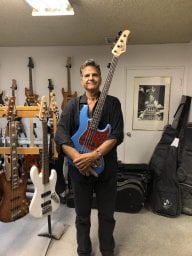
To answer your question in the title of the OP....
Dropping Bombs...
And some times you've just gotta groove between any of those extra 5 notes....
Dropping Bombs...
And some times you've just gotta groove between any of those extra 5 notes....

A 5 string bass gives you 5 more notes below the open E. Use them however you see fit. It's not rocket science.
When I got a 5 I sold my 4 to get it . So I took the plunge in deep . When I finnaly got used to the feel and the use of the tuning I got another 4 and I got better at both and enjoyed them for what they are .
but when/if you get one choos one of equal/close value
but when/if you get one choos one of equal/close value

There's nothing special about any bass, unless it is right for you.
Why 5? Why NOT?
Here is my stock reply for this question, which I have posted many times in the past.
For me and a lot of other 5 stringers with a low B, the B string is not primarily about the low notes, nor is it a thumbrest. The low notes are nice, but the main reason that I love 5 and 6 stringers is so that I can play in Eb, so I can play in E without using an open string, so I can play in F, F# and G without having to play in first position, so that I can do two octave runs(two and a half on a six) without shifting my hands, so that I can can grab a root and a tenth on the B and D, E and G, and on the six, A and C strings. The low notes are cool too. But I spend 90% of my time between the fifth and fifteenth fret.
Want to ask 'Why 6?' Got a stock answer for that one too.
If I want to pedal a note on the B or E string, and pop a tenth, or the second octave, it's necessary. I don't have to do that, but if I want to, I need that sixth string. If your fingers are six inches long, you won't need it for that situation. Mine aren't. My hands are small. One of my solos requires the sixth string, I go up to the 22nd fret on the sixth string. Also, on another original, I slap chords on the intro and during the guitar solo. You can do that with a four or five stringer, but you get mud on the ADG strings. DGC works great for chords.
Again, why NOT?
Why 5? Why NOT?
Here is my stock reply for this question, which I have posted many times in the past.
For me and a lot of other 5 stringers with a low B, the B string is not primarily about the low notes, nor is it a thumbrest. The low notes are nice, but the main reason that I love 5 and 6 stringers is so that I can play in Eb, so I can play in E without using an open string, so I can play in F, F# and G without having to play in first position, so that I can do two octave runs(two and a half on a six) without shifting my hands, so that I can can grab a root and a tenth on the B and D, E and G, and on the six, A and C strings. The low notes are cool too. But I spend 90% of my time between the fifth and fifteenth fret.
Want to ask 'Why 6?' Got a stock answer for that one too.
If I want to pedal a note on the B or E string, and pop a tenth, or the second octave, it's necessary. I don't have to do that, but if I want to, I need that sixth string. If your fingers are six inches long, you won't need it for that situation. Mine aren't. My hands are small. One of my solos requires the sixth string, I go up to the 22nd fret on the sixth string. Also, on another original, I slap chords on the intro and during the guitar solo. You can do that with a four or five stringer, but you get mud on the ADG strings. DGC works great for chords.
Again, why NOT?

Erm...did I say tab? I meant the popular 80's soft drink... 
But anyways, the genre I play seems to be of importance, so I will say it: I play mostly metal, rock and punk. I also wanted to say that I got most of the inspiration for the 5er from Rob Trujillo (since I play a lot of Metallica), and he seems to always be using 5ers.
I will try to learn by ear though, promise. I have learned a few songs by ear in the past...just haven't really done it in a while.
But anyways, the genre I play seems to be of importance, so I will say it: I play mostly metal, rock and punk. I also wanted to say that I got most of the inspiration for the 5er from Rob Trujillo (since I play a lot of Metallica), and he seems to always be using 5ers.
I will try to learn by ear though, promise. I have learned a few songs by ear in the past...just haven't really done it in a while.


