• TalkBass has been independent since 1998. Add your voice.
    Create a free account to reply to discussions, view embedded media, and browse with fewer display ads.
    Join freeLog in
    Want zero display ads or expanded classifieds tools? Compare plans.

When is a build considered a counterfeit?

BTL

Commercial Seller
Commercial User
Sep 26, 2006
3,678
1
6,887
Odessa, FL
Disclosures
Brad Lowe, Lowe Custom Guitars
The topic of counterfeiting was a sidebar conversation in a recent Fender copyright discussion here on Talkbass, and I’m sharing a comment I received on a related topic from a builder and painter over at Offset Guitars that surprised me.

My understanding was that adding a Fender logo to a licensed neck was prohibited by the Fender licensing agreements, and that doing so was the textbook example of a “counterfeit”. I believed and understood that Fender pursued builders who applied Fender logos and non-Fender logos with the same vigor and diligence. The most prominent or public example of this was the Kelton Swade court case.

For different reasons, both Lowe Custom Guitars and Feelgood Guitars/Copacetic Customs have received C&D letters from FMIC.

Here is copacetic’s comment that surprised me:

[…] Fender's view expressed to me via their lawyers is that Fender decals can only be used on aftermarket necks if the neck is a licensed replacement neck by Fender and going on an official Fender body. Which is basically his guitar. […]

Here is my reply:

BTL said:
That is not my understanding, but my C&D letter was the result of installing a Lowe logo on Mighty Mite licensed necks, so more “Nash” adjacent vs. “Beato” adjacent. Also, it was 2016 and I can’t find the document now.

Warmoth used to have the licensing agreement on their website, but they’ve taken it down. Perhaps Fender has moderated their approach in recent years, but I can’t find documentation online to support that (other than right here).

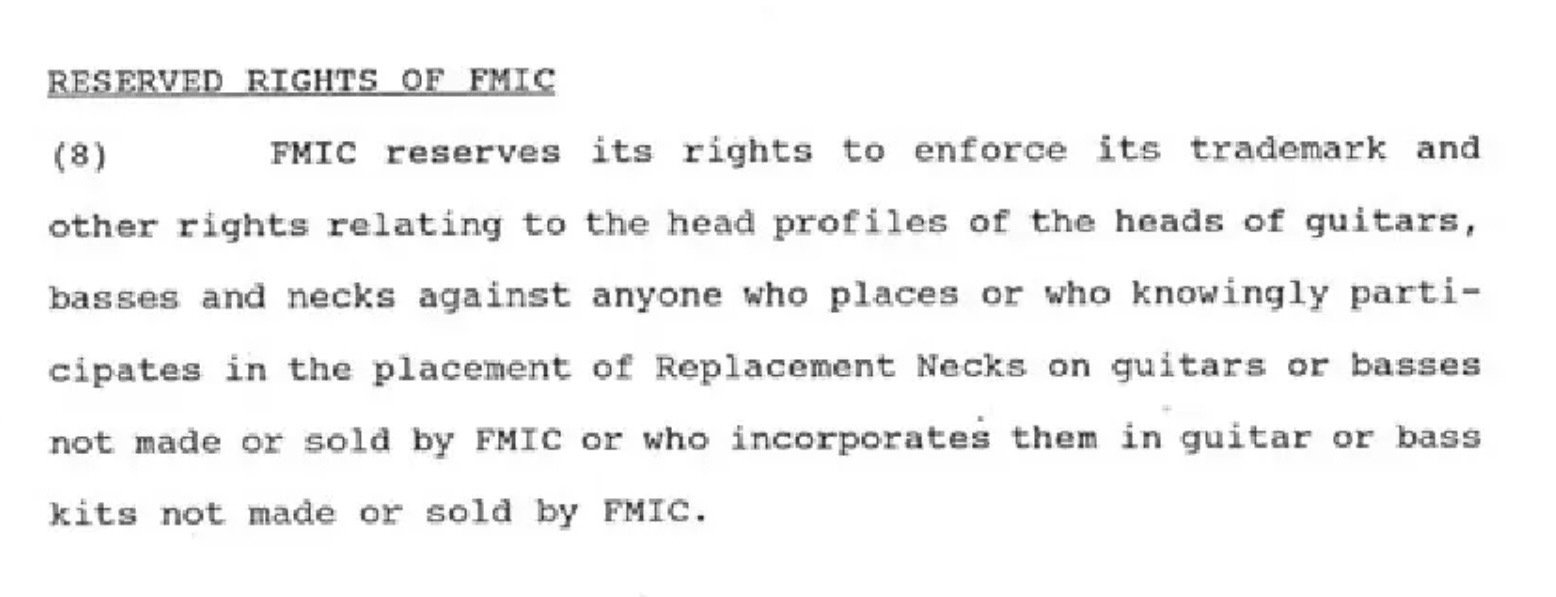
I was able to find a scan of the Warmoth licensing agreement online, and this is the paragraph I was looking for:
IMG_0916.jpeg


What do you consider to be a counterfeit, have you ever received a C&D letter from a manufacturer, and if so, what was your experience?
 
Last edited:
  • Like
Reactions: Ellery
I’m fairly certain any sort of headstock logo is prohibited. This includes even the licensed neck manufacturers, like Warmoth/Mighty Mite/AllParts/Musikraft/Hoxey. It’s part of the licensing agreement.

What a personal, non-commercial entity decides to do is fair game, but if you start selling products with said licensed necks with your own logo, then you will be in violation.
 
It’s designed to trick the potential buyer. Like in the art world. The fender design is a masterpiece. It doesn’t look right without a decal.

When it comes to Fender, they are a sum of their parts. IMO a Fender with non original factory parts is not authentic either. It’s very hard if impossible to know a vintage neck of the same year was originally on the body. Especially these days. People make it their living ripping off others.

I may have good intentions putting on a f decal on a fso which is illegal but if it gets sold off then it’s out misrepresenting its self and a fake in circulation. There is simply no need to fake one unless you want to misrepresent and mislead the viewer or buyer.
 
The topic of counterfeiting was a sidebar conversation in a recent Fender copyright discussion here on Talkbass, and I’m sharing a comment I received on a related topic from a builder and painter over at Offset Guitars that surprised me.

My understanding was that adding a Fender logo to a licensed neck was prohibited by the Fender licensing agreements, and that doing so was the textbook example of a “counterfeit”. I believed and understood that Fender pursued builders who applied Fender logos and non-Fender logos with the same vigor and diligence. The most prominent or public example of this was the Kelton Swade court case.

For different reasons, both Lowe Custom Guitars and Feelgood Guitars/Copacetic Customs have received C&D letters from FMIC.

Here is copacetic’s comment that surprised me:


Here is my reply:


I was able to find a scan of the Warmoth licensing agreement online, and this is the paragraph I was looking for:

IMG_0916.jpeg


What do you consider to be a counterfeit, have you ever received a C&D letter from a manufacturer, and if so, what was your experience?

Just don’t try to sell it to someone else as authentic. Other than that, do whatever you want with your own belongings.
 
I'd think it's obvious: It's either a factory Fender neck, or it's not. IF a licensee could place them legitimately (say Warmoth, Might Mite, etc.) on an aftermarket and/or replacement neck, they would. The fact that they don't tells me what I need to know, that obviously it's NOT a part of their licensing deal.

Let the hair-splitting begin/continue.
 
  • Like
Reactions: SactoBass and BTL
I was surprised to learn that Fender allows the placement of a Fender logo on a licensed replacement neck when it’s replacing a neck on an authentic Fender bass. I thought logos were prohibited in all circumstances on licensed necks.
If you do this, then where do you get the decal? AFAIK, Fender understandably has never sold decals, so the only source would be third party counterfeits. Are they saying they are OK with that?
 
  • Like
Reactions: BTL
To me the intent to deceive is implicit in counterfeiting.

While intent may be challenging to prove, some physical characteristics of an instrument are subject to intellectual property laws, which, when "cloned for profit" comprise an explicit act of deceit instead of an implicit intent to deceive, and can be easier to use as a cause of action in a suit or enforcement action.

In my opinion. I don't pretend to be an expert, etc.
 
  • Like
Reactions: BTL
Most of what’s sold on Aliexpress is clearly counterfeit, as they fake the logos and TRC’s with the clear intent to deceive, but from what I’ve read (and not fully understood) purchases of (1) knockoff is not illegal for the buyer, but is for the seller. I’ve built several Ric clones under the assumption that’s ok under “fair use”, and have my own custom TRC logo. I also include a few subtle “tells” to indicate they are not genuine, and I’m not selling them to anyone, but I suppose some future owner could slap a Ric TRC on them and sell as genuine, which is…. not my problem. The whole Fender Fiasco has been thoroughly hashed and re-hashed, and they pretty clearly have no case, but actually having a case is entirely superfluous to the American legal system, so I guess they are going through with it. I wish them no luck with it.
 
  • Like
Reactions: BTL
The license agreement explicitly prohibits the OEM (Warmoth, Allparts, Mighty Mite, etc.) from adding a logo. I was shocked to learn there are cases where Fender will allow a painter or repair shop to add a logo to a licensed replacement neck.

To that end, my current understanding is the only logo that can be used on a licensed Fender neck is a Fender logo and only when the licensed neck is being used within the scope of the license rights. That was surprising news to me.
 
I was surprised to learn that Fender allows the placement of a Fender logo on a licensed replacement neck when it’s replacing a neck on an authentic Fender bass. I thought logos were prohibited in all circumstances on licensed necks.
When Fender introduced the bullet truss rod, there was a wave of broken necks where the fb came off the neck at the nut. They replaced them free of charge (through authorized service centers) for a couple of years but stopped. I don’t know when the older aftermarket companies started production, but there must have been some operating in the 70s. It wasn’t uncommon to see older, even pre CBS instruments with replacement necks with no logo, or refinished necks with no logo, because nobody cared- the brand alone did not have cachet or significance.
When that was the case, a logo less neck was simply an indictment of Fender’s bad QC or production practices, or the (lack of) care which the bass was subjected to by the owner.
So having logo’d replacement necks, a business that Fender didn’t want to be in, could still be seen as being beneficial to the brand, if you could see the need for replacement as a negative.
If Fender had some control over who was an “authorized” repair shop, and those were the only places to get genuine parts, it kind of makes sense to permit them to logo necks that were licensed and paid for by a customer who was determined to have a genuine Fender body. Again, these were decisions made by a company who didn’t want to provide factory service before anyone could make any sort of real money faking the brand. Unless, of course you were making them overseas and importing them by the boatload. Long ago, those were much easier to spot. Then, Fender started making instruments in Japan anyway (and making them imitating older build/design parameters), at which point the whole exercise became kind of a farce. Then the 90’s, the proliferation of authorized service centers, broader availability of OEM parts, etc. Basically, the usual story of corporate acquisition transforming a manufacturing company into a clown car full of lawyers who are so focused on intellectual property that they can’t make a decent product, or even respond to demand in a timely fashion. How long did it take Fender to begin offering fivers? I bought my first in 1987. It was at least five years before I saw a Fender with a low b.
I remember this having (somewhat) practical implications way back when. A friend of mine bought a strat, heavily modified it, including refinishing the body, and replacing the electronics, and our local store tech would not put a logo on a replacement neck because he couldn’t prove it was an actual strat body, which was pretty ridiculous. He later was able to procure some logos and figured out how to do it himself. It wasn’t for resale, he just wanted the logo.
It amuses me that players are working themselves into a high dudgeon about current practices. I’m not old enough to remember pre cbs days, so to me, they’ve always been kind of a cr@ppy company.
 
  • Like
Reactions: kodiakblair and BTL
I recently learned the licensing agreements were the result of Fender’s first round of IP litigation in the mid 90s. Fender’s second major attempt to secure or defend its IP rights was the failed body trademark filing in the US in the 2000s. The current EU copyright action seems to be the third major attempt by FMIC to secure and defend its IP rights on its original designs.

It will be interesting to see how it all shakes out.
 
  • Like
Reactions: hbarcat
The license agreement explicitly prohibits the OEM (Warmoth, Allparts, Mighty Mite, etc.) from adding a logo. I was shocked to learn there are cases where Fender will allow a painter or repair shop to add a logo to a licensed replacement neck.

To that end, my current understanding is the only logo that can be used on a licensed Fender neck is a Fender logo and only when the licensed neck is being used within the scope of the license rights. That was surprising news to me.
Warmoth is “indirectly” in violation of Fender’s stipulation about placing logos on the licensed necks. Has anyone ever seen a Warmoth decal on an officially licensed necks? No Warmoth doesn’t place them on the necks, but they do sell the “Warmoth” logos. Kinda like throwing gasoline on an a fire. 😂

This is the most convoluted BS that I’ve ever seen.
The simple solution is this:

Put whatever you want on the headstock of your instrument and enjoy it while it’s yours.
If you decide to sell and you’ve placed a Fender logo on it, remove it before selling.
Letting the potential buyer know does nothing to prevent them from reselling it as the real thing.

Pretty simple. Now let’s light a fire to this “polarizing” thread and move on.
 
Last edited:
  • Like
Reactions: BTL
[…] Now let’s light a fire to this “polarizing” thread and move on.

You asked me to take the discussion elsewhere, and I did so. This topic is interesting to me, and I fully admit to being confused by some of the minutia and nuance. I believe the discussion adds value to the forum, and it certainly adds value to my own experience and perspective. YMMV. :)
 
You asked me to take the discussion elsewhere, and I did so. This topic is interesting to me, and I fully admit to being confused by some of the minutia and nuance. I believe the discussion adds value to the forum, and it certainly adds value to my own experience and perspective. YMMV. :)
You are correct and with the Fender C&D in Europe, it’s going to interesting. I also commend you for moving it to a fresh thread, but I’d be willing to guess there are are 20+ threads in the archives that deal with the same thing.
These threads are polarizing and are destined to be locked due to heated discussions. It’s happened in the past. Hopefully history won’t repeat itself. 🙂
 
  • Like
Reactions: BTL