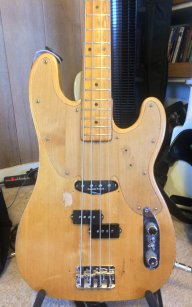
I need one of these preferably in a black finish and in good condition. Does anyone have any clue where I can find one?

TalkBass has been independent since 1998. Add your voice.
Create a free account to reply to discussions, view embedded media, and browse with fewer display ads.
Join free Log in
Want zero display ads or expanded classifieds tools? Compare plans.
You sir are a genius I searched hohner headless spare parts and ran across this!My guess is it's a hohner...
I think this will do exactly what I need haha!
I didn't realize that at first but now that I looked again your right. Do you have any clue where to get the exact part? Or would I have to machine the one I found to be exactly the same? Looking at it the front piece that would sit on the fretboard and guide the strings would be in the way. I'm trying to basically copy what's in the picture. Which was take a regular bass and make it headless.Hi.
Are You looking for the exact part in the pic you posted, or just a "generic" ball end head-piece?
If it's just a generic one, then that one will probably do, but that's nowhere near the same part as in the pic.
Regards
Sam
Do you have any clue where to get the exact part?
Or would I have to machine the one I found to be exactly the same? Looking at it the front piece that would sit on the fretboard and guide the strings would be in the way.
I'm trying to basically copy what's in the picture. Which was take a regular bass and make it headless.
So here's the question I have. Could I machine a headpiece to lock the strings in place sort of like a Floyd rose nut? The problem I'm having with all of this is the bass I'm trying to convert is short scale (28" roughly) and I'm not sure if I could even find double ball short scale strings. I'm still trying to get a grasp on the whole headless thing. How exactly does the bridge work on them? Do you have to use a ball end on them? I came across this one that I figured would do for the time being until I could afford a really nice one to slap on it and give me a grip on having the headless setup http://www.ebay.com/itm/280947073520Hi.
Short of DIY, no I do not.
In all fairness though, during the heyday of headless instruments, ie. the 80's, there was many manufacturers that tried the approach and most did not last very long.
Some designs were successes, some were failures.
The Hohner one is IMO actually better engineered part than the one in Your pic, unless there's hidden from the view anchoring inside the neck.
A simple flat piece on the end of the neck can work, but it can also fail quite spectacularily.
Screwing something into the end grain isn't preferred in woodworking.
The added support on the Hohner piece helps in that.
If You're using a ball end bridge, I for one would not use ball end head-piece, the availablity of dual ball end strings is still rather poor, especially if other than standard scale lengths/varieties are required.
Machining a flat head-piece like in the pic is relatively easy with even with just hand held drill, and a breeze with a bench drill.
I'd braze tubular anchors into it for added support though.
Regards
Sam
Could I machine a headpiece to lock the strings in place sort of like a Floyd rose nut?
I'm still trying to get a grasp on the whole headless thing. How exactly does the bridge work on them?
Do you have to use a ball end on them?
I came across this one that I figured would do for the time being until I could afford a really nice one to slap on it and give me a grip on having the headless setup http://www.ebay.com/itm/280947073520
 .
.