• TalkBass has been independent since 1998. Add your voice.
    Create a free account to reply to discussions, view embedded media, and browse with fewer display ads.
    Join freeLog in
    Want zero display ads or expanded classifieds tools? Compare plans.

Where to start

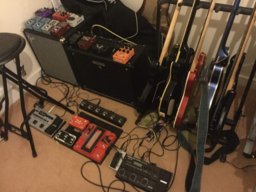
I started off with some behringer stomp boxes as they're all cheap but not bad, joyo are the same though arguably better as they're made of metal (but I've never heard of a plastic behringer breaking! ) but to be honest I wish I had have saved money by skipping those and going straight for the B3 and MS50g, they do EVERYHTING I could ever want and didn't break the bank. You learn so much from multi fx too and if any effect interests you but you don't feel the multi effect version cuts it (which isn't really a problem with the zooms except that some people don't feel that the pitch shifters are up to scratch) then you can splash out on dedicated pedals for those, but for my uses, every effect in the zooms is more than good enough for recording my music; good amp mods, good distortions, good delay echoes, good chorus and flange effects, good scooping range, good EQ, good tremolo, good synth (as long as you're careful not to confuse the tracking), good everything as far as I'm concerned.

I only use the pitch shifting to lower the bass 1 tone for a Korn Fieldy patch and it works perfecty for me, though if I wanted to go further down than that I would buy a Drop pedal but for one tone, the Zoom is more than capable, so I'm happy! The only non zoom pedal I keep in my board now is a behringer limiter pedal to stop it getting too loud on some notes, but the zooms technically can do that too, I just want it always on.

Since taking this picture, I've removed the delay pedal as the zoom CDR handles all my delay, reverb etc needs so it Became redundant!

YFienqD.png
 
Practically speaking, the first pedal you should buy is s tuner pedal. After that, I'd look into overdrives, but.....

It's hard to try anything in stores anymore, especially anything made for bass. Most of the time you have to listen to clips and videos of someone else playing, guess which pedal might be what you want, and order it. I HIGHLY recommend you go with a store with a good return policy - I've tried way more overdrives than you'd think it would take to get a few good ones, and returned all but a chosen few. Same thing with choruses - getting one that sounded like I wanted it, without a lot of added hiss.....
 
  • Like
Reactions: Sartori
take your time .. ! don't waste your time/money buying crap ...

there is enough info and experience to be researched here to help make solid choices .. !

a good start - decent comp pedal ... i think , for the money , the Seymour Duncan Studio Bass is hard to beat ! having a Mix/Blend knob help you keep Your tone ..

after that , it really is a matter of what tone you want and what type of music you're playing ..!?
 
I actually don't use any so perhaps I am not the best to answer this, but I'd say that unless your amp has a great built in compressor, a full featured compressor would be a good choice. If you are not looking for some specific elephant stomp compressed sound with no attack when you pluck the string, then properly using a compressor will make it sound like you aren't using one. It will give you longer sustain and lower peaks allowing you to increase the average dynamic level of your playing (won't be as much difference between your loudest and softest notes) without damaging your gear by exceeding your speakers XMAX ratings.

My Eden WT500/800 amp has a built in compressor that I NEVER use because the only time it sounds good is doing slap bass stuff which I really almost never do. For normal compression where you don't want to max out the amp or speakers and you want more sustain than you are getting out of it, I don't like it at all. It has a hard-knee compression meaning when you hit the threshold to trigger the compression it comes on all at once. The only control on it is the gain setting which acts as a threshold setting when you have the compressor engaged. That works great for slap...not so good for anything else because it is such a noticeable difference. Plus, I get outstanding sustain from my maple-neck Jazz bass, so I never even think about that.

When I run through FOH, the board almost always puts on compression, but that's to protect their speakers, not mine. Even putting out the full 800 watts from my amp, my cab has no problem handling it with its 1400-watt RMS power handling. I honestly doubt I could be anywhere near my amp and speakers if I was utilizing my full 800 watts because it would be so loud. I never try to get that "squashed" sound because that's just not the style of playing I do. If you get a good compressor that will let you set threshold, ratio, attack, and decay, you can get the full gauntlet of the sounds a compressor can produces as well as the ability to get greater sustain without it sounding like you're using compression. If I was forced to have a pedal on-stage, that would be it, but it would almost never get switched on because for my sound, I don't need it. YMMV!

If you need to play with distortion, then you'll need an amp that has it built in or a pedal that will give you the effect. If you go for one of those try for one that will give you both the real dirt and also produce an overdrive sound too, which is a little more subtle.

That's my 2¢.
 
If you're set on individual pedals/effects, I would start with a tuner and then then look at pedals that might give you something in terms of a sound/tone you need for the music you play that you simply can't coax out of your current bass, amp and/or cab.

If you think you'd like to simply experiment a bit and see what things you might like, a multi-effect pedal like the Zoom B3 isn't a bad investment and might actually do everything you'd ever want (including having a built in tuner). I really favor the multi-effect route for folks who don't have a specific need and are just looking to explore or expand their tonal options.

Good luck!

I have two B3's and find they suck a bit of the tone from my bass, even when bypassed. Also, they really don't compare to analog effects. Great fun to goof around with, though, and a pretty good computer interface.

I used to have a Boss ME30, and think it was better.

Haven't tried the Tech 21 Bass FlyRig, but bet it's killer. All their stuff is first rate.

My rec for single first pedals:
  1. know what you want to do with them, how you want to change your sound. If you have no idea, then just go straight to the amp and be done with it.
  2. I really liked the chorusing effect so I've had a couple of those. Best I think currently is the Tech 21 Boost/Chorus. It allows one to "detune" for the chorusing effect, rather than modulate the whole signal which oft times will drop low end.
  3. Flanger. This is kind of an alternate to the chorus, or you make like it too. A very similar modulation effect, but has a different sound. Listen to Mars Cowling of Pat Travers.Not sure of a rec for this one, ADA used to be the one, but that was back in the 80's. I heard they are being made again, but not sure.
  4. compressor pedal. These aren't sexy at all, but can fatten up a bass tone. There are many on the market of many different types. I've tried a LOT of them and rather don't like them all. I hear good things about the Broughton Monocle, but I have the Behringer knock-off of Boss, which is fine for me, as it sits unused on my shelf.If I had to have one, I would first try the Monocle, or Boss or MXR.
  5. Octave. I was in love with the Pino tone from the 80's so of course I had one. And the Octave FX in the B3 suck suck suck. Boss OC-(2 or 3?) is the one to get.
  6. One of my main peeves are clanky amps, and I have a hard time de-clanking them with tone controls. The best is the VLE circuit in a MarkBass amp, but since that's not a pedal, the next best thing is the Broughton L/HPF. Has two filters, one for low pass, the other for high pass. People on here rave about them, and I have just ordered one.
  7. Distortion. Throw them in the trash. A pox on bass tone.
A final note on pedals and tone:
Buffered vs true Bypass: One of the nice things about Boss is that they are buffered. A lot of hype gets thrown at true bypass, and on the surface one might think that's a great thing - passing the unvarnished signal straight through an unused pedal. The problem is that if one has a passive bass, the cable's capacitance loads the pickups, and changes the tone - causing a drop in high end and a general muddiness. A bypass limits that capacitance to only the first cable, the one between the bass and the first buffered effect. If one has all true bypass pedals, then the bass will see the load of the entire signal chain - which could be in excess of 60 feet - and the bass's high end will be cut. Actually, more than that - the bass will be muddied up because the resonant frequency and high end rolloff of the pickup will change. Having at least a buffered pedal at the beginning of the chain will alleviate this. That why I like Boss's stuff, as it's buffered. Including their tuner. So having a Boss tuner first in the chain is a good thing.
 
Personally, I think a compressor isn't really necessary if you're a beginner. That starts getting important when you play with other people or start playing gigs (perhaps the OP is there already?). And even then, not everyone uses or needs them.
 
  • Like
Reactions: Sartori
And a final note I forgot - I find that all those effects just get in the way of my playing and the tone I really want, so I don't use any.
There is a lot of great information in your two posts. I actually don't own many "effects/pedals" as the style of music I play doesn't tend to require much and I have a broad range of amps, cabs and basses to choose from as a starting point depending on what I need. Your point about passive basses and well designed buffers versus true bypass is also one worthy of reading up on and taking into account.

I agree that Tech 21 makes nice stuff. I also like Aguilar, Xotic, MXR, and Diamond - all brands I own along with Tech 21. I find preamps (including Sans Amps), boosters and compressors cover my needs nicely. While I'm guessing most would not consider a DI box an "effect", I find there are even differences between them that can be heard by the discerning ear (the Radial JDI and Countryman 85 are my go to boxes there). While I don't own a multi-effect, I have played on the Zoom B3 and a couple of the Boss models.

For my money and to my ear, the single pedal approach gets you the highest quality in all regards. However, for learning what effects do and deciding what you might want in a single pedal or more, multi-effects are a very cost effective way to play the field a bit before committing big bucks for things you may not even be sure how to shop for (in terms of the sound and controls you really want).
 
  • Like
Reactions: bdplaid
Nor are they necessary for a seasoned pro, either. I used to use compressors, but that was just because it was said that bass can't sound as good as it can without one. Good playing technique can cover most of it, outside of, say, reigning in hot peaks from slappin' da' bass, for example.

I find compressors very limiting to dynamic playing. If they do what they are supposed to do - level things out - you'll have much less control over both your volume and the sounds that one controls by touch. Compressor by nature get rid of all that. Which is why I can't get used to them.
 
I have two B3's and find they suck a bit of the tone from my bass, even when bypassed. Also, they really don't compare to analog effects. Great fun to goof around with, though, and a pretty good computer interface.

I used to have a Boss ME30, and think it was better.

Haven't tried the Tech 21 Bass FlyRig, but bet it's killer. All their stuff is first rate.

My rec for single first pedals:
  1. know what you want to do with them, how you want to change your sound. If you have no idea, then just go straight to the amp and be done with it.
  2. I really liked the chorusing effect so I've had a couple of those. Best I think currently is the Tech 21 Boost/Chorus. It allows one to "detune" for the chorusing effect, rather than modulate the whole signal which oft times will drop low end.
  3. Flanger. This is kind of an alternate to the chorus, or you make like it too. A very similar modulation effect, but has a different sound. Listen to Mars Cowling of Pat Travers.Not sure of a rec for this one, ADA used to be the one, but that was back in the 80's. I heard they are being made again, but not sure.
  4. compressor pedal. These aren't sexy at all, but can fatten up a bass tone. There are many on the market of many different types. I've tried a LOT of them and rather don't like them all. I hear good things about the Broughton Monocle, but I have the Behringer knock-off of Boss, which is fine for me, as it sits unused on my shelf.If I had to have one, I would first try the Monocle, or Boss or MXR.
  5. Octave. I was in love with the Pino tone from the 80's so of course I had one. And the Octave FX in the B3 suck suck suck. Boss OC-(2 or 3?) is the one to get.
  6. One of my main peeves are clanky amps, and I have a hard time de-clanking them with tone controls. The best is the VLE circuit in a MarkBass amp, but since that's not a pedal, the next best thing is the Broughton L/HPF. Has two filters, one for low pass, the other for high pass. People on here rave about them, and I have just ordered one.
  7. Distortion. Throw them in the trash. A pox on bass tone.
A final note on pedals and tone:
Buffered vs true Bypass: One of the nice things about Boss is that they are buffered. A lot of hype gets thrown at true bypass, and on the surface one might think that's a great thing - passing the unvarnished signal straight through an unused pedal. The problem is that if one has a passive bass, the cable's capacitance loads the pickups, and changes the tone - causing a drop in high end and a general muddiness. A bypass limits that capacitance to only the first cable, the one between the bass and the first buffered effect. If one has all true bypass pedals, then the bass will see the load of the entire signal chain - which could be in excess of 60 feet - and the bass's high end will be cut. Actually, more than that - the bass will be muddied up because the resonant frequency and high end rolloff of the pickup will change. Having at least a buffered pedal at the beginning of the chain will alleviate this. That why I like Boss's stuff, as it's buffered. Including their tuner. So having a Boss tuner first in the chain is a good thing.

Well that's just like, your opinion, man.

I disagree with just about every recommendation here, because it's a recommendation for you and not someone else. I ran blindly into effects and jumped around learning what each one did slowly, and sometimes painfully, but now I have a pretty solid understanding of what each one does to my bass. Now when I need a sound, I can just go get it without kicking my head in. The B3 is the shortest route to that expertise. There's a few pedals that have such a unique tone you'll need to experience them outside the multi, but most of your cloned-1000-times pedals will have a reasonable facsimile in the pedal.

I don't need effects very much any more, but when I do they make my performance better.
 
Nor are they necessary for a seasoned pro, either. I used to use compressors, but that was just because it was said that bass can't sound as good as it can without one. Good playing technique can cover most of it, outside of, say, reigning in hot peaks from slappin' da' bass, for example.

I have owned a couple of Aphex 661s and a Punch Factory, and a UA LA-610 Mk II,so I have experience with some "industry standard" quality compressor, and as great as they were, I found I didn't need them; YMMV. In the studio for recording, I'll just let the engineer do his thing.
+1.

Sometimes I've felt like I'm the only person on talkbass who doesn't use a compressor. I just use my amp's front end as my compressor.

Current board:
13720491_10157085219270328_2076572615_o-jpg.jpg
 
  • Like
Reactions: Jeff Scott

Latest posts