• TalkBass has been independent since 1998. Add your voice.
    Create a free account to reply to discussions, view embedded media, and browse with fewer display ads.
    Join freeLog in
    Want zero display ads or expanded classifieds tools? Compare plans.

Which of these lining materials to use?

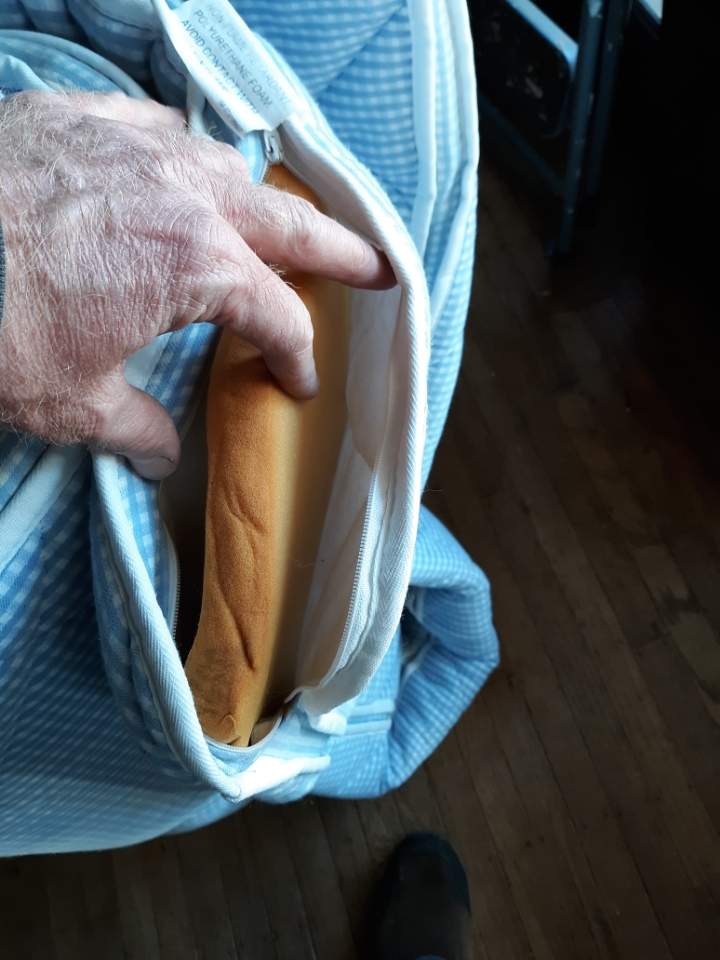
I'm trying to find something around the house today to use to line the inside of a cab. This futon thing (pictured) may be the victim. Would folks recommend using the inner foam, or the quilted outer layer, perhaps doubled up?

The cab in question is a cheesy old PA cab from JCPenney's, from 35 years ago. Trying to turn it into a 2x10, to house the eminence CA10's that I seem to have fallen in love with. Had been a 1x15 in there that had seen considerable use. The bolt-on on baffle made the project relatively easy. But, it is booming badly between the low B & D on my 4 string P Bass.

Improvised foam so far seems to remove much of the booming, so maybe I'm on the right track...
Resized_20191124_131333.jpeg
 

Attachments

  • Resized_20191123_164528.jpeg
    Resized_20191123_164528.jpeg
    53.3 KB · Views: 148
  • Resized_20191124_131333.jpeg
    Resized_20191124_131333.jpeg
    59.3 KB · Views: 135
This pic shows the cheesy port a bit better. I am definitely open to other suggestions involving more radical surgery and perhaps plugging the existing ports and creating new ones in the baffle.

Some would suggest just buying a cab. Having purchased seven in the last year, I'm a little wary of that. So is the woman of the house. :-)

Finding a 2x10 cab and throwing in my favorite speakers would be one way to go. Most seem to be surprisingly heavy though, with tweeters which I don't need. Also, front porting is mandatory.

20191124_133343.jpg
 
Hmmm... seems a bit like the cone in the homemade cab is moving a lot more than the cone on my other ca10, which is in a different cab... when using them both simultaneously. Possible that my improvised situation is not supporting the speaker in some way?

Still would like to know which material is best for lining... :-)

My long-term planned may be to keep an eye out for a SWR Goliath III Jr., which if I recall, uses the ca10 as specified replacement speaker. I wonder if that also applies to Eden XLT 2x10, couple of those on Craigslist locally right now. Heavier than SWR, supposedly.
 
There isn’t a best material. You want something that will absorb and scatter the sound waves. They use all sorts of materials for damping. Try the foam, then try the cover. Use double sided carpet tape to adhere it to the walls. If the foam is large enough, friction alone can hold it in place. Try the back wall only or the back and the sides.

Experiment and see how it affects the mids by making the sound less muddy.
 
About the best thing you buy for this job is cheap... you could even salvage a strip from just about any remodel/construction job. Just buy or grab a short batt of unlined [if it has paper or foil remove it] fiberglass insulation [the pink stuff will do fine] 2 to 3" thick [you can peel a thick batt down thinner fairly easily]. Attache using long staples through a square of card stock [or use screws through card stock but don't drive them through the cab wall]. One piece running across the the top and then down rear wall will probably do the trick - but stay well clear of the port opening.
 
I fear experimentation is your only friend here. Try everything in every combination of thickness, number of walls covered etc, and for goodness sake keep detailed notes of what you try. IME you'll be amazed at how much difference it makes and you'll soon forget the permutations if you dont keep a record.
I'd avoid fibreglass though, don't want those fibres drifting out of the port.
But i i would also have a good go at measuring up the cab and running it through a modeller like Winisd to see if the ports are roughly right.
 
Last edited:
  • Like
Reactions: pie_man_25
I think it unlikely that the acoustic characteristics (internal volume and port dimensions) of that cab are correct for those speakers. This explains why you are seeing much larger cone excursions and hearing an uneven response including boom. As has been said already you should do some investigation into speaker cab design for these drivers as you risk damaging them through over excursion.
 
I fear experimentation is your only friend here. Try everything in every combination of thickness, number of walls covered etc, and for goodness sake keep detailed notes of what you try. IME you'll be amazed at how much difference it makes and you'll soon forget the permutations if you dont keep a record.
I'd avoid fibreglass though, don't want those fibres drifting out of the port.
But i i would also have a good go at measuring up the cab and running it through a modeller like Winisd to see if the ports are roughly right.

I'd agree with this with The only caveat being that IOT prevent analysis paralysis find one thickness - let's say either one or two inches - and then vary it by covering all surfaces except the baffle, then only half, then only one, and lastly uncovered. From there you only have to pick between four options including your control instead of several.
 
2 things I'd suggest before stuffing the thing with a randomly chosen material:

1) As suggested by others, the cabinet volume and port tuning are things that have to be designed with the drivers you want to use in mind, or the result is a crapshoot.

2) My guess is that your cabinet probably doesn't have much in the way of bracing - assuming you get the first point sorted, the next issue is to stiffen the walls to try to reduce wood vibrations - tying opposing walls together at their centers with a rod perpendicular to both walls can dramatically reduce the most prominent (and audible) vibration mode of each wall. Yes, both walls will still move some , but by tying them together, one moves in, the other out - the net effect is good cancellation outside the box.

After you've dealt with the design and bracing issues, some damping can be a good thing. But it's not the solution to most boominess issues.
 
Almost certainly the porting isn't even close to correct, which is by far the most likely reason for excessive excursion. Modeling the ports is going to be very difficult because they are a tapered cross-section which will behave differently. Without understanding a fair amount of theory, you are facing quite a challenge that may not have a positive outcome without going to an entirely revised cabinet (porting), Guessing osn't going to be a successful method unless you have uncanny odds, which if you do I would recommend buying a new cabinet that you really like with your lottery ticket winnings.

Acoustic material inside the cabinet isn't going to change this, it's like placing a bandaid on an amputation.
 
  • Like
Reactions: Bodeeni
Hey... I resemble that remark. :-)

So...how would I go about fixing this thing up? Sealing off the existing ports, and putting in some conventional round tube type ports perhaps.

Sorry, I am new to this, but pretty good with wood and with software. Would love a quick suggestion as to what program to download, and how to get moving thanks! If this seems viable...
 
Bsssbox pro is a good start, seems to be reasonably accurate.

If you are good with wood, why not take this project to the next level and build a box?