• TalkBass has been independent since 1998. Add your voice.
    Create a free account to reply to discussions, view embedded media, and browse with fewer display ads.
    Join freeLog in
    Want zero display ads or expanded classifieds tools? Compare plans.

Which variables have the biggest impact on tone?

Top three influences on tone

  • Fretboard/neck material

    Votes: 16 5.4%
  • Body wood/material

    Votes: 14 4.7%
  • Pickup type (single coil, humbucker, etc...)(magnet)

    Votes: 154 52.2%
  • Pickup location

    Votes: 127 43.1%
  • String type/material

    Votes: 149 50.5%
  • Player technique (slap, fingers, pick, mute)(location of pluck attack)

    Votes: 206 69.8%
  • Electronics (pots, caps, onboard preamps)

    Votes: 25 8.5%
  • Hardware (tuners, bridge, etc...)

    Votes: 1 0.3%
  • Fretted vs fretless

    Votes: 31 10.5%
  • Neck joint construction (bolt on, set, through)

    Votes: 3 1.0%
  • Carrots

    Votes: 12 4.1%

  • Total voters
    295
30% of you are just wrong. If you look at Johnny Long's videos there is a great example of the fact that playing is mostly in technique. While there are minor differences in each bass, everytime that dude plays if you are blindfolded you can tell it is all him. The way he hits the strings and the way he sounds is virtually uniform across the board. Of course there are some tona differences when he switches between pickups, but aside from that, his ears, hands and amp setup show that which bass he is playing is almost a non factor. There are subtle differences in everything, but I will never sound like Ox or Geddy or whoever if I play like me.
 
  • Like
Reactions: Vinny_G
for ex. I'm a member of VARA... and the one thing they pushed on us over and over in school was be like Jackie Stewart , Jackie drove that car with less brake changes , less tire changes , less fuel usage and less pit stops . He crossed the finish line while guys were still in the pits . Be like Jackie Stewart :)
 
For the other options I'd go

1. Pickup Position
2. Pickup Type
3+4 Player Technique and String Type
5. Electronics
:thumbsup: however, IMHO the order changes depending on context, so perhaps this is actually a somewhat poorly formed question.

For example, unless we are talking about comparing extremely crappy pickups to high quality pickups, I think the difference between fresh rounds and old flats would put strings at least at the #2 position. IMHO the difference in tone between round and flats is pretty major, and cannot be compensated for with EQ. You can generally use EQ to compensate for variations in the response of different pickup types.

Depending upon pickup location of the specific basses we were comparing, the significance of the difference in strings may even move all the way to #1.

You would probably be surprised by what can be achieved with EQ, which would fall into your category 5.

The first rig I assembled used an Orban 672A and I used to spend hours trying to get my Ric 4001 to sound like the bass on different hits of the day; I was able to get surprisingly close :smug:.

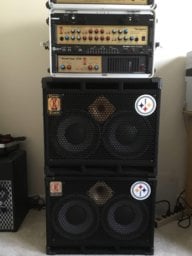
attachment.jpg

The 672A was common in FM radio broadcast. I read a magazine interview with Stanley Clarke around the late 70s/early 80s and he mentioned the 672A was the core of his 3-way stage rig, so of course I had to have one. Never heard of any other musicians who used one. To be honest they don't sound that great by today's standards, but they are capable of some pretty incredible tone shaping.
 
I want 5, player’s technique, pickup location, pickup type, strings - and active vs passive but as has already been said for fretted and fretless they are almost 2 different animals.

Nothing more likely to kill tone than loose tuners and/or dust or shavings In the neck pocket or a poorly seated neck.
 
I didn't expect that so many others have chosen the same 3 variables as I did (pickup type, location and strings). I think it kind of doesn't fit to put playing techniques into the equation. Slap always sounds like slap and different from fingerstyle, so playing style has the biggest impact, kind of. No pickup location will make Jamerson sound like Markus Miller or the other way round. But slap does sound completely different played on old flatwounds or new steal roundwounds. It is a bit like asking what impacts the quality of a still and then offering to choose different types of cameras with different glasses and lights or the photo motif. No variable of a camera will make the ocean in the blue hour look like James Jamerson after 3 nights in a bar. And no variable of a bass will make slap sound like muted fingerstyle.

I like it that so many players nowadays do not believe in all the myths about body wood and rosewood/maple etc.
 
  • Like
Reactions: zie
When General Pickett was asked after the Battle of Gettysburg why the charge named for him failed, he said, "I always thought the Yankees had something to do with it."

With that kind of pragmatic yet non-sequitur thought in mind, I'll say that the rig the bass is played through has probably a greater effect on tone than the bass itself. The effects, amp et al, all the knobs in the signal chain between the pickups and the speakers...that's where what we really hear as "tone" is made.
 
  • Like
Reactions: DrThumpenstein
It depends on how extreme you go.. Tapewound strings will sound way different than steel rounds. I'd say strings, PU type and placement make the biggest difference as well as the preamp if there's one.
 
I’d say the things that are most recognizable in a recording. Technique, and strings, and fretless.

Otherwise it’s more subtle eq type things.

Also, on some amp settings you can hear the acoustic sound of the bass and it’s innate tonal color. But add a bunch of bass tone, extreme eq settings, volume, overdrive and the bass’ acoustic sound is lost.
 
I guess you mean this video:


My answer regarding these P basses is that I don't know. It's even possible that a different part dominates in each of these basses: the neck with one of them, the body with another, etc. All types of bass combined, I would say pickup type and placement first and foremost, string type/material, then player technique.

But since you offer these choices in your poll, I'm pretty sure they'll be the most answered, because it's obvious to most of us. In a mix I can tell the difference between a P-bass with flats, a J-bass with nickel rounds and a Stingray with stainless rounds (or any other combination of these), but that's about it.


Yeah. Same with strings. Marketing is too easy for some. All rounds sound the same in a live setting. And a small twist of a single knob on the amp or bass will change the tone anyways.

The amp has far more to do with tone than the bass anyways. I have Ric4003s, G&L SB-2, a T-bird, and an active Carvin. I can get
them all to sound the same live with enough nob turning.
 
  • Like
Reactions: Vinny_G
I was surprised that electronics was rated so low. Two identical instruments with 250k 20% tolerance pots will sound noticeably different from one another if one has a pot measuring 300k and the other is closer to 200k. Not to mention onboard preamps and the way they can color sound, although there are plenty of preamps that are neutral-sounding. I just feel like electronics are a big factor in tone. Just my 2 cents.
 
You need to put overall neck construction on that list. Forget about maple vs rosewood etc etc. The neck itself has the most impact on tone..well at least on par with pickups and strings. I have a couple parts basses that I've tried many different neck on and it's astounding how much that not only impacts playability but overall tone.
Keep in mind that most necks are made out of maple. Maple is a very moist, sappy wood. Due to the length and method of drying and curing, there some variables of how the tone is affected.
 
I was surprised that electronics was rated so low. Two identical instruments with 250k 20% tolerance pots will sound noticeably different from one another if one has a pot measuring 300k and the other is closer to 200k. Not to mention onboard preamps and the way they can color sound, although there are plenty of preamps that are neutral-sounding. I just feel like electronics are a big factor in tone. Just my 2 cents.
What about "fretted vs fretless"? I mean, that has to have a little more impact over "technique", right?
 
  • Like
Reactions: Claymore
Interesting poll. Kind of validates my thoughts.

As an owner of a Gibson Grabber, I learned about the influence of pickup position in nicely controlled conditions. The influence of pickup position on tone is easily discernable. Same pickups, same strings, same technique, different tone. Clearly brighter toward the bridge and darker toward the neck. I played mostly reggae on that bass, pickup as close to the neck as it would go and fingerstyle over the fretboard. But once in a while I'd get together with some jazz buddies, where playing with it closer to the bridge brightened that bass up.

But pickup position didn't get my vote. I voted for the other 3, because, having experienced all of the other variations of strings, pickups, and most importantly, what I do with my hands, pickup position effect on tone is relatively minor.

I'd say the other items on the list influence tone to a similar degree that they influence TB. A little, not a lot.