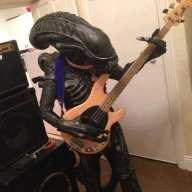
The... goats? Is it the goats?If the 4H talent coordinator pays me at a county fair......well we all know the answer

TalkBass has been independent since 1998. Add your voice.
Create a free account to reply to discussions, view embedded media, and browse with fewer display ads.
Join free Log in
Want zero display ads or expanded classifieds tools? Compare plans.
The... goats? Is it the goats?If the 4H talent coordinator pays me at a county fair......well we all know the answer
If it's the club , you'll check the amp's limiter from time to time if it's not always redWhether it's the club, band, promoter or 4H talent coordinator wouldn't the point still be to serve the audience? So as to bring in and keep bigger audiences? Because that should be the desire of all the above entities.


One perspective is the sound tech is there to do the band's bidding. To translate the band's sound into the room. Doesn't matter if the band makes poor musical choices (e.g. overplaying), whatever they do should be reflected in the room.
Another perspective is the sound tech is there to transform the band's input into the best audio product for the audience. In this role, sound tech is much like a producer. When the band is nailing it, their job is to translate that into the room. If the band makes poor musical choices the tech has the right to make adjustments including pulling something back or selectively muting.
I'm curious what your thoughts & experiences are ...
The sound-tech serves whoever pays them. It's no more complex than that.

Good one!!!If it's the club , you'll check the amp's limiter from time to time if it's not always red
If it's the band , you'll ask the local guy to turn down the limiter on the amp and have control on the subs and front fills
If it's the promoter , you'll have to make everyone happy , wich is impossible , so you'll put your hair on fire and run to the exit

One perspective is the sound tech is there to do the band's bidding.
Another perspective is the sound tech is there to transform the band's input into the best audio product for the audience.
I'm curious what your thoughts & experiences are ...



It sounds bananas that someone (bass player in this case) would think the soundman's job is to make them, the individual player, sound good. Their job is to make the band sound good for the crowd (the customer).
These are not mutually exclusive. I would suggest that to make a band sound good, each instrument and vocal should be mixed to sound good.It sounds bananas that someone (bass player in this case) would think the soundman's job is to make them, the individual player, sound good. Their job is to make the band sound good for the crowd (the customer).
Been in the audience multiple times and even while wearing earplugs I couldn’t take it and had to leave. I don’t know why this is a thing but I hate it.… I am so done with guys who just blast the kick drum.
I'm curious what your thoughts & experiences are ...

I'm glad I could amuse you. Furthermore, thanks for your opinion.I'm amused by the sentiment that it's the soundguy's job to make the band sound good, but also, they shouldn't have a musical opinion. But literally, the intuition of whether something "sounds good" or not IS a musical opinion. Furthermore, it's possible for one person's version of "good" to be another person's "bad".
Which is all a long way of saying "hire people who do work that you like." Also, pay them.




Wait, you're telling me that a bass drum that sounds like a cannon causing an earthquake isn't appropriate for some genres of music?It's basically crap in, crap out and the sound guy has to do the best he can.
I am however tired of sound guys who feel the need to mix everything like it's a dub step rave.