

Enjoy the benefits of a premium membership!
Upgrade Account
-
TalkBass has been independent since 1998. Add your voice.
Create a free account to reply to discussions, view embedded media, and browse with fewer display ads.
Join free Log in
Want zero display ads or expanded classifieds tools? Compare plans.
You are using an out of date browser. It may not display this or other websites correctly.
You should upgrade or use an alternative browser.
You should upgrade or use an alternative browser.
More options
Who Replied?



Well... I'm jumping the gun a little... the last 4 was just bought today and will be on its way to me soon. Anything that I don't NEED a 5-string for, I'll be using this new 4-banger (hopefully...)Looks similar to me...except the last 4.
Seems pretty easy to switch, and each number of strings invites a slightly different approach. I like variety, so I switch between 4, 5, and 6 all the time, sometimes in the same practice or jam. But I'm an improvisor, I don't have to worry about playing other people's songs or styles. Since I played four strings for decades, I still see my new extended range basses as just that, a four stringer with an extended range. Since they are always tuned in fourths, it's always the same shapes and patterns, doesn't really matter if it's across the neck or up and down it. One thing I notice when I go back to four strings is a sense of freedom, fluency, and familiarity, but then also limitations. A trade-off.

wintremute
mediocrity at its finest
- Oct 16, 2014
- 6,942
- 29,551
- Disclosures
- Endorsing Artist: Langstrom Carrot Farms
There's no reason you have to play only one number of strings.
I play 2, 4, 5, 6 or 8 as appropriate for the gig. It's no big deal.
Do you have a pic of your 2-string?

Right. That's what I was trying to say I guess. Well done.One thing I notice when I go back to four strings is a sense of freedom, fluency, and familiarity, but then also limitations. A trade-off.
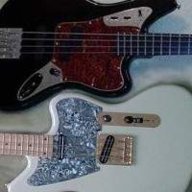
Let's see, I started on 4 string, then a year later I modded one of my 4s into an 8 string and loved it. I built my own doubleneck 8-string/4-string fretless. Eventually i discovered the mighty 12 string bass and I played it exclusively for about a year. I developed a lot of finger strength and when I started playing 4s again I noticed I was way faster. Never liked the feel of 5 stringers when I tried them at music stores. Then I went and got myself a 6 string and modded it to low F#. That phase didn't last long. Then I built the first incarnation of my current fan-fret bass but with a Hoppus J body tuned BEAD. That was kinda cool, but I didn't really go below D much. So I bought a new Squier VM jag and ripped it apart the next day to rebuild my current bass which is a 4 string with hipshot D-tuner.
Been happy and GAS free for basses ever since.
Been happy and GAS free for basses ever since.

Do you have a pic of your 2-string?
Link Removed

I am from the generation that really gravitated to fives. I like fours, and there are some brilliant young guys who mainly play fours, but I know who I am, and like fives as my main basses.
SteveC, you make life harder than it has to be. You do not have to break the bank to have a nice four string. Just buy one and scratch your itch.
SteveC, you make life harder than it has to be. You do not have to break the bank to have a nice four string. Just buy one and scratch your itch.
I got some information tonight that has encouraged me wait a bit before I get a 4 string jazz type bass. I'll just "get by" with my lovely Roscoe 5 for now. It's an amazing bass that I love to play and works for all my needs. Still curious to hear others thoughts on the switch.
I always wonder why more people don't just use heavier strings and tune BEAD? Or tune and intonate the lowest string to A0 and maintain the perfect 4th tuning? Or use standard tuning and an octave down pedal? Then the keyboard become a mute point. You would have to have a large array of subs though 
I always wonder why more people don't just use heavier strings and tune BEAD?
The answer in my case was that I convinced myself that I really never used the G string that much so why not tune BEAD? So I did. Only after a couple gigs like that I discovered that I really WAS using the G string much more than I thought I was. Hence a 5 string ending up the answer.
If you are a gigging bass player it is unprofessional not to have a backup bass.
There is no reason to "pick". Just play whichever is appropriate for the gig. Bring the other one in case the first one has a problem.
Nonsense! I've been reading TB a long time and I've learned quite a few things. One of them is that there are many professionals who never have had a bass fail and think bringing a back up is a waste of time. Also there are many who have never had a strap problem and don't need any kind of straplocks. And of course there are a great many pros who not only just need one bass but only need four strings as well (starting with Jaco). If you can't trust TB to know that a single 4 string bass without straplocks is all you "need" then who can you trust?
I hear that it's just like "going home"... or in my case back to high school when a single 4 string bass without straplocks was all I could afford.Sure. Makes sense. Of course, the bass guitar standard tuning, while not as low as a keyboard, can have it's place even with a keyboard or bass tuned instrument. That's where creativity comes in. Check out the band Dianogah from Chicago. 2 basses and drums. One bass is treblier than the other in terms of tone and plays more melodically. Works great! Or listen to Mark Sandman's 2 string slide bass. Or the 0 string bass on White Stripes songs (0 strings, because it's a 6 string guitar--heresy!--with an octave down pedal).
The creativity is what makes the artist regardless of medium or tools.
The creativity is what makes the artist regardless of medium or tools.

I am quite pleased having both 4- and 5-string basses. I do use both. It's not a bad thing that each gets me to think about the fingerboard differently.
Same here, but after quitting a cover band in which I mostly played a five, I'll probably revert back to my fours most of the time. I love my M-2500, but when I don't need it, I usually prefer fours. Not always, but usually.

With your experience with 5s, if you are going tolimit yourself to one bass, make it a fiver. It is just a 4-string with an extra string anyway. You can play it like a 4, but the extra string will be there for the odd occasion you want it or if you decide to play more fiver note patterns again. Seems the only downside might be weight.I agree. But I have a self-imposed limit of one bass. I just wonder how much I'd really miss my B string and how much is what I've talked myself into. I'm get at playing mind games with myself.

After switching from a four to a five in the late-90s, I didn't own or play another four again for 12 years. I went back to fours because I like the easy interchangeability of components, since Fender is the prevailing standard. No single fiver predominates in the same manner Fender does for fours. Moreover, at the end of the game, a fiver only brings you five extra notes that you didn't have with a four. Not a big deal to me.
I just vibe way better with a 4, though I've had some fivers that were awesome basses that I really loved (AB1, L2500 in particular). I frankly just don't like how I PLAY on a fiver! It's all mental I know . . .

Hi Steve
You could keep the 5 string and have a self
imposed restriction to only play the E-G strings. This would give you the change you seem to want/need while retaining your 5 string for those times you need the low B.
I've heard of many great players who advocate for restricting themselves to certain aspects of playing when they're practicing eg only using chord tones, only playing in one position, only playing on the E and A strings etc etc. I think it's a great way to force a change in your playing and to grow as a musician.
Cheers
Ben
You could keep the 5 string and have a self
imposed restriction to only play the E-G strings. This would give you the change you seem to want/need while retaining your 5 string for those times you need the low B.
I've heard of many great players who advocate for restricting themselves to certain aspects of playing when they're practicing eg only using chord tones, only playing in one position, only playing on the E and A strings etc etc. I think it's a great way to force a change in your playing and to grow as a musician.
Cheers
Ben


