Enjoy the benefits of a premium membership!
Upgrade Account
-
TalkBass has been independent since 1998. Add your voice.
Create a free account to reply to discussions, view embedded media, and browse with fewer display ads.
Join free Log in
Want zero display ads or expanded classifieds tools? Compare plans.
You are using an out of date browser. It may not display this or other websites correctly.
You should upgrade or use an alternative browser.
You should upgrade or use an alternative browser.
Who plays above the 5th fret?
- Thread starter 707GK
- Start date
More options
Who Replied?

My 'home position' would be with my index finger resting on A (E string, 5th fret) on my 6 String.
My Ibanez BTB has a tendency to let the unplayed and unmuted strings vibrate, so I use a Fretwrap as a crutch when my muting game is not up to par. That fretwrap often slides down to the 2nd fret postion, totally unnoticed. I do not play those positions very often. The big decisions are G: E string 3rd fret for growl and sustain or B string 8th for thump. Same goes for C ... and of course for open string vs. 5th fret.
The preferences change with the basses I play, though.
My Ibanez BTB has a tendency to let the unplayed and unmuted strings vibrate, so I use a Fretwrap as a crutch when my muting game is not up to par. That fretwrap often slides down to the 2nd fret postion, totally unnoticed. I do not play those positions very often. The big decisions are G: E string 3rd fret for growl and sustain or B string 8th for thump. Same goes for C ... and of course for open string vs. 5th fret.
The preferences change with the basses I play, though.
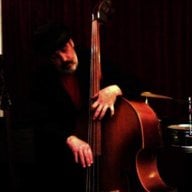
Coming from DB, it's a lot easier to play further up the fingerboard. 3rd-4th position is a real sweet spot on a DB (equivalent to index finger on 5th-7th fret on a BG). Playing notes fingered rather than open has the added benefit of tonal consistency on either instrument. On a 5- or 6-string, you can play everything you'd play on a 4-string without dropping below this area of the fingerboard (E1 is 5th fret on the B string).

I prefer to play between the first to fifth frets. It is just a preference and not a principle. You do you, I say.
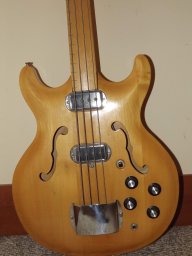
This guy certainly did:
and his playing shows awareness of the tension created by playing up that high.
Who was it that said playing up high on a bass is like a bear on a high wire act? Or was it a buffalo
in a tutu?
Anyway there are many good reasons to play up high on the neck including using double stops, chording and easily fingering long runs over several strings.
and his playing shows awareness of the tension created by playing up that high.
Who was it that said playing up high on a bass is like a bear on a high wire act? Or was it a buffalo
in a tutu?
Anyway there are many good reasons to play up high on the neck including using double stops, chording and easily fingering long runs over several strings.
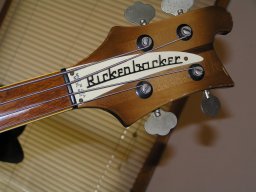
I use every string on every fret. I paid for 'em and I'm gonna durn well use 'em!


I tend to play diagonally across the neck - obviously, the lowest notes are only available low on the neck, but as I go up in frequency, on the middle strings, I'm higher up the neck. The G string is used mostly for octaves, which means I'm playing a couple frets higher than on the A string. Net result is I don't often play low on the G or D string, or high on the B or E string.
This is basically the exact way that I would answer, except more eloquently and with better grammar.
I like how Graham maby uses the 1st 5 frets on the g string.
Graham Many is a demigod.

With BG, I seldom go above the 12th fret, in most keys I spend most of my time below the 9th fret, mainly because like most BG players I avoid open strings.
When playing blues on a P bass if I need to pump roots sometimes I'll stay on the E string, shifting up and down the string. Makes for a fat tone.
With DB I use traditional classical fingerings from the Simandl books. That means I move to the next open striing as soon as possible until I get on the G string and then head all the way up the neck. Like this:
E F F# G G#
A A# B C C#
D D# E F F#
G G# A A# B C C# D D# E F F# G
Sometimes I will also use the D or A strings in upper registers when it helps with shifts but almost never the E string, it's too hard for me to play cleanly.
That's just me, you should play anywhere on the neck that you like.
When playing blues on a P bass if I need to pump roots sometimes I'll stay on the E string, shifting up and down the string. Makes for a fat tone.
With DB I use traditional classical fingerings from the Simandl books. That means I move to the next open striing as soon as possible until I get on the G string and then head all the way up the neck. Like this:
E F F# G G#
A A# B C C#
D D# E F F#
G G# A A# B C C# D D# E F F# G
Sometimes I will also use the D or A strings in upper registers when it helps with shifts but almost never the E string, it's too hard for me to play cleanly.
That's just me, you should play anywhere on the neck that you like.
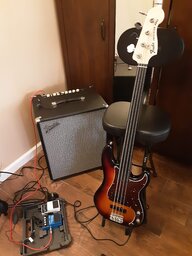
Routinely, but only on the 5 string. On that bass I move up 5 frets and down one string and play it like a 4 string bass. Much simpler to move around the fretboard since the frets are a little closer together and I can play "on the other side of the nut."

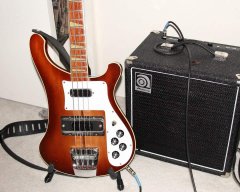
3–9 is my "home base." That's where most things happen. I don't often inhabit the range above that, and don't really use the first two frets very often. As for open strings, I almost never play open strings other than E.
That's the perfect excuse to insist on never going there.
Can't play Sweet Child without going there.
That's the perfect excuse to insist on never going there.
I play everywhere a uaeful sound can be made... I'm not about to constrain my playing to within the bounds set by anybody else. That means anywhere on (and off) the neck in in-play.
That said, I am not one to spend alot of time noodling, wanking, or tone-chasing as a means to self-indulge. For me, it's all about the song and the audience.
That said, I am not one to spend alot of time noodling, wanking, or tone-chasing as a means to self-indulge. For me, it's all about the song and the audience.