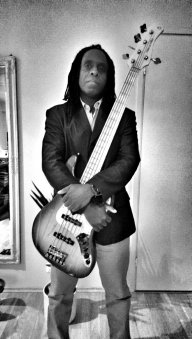
Oh I can hear the cries of "Rubbish!!!" already!
But this is my opinion:
In reality a working bass player won't play over more than 2 octaves in a piece music so that he/she/it (to be PC), does step on anyone's toes.
That's fine, but on a four string to do that in certain keys. D and E-flat, one ends up going above middle C, which is no longer in the bass clef! A lot of Jazz pieces use D and E-flat. Thus having five string allows you to do that, as well as giving you the possibility of playing three octaves in C above middle C. There are even ABG that have 5 strings although it is not as important with those because you are most likely to be playing with just guitars, although it might be useful if you are doing baroque arrangements.
This argument of course goes for Double Basses as well, I'm currently looking to convert my old Double bass to 5 strings.
But this is my opinion:
In reality a working bass player won't play over more than 2 octaves in a piece music so that he/she/it (to be PC), does step on anyone's toes.
That's fine, but on a four string to do that in certain keys. D and E-flat, one ends up going above middle C, which is no longer in the bass clef! A lot of Jazz pieces use D and E-flat. Thus having five string allows you to do that, as well as giving you the possibility of playing three octaves in C above middle C. There are even ABG that have 5 strings although it is not as important with those because you are most likely to be playing with just guitars, although it might be useful if you are doing baroque arrangements.
This argument of course goes for Double Basses as well, I'm currently looking to convert my old Double bass to 5 strings.
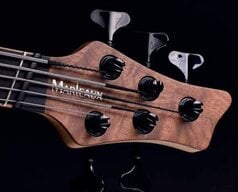






 , and one time a guy in the front row actually puked when the bassnote hit him - lol