

Enjoy the benefits of a premium membership!
Upgrade Account
-
TalkBass has been independent since 1998. Add your voice.
Create a free account to reply to discussions, view embedded media, and browse with fewer display ads.
Join free Log in
Want zero display ads or expanded classifieds tools? Compare plans.
You are using an out of date browser. It may not display this or other websites correctly.
You should upgrade or use an alternative browser.
You should upgrade or use an alternative browser.
Why 5 Strings are essential
- Thread starter oldprussians
- Start date
More options
Who Replied?
alexclaber
Commercial User

jzbass6
One Nation Under A Groove
A 5 string essential for me because...
Well...
Because i'm a 5 string player dangit.
Ditto Dr., it's also a matter of the type of music your playing. A 5 string just allows "for me" greater flexabilty and options, I've even tuned my 5 down a whole step to play some gospel tunes.

I would have to say not essential. As others have pointed out, nice to have and it can add an extra dimension to your playing, but essential?
If a 5 string is essential, then I guess guys like Victor Wooten, Stu Hamm, Jeff Berlin, Billy Sheehan, and other guys who seem to do the majority of their work on a 4 string are going to stop getting work (note: the previous statement contains a slight bit of sarcasm provided for amusement only and not intended to start any arguments ).
).
I think my only real "gripe" with some players who either migrate to a 5 string or use one a good majority of the time, is that they tend to try and play EVERYTHING down on the B and E strings. I guess that seems to come from a good number of players out today who play in newer rock bands... it seems there is a trend to play everything that low and just mimic the root of the guitarist.. probably because the guitarist are also playing a whole step down to D and then dropping their low string from a D to a C.
I personally have tried a ton of 5 strings, and liked many of them, however, none of them have sounded or felt as good as my old beater `71 p-bass, so until then I'll keep looking.
I do have an old Carvin LB76 that I still like and use now and then, but it is so far away from my p in both sound and feel that it is like comparing apples and oranges.
I'm just going to build myself one of my own new bolt neck basses in a 4 and a 5 string so I can have one, thereby killing two birds with one stone... getting a 5 string and having one of my own basses.
If a 5 string is essential, then I guess guys like Victor Wooten, Stu Hamm, Jeff Berlin, Billy Sheehan, and other guys who seem to do the majority of their work on a 4 string are going to stop getting work (note: the previous statement contains a slight bit of sarcasm provided for amusement only and not intended to start any arguments
).I think my only real "gripe" with some players who either migrate to a 5 string or use one a good majority of the time, is that they tend to try and play EVERYTHING down on the B and E strings. I guess that seems to come from a good number of players out today who play in newer rock bands... it seems there is a trend to play everything that low and just mimic the root of the guitarist.. probably because the guitarist are also playing a whole step down to D and then dropping their low string from a D to a C.
I personally have tried a ton of 5 strings, and liked many of them, however, none of them have sounded or felt as good as my old beater `71 p-bass, so until then I'll keep looking.
I do have an old Carvin LB76 that I still like and use now and then, but it is so far away from my p in both sound and feel that it is like comparing apples and oranges.
I'm just going to build myself one of my own new bolt neck basses in a 4 and a 5 string so I can have one, thereby killing two birds with one stone... getting a 5 string and having one of my own basses.
There is more to a note than its fundamental frequency...
Alex
Well I guess all those harmonics flying above that colour the sound, and define the timbre of the instrument.
You're not wrong
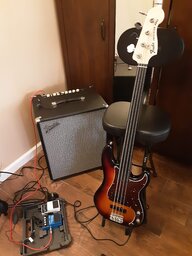
I don't agree it is a solution in search of a problem, but I also don't agree they are "essential" unless the music specifically calls for it. They are nice to have, and I see no advantage to buying a new 4 string. Examples of when I "need" my 5 string:
We learn a new song, everything is set, and the singer says: "Some of those notes are really stretching for me, can we we drop it a step. On the 5 I just shift my hand position, on a 4 I "might" have to change my pattern, depending on the pattern and the original key.
The song is in drop D tuning. I don't know about the rest of you, but I do not like dropping the E to D. It screws me up as to what notes are where, and it feels strange. I can do it, but a 5 string elimates the need.
And it does make a sweet thumb rest.
We learn a new song, everything is set, and the singer says: "Some of those notes are really stretching for me, can we we drop it a step. On the 5 I just shift my hand position, on a 4 I "might" have to change my pattern, depending on the pattern and the original key.
The song is in drop D tuning. I don't know about the rest of you, but I do not like dropping the E to D. It screws me up as to what notes are where, and it feels strange. I can do it, but a 5 string elimates the need.
And it does make a sweet thumb rest.

+1I have never played anything else but a four string. I have never had the desire to. To each his own though. If you would have never touched one, you wouldn't know the difference.
5 strings are essential?
Well, I guess I ought to just go ahead and put away my washtub bass. I can't imagine it with two strings, let alone 5.
If I correctly understand your point, we could all just stick to four-stringed basses and restring them, BEAD, which I have done on occasion. But then, I have also strung them, ADGC. If I ever get a good six-string, it would save me a lot of restringing work.
I have a 5-string upright, primarily due to my experiences restringing my 4-string electric bass guitars. That, and I just love to go lower and lower.
I tried uprights converted from 4-strings to 5-strings and compared them with ones initially made to be 5-strings. I'd recommend getting one that is made to be a 5, but that would all depend on what instrument and budget U are working with and why U are doing it in the first place.
Well, I guess I ought to just go ahead and put away my washtub bass. I can't imagine it with two strings, let alone 5.
In reality a working bass player won't play over more than 2 octaves in a piece of music so that he/she/it (to be PC), doesn't step on anyone's toes.
That's fine, but on a four string to do that in certain keys. D and E-flat, one ends up going above middle C, which is no longer in the bass clef! A lot of Jazz pieces use D and E-flat. Thus having five string allows you to do that, as well as giving you the possibility of playing three octaves in C above middle C.
If I correctly understand your point, we could all just stick to four-stringed basses and restring them, BEAD, which I have done on occasion. But then, I have also strung them, ADGC. If I ever get a good six-string, it would save me a lot of restringing work.
This argument of course goes for Double Basses as well, I'm currently looking to convert my old Double bass to 5 strings.
I have a 5-string upright, primarily due to my experiences restringing my 4-string electric bass guitars. That, and I just love to go lower and lower.
I tried uprights converted from 4-strings to 5-strings and compared them with ones initially made to be 5-strings. I'd recommend getting one that is made to be a 5, but that would all depend on what instrument and budget U are working with and why U are doing it in the first place.



Calebmundy
Supporting Member
- Apr 5, 2007
- 1,135
- 820
- Disclosures
- Endorsing Artist: DNA Amplifiers, Lākland Basses
I can see this both ways. To be a great session player, I would have a 5, or even a 6, but they are not required...
I really can't imagine a 6 being necessary for studio work. I guess I may be stuck in my "studio work=popular (pop, country, rock, rap, on the radio, etc.) stuff," but I've rarely, if ever, heard a big time studio cat list a 6 among his main recording-bass-list.
Also, the requirement of a 5, I think is pretty ridiculous. There are a few places where they're needed (interestingly modern Country seems to have embraced the 5 more than a lot of other current styles), but the idea that bass is clashing with guitar because they cover the instruments overlap range, or that the placement of a note on the bass clef has any real deciding value in terms of sonic placement in a group setting is a pretty weak argument. In the end it's what the ears hear, because of tone or line or because you dropped out to let the guitar player have a break or something-after all we don't "see" music, right? What's that old quote-"reading about music is like listening to art" or something like that.
I have often heard four-strings sound huge and deep, and I've wondered if I am hearing extended range notes, only to realize that the line is being played on the "A" string! Sounding big and full (and sometimes deep) has more to do with EQ and volume than range in my experience.
I've had only a 6-string for a few years, but I just ordered a 4-string. I'm 48, and learned on a 4-string as a teenager and had a few other 4-strings in my 20s - other than a 4-string Squier I had when I was first getting back into bass, I went with a 6 for my "Church Gig" for the extra range and reduced fret-hand movement. I seldom went below low E (doesn't sound good to me); the B just meant I didn't have to move my fret-hand so much. Additionally, I'm now accustomed to the "B-string thumb-rest". My 6-string is exclusively old-school flat-wound "thump". My La Bellas sound surprisingly good even on the high C if I pay attention to where I pluck the string.
I went with the 4-string because I like 34" scale-length, and in that scale-length and my $600 budget, I didn't see a 5-string with the 19" spacing that I wanted. I'm getting the 4-string primarily as a "slap" bass, and when I want the round-wound sound or a meaty growl.
Interestingly, with a 6-string, I was getting lazy about moving up/down the neck, and wasn't doing much to really KNOW where the notes were on the neck. When I see the most rudimentary slap-routines done on a 4-banger, folks are all over the neck. I think I'll learn the neck better with my 4.
As a side-note, I think it is easier to get a good string-to-string balance with fewer strings. On my 6-string, I tend to pluck closer to the neck on the high strings so I get a good string-to-string match in the "sound".
I went with the 4-string because I like 34" scale-length, and in that scale-length and my $600 budget, I didn't see a 5-string with the 19" spacing that I wanted. I'm getting the 4-string primarily as a "slap" bass, and when I want the round-wound sound or a meaty growl.
Interestingly, with a 6-string, I was getting lazy about moving up/down the neck, and wasn't doing much to really KNOW where the notes were on the neck. When I see the most rudimentary slap-routines done on a 4-banger, folks are all over the neck. I think I'll learn the neck better with my 4.
As a side-note, I think it is easier to get a good string-to-string balance with fewer strings. On my 6-string, I tend to pluck closer to the neck on the high strings so I get a good string-to-string match in the "sound".

I can accomplish many basslines with 2 strings and 5 frets, but I'm glad I don't have to.
Fieldy needs 1 string and 3 frets. We all suck.
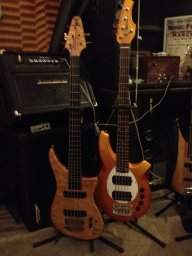
W T F are we arguing about? Some like 5 strings. Some like 4. Some like even more than 5. Why can't we all just get along? ;^)
W T F are we arguing about? Some like 5 strings. Some like 4. Some like even more than 5. Why can't we all just get along? ;^)
Because my favored configuration is better than your favored configuration, unless you use the same configuration as mine, then we're equals.

I only play 5 strings, but more because that's what I'm comfortable with. I guess the way I look at it is that if you have your muting perfected (which is a little more of a chore on a 5 versus a 4, especially if you use slap technique as part of your performance tool bag) there is nothing you can do on a 4 that you can't do on a 5. Of course, the same could be said of a 6 string, but the width of the neck and the string spacing starts to feel quite different on a 6 versus a 4 to me, and muting can really be a chore (again IME.. others have no problem).
I go through many gigs without ever using the B string, but it's nice to have there for certain tunes, to provide some 'drama' on occasion when transitioning to the bridge of a tune, to simplify fingering in some keys, and to 'go down low' with an entire figure on occasion.
There is not one gig or tune that I play on a 5 that I couldn't play on a 4 though, so 'necessary' is way too strong of a word. I dig it though, and haven't gigged on a 4 string in over 15 years.
+1000 I don't even own a 4 anymore, but it's all about comfort, not the essentialness of the low B string. I'm more comfortable with the wider neck, I like being able to go low if I want to, or if I feel the music calls for it. Most of the time, I'm still only using the E-G strings, but it's nice to have that B there for those moments I go that low. It's also nice to play in one position, although sometimes the tonal differences of playing in different positions on thicker/thinner strings is of great use too.

Originally Posted by nad
I can accomplish many basslines with 2 strings and 5 frets, but I'm glad I don't have to.
Well whaddya know
It is possible to flog humor out of a dead horse thread.
Thanks guys.
I can accomplish many basslines with 2 strings and 5 frets, but I'm glad I don't have to.
Fieldy needs 1 string and 3 frets. We all suck.
Well whaddya know
It is possible to flog humor out of a dead horse thread.
Thanks guys.

Oh I can hear the cries of "Rubbish!!!" already!
Here's one; RUBBISH!
I've never needed a 5-string and don't see the need in the future. Regardless of whether I eventually need one, the fact that I've never needed one so far is proof that 5-strings are NOT essential. It's a ridiculous assertion to make.
Latest posts
-

-
-

-
 Does the truss rods engagement add stability to the neck?
- Latest: Zootsuitbass
-