• TalkBass has been independent since 1998. Add your voice.
    Create a free account to reply to discussions, view embedded media, and browse with fewer display ads.
    Join freeLog in
    Want zero display ads or expanded classifieds tools? Compare plans.

Why are some notes dropped from wall chart fretboard posters?

OK, been looking at wall chart fretboard posters. Some show all four notes available at each fret position, while others only show sometimes only one, two or three notes. Why? Are the missing notes ones that are considered never (or almost never?) played on a bass guitar? Since I'm relearning again on a fretless I'd like to get this cleared up in my fairly dense mind.... ;>})
Thanks,
Greywoulf
 
OK, been looking at wall chart fretboard posters. Some show all four notes available at each fret position, while others only show sometimes only one, two or three notes. Why?
If you are just now reading this post.
Lot of reasons here. Not every song will use a note for each beat.

Are the missing notes ones that are considered never (or almost never?) played on a bass guitar? Since I'm relearning again on a fretless I'd like to get this cleared up in my fairly dense mind....Thanks, Greywoulf
No that is not why they are missing. A string of notes that goes on and on is not really music, it's just a bunch of notes. Music is usually in phrases, the melody takes a break to breath, etc. With out the standard notation fly specks we kinda have to guess at the rhythm - the rhythm of the note flow.

That's why the time signature, 3/4, 4/4, 6/8, etc. is important to know. Fake chord sheet music probably will not show the time signature. So you need to know the tune and sing it to get the rhythm when using dirt simple fake chord sheet music.

All kinds of reasons is the answer to your question. Google has always been a friend, ask Google.

Show us the sheet music you have and we can zero in a little better.
 
Last edited:
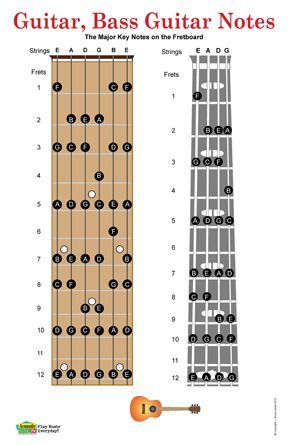
Pretty sure the OP is talking about this kind of thing
69e5e950ba282d1704b7f8942fb1c5cd.jpg


Not an actual song chart
 
  • Like
Reactions: Lobster11
Pretty sure the OP is talking about this kind of thing
69e5e950ba282d1704b7f8942fb1c5cd.jpg


Not an actual song chart
Ah, that's what I though - no sharps / flats. The assumption must be you can figure that out for yourself - i.e., the note between a C and a D must therefore be a C#/Db.
 
So that chart is showing you the notes in C Major / A (natural) minor.
Yes and no. It is showing you the notes on the neck of the bass guitar. If you take the major scale box pattern and put the root note of the pattern on the C note you get C major notes with the box.

If using that major scale box pattern and put the D root noet on the R of the pattern the notes of the D major scale await you within the box.

Go to post # 14 in this string How to get started? it goes into detail.

Happy trails.
 
Last edited:
You can Google the other scales.
If you play through them you'll notice that each has a "flavor".
When I did this with 6 string guitar I noticed how much I loved the pentatonic minor scale, but I loved it so much I never learned anything else. Don't let that happen.
 
Yes and no. It is showing you the notes on the neck of the bass guitar. If you take the major scale box pattern and put the root note of the pattern on the C note you get C major notes with the box.

If using that major scale box pattern and put the D root noet on the R of the pattern the notes of the D major scale await you within the box.

Go to post # 14 in this string How to get started? it goes into detail.

Happy trails.
No, @g-dude was correct: These are all the notes in the C major (or A natural minor) scale -- i.e., all the notes with no sharps or flats. The "box pattern" you refer to is just one of many possible fingerings for the scale. If you're locked into that box pattern, you might find it a useful exercise to use the fretboard chart to work out other possible fingerings.
 
  • Like
Reactions: LBS-bass
Yes and no. It is showing you the notes on the neck of the bass guitar. If you take the major scale box pattern and put the root note of the pattern on the C note you get C major notes with the box.

If using that major scale box pattern and put the D root noet on the R of the pattern the notes of the D major scale await you within the box.

Go to post # 14 in this string How to get started? it goes into detail.

Happy trails.

I think you misunderstood me.

The examples posted, and any example that only uses the natural tones, are in C-Major / A-Minor.