Thunderbirds are pretty damn popular. Otherwise?
Unlike Fender, Gibson never showed the same love to bassists that they did to guitarists. Too often they just took a guitar body and put a longer neck on it. "There's your damn bass!" Les Paul bass. Explorer bass. Flying V bass.
I think this is a little unfair.
--Body shape determines only ergonomics of play, not sound. If there are ergonomic guitar body shapes out there, why not simply adapt them to the needs of a bass?
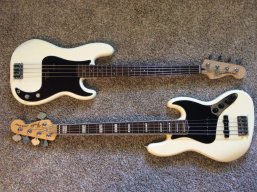
--Did not Leo Fender himself do exactly this when he invented the electric bass in the first place? Is the P bass not originally just a modified Tele? Is the Jazz bass body not just a slightly modified Strat body?
--Gibson have actually produced a much wider array of bass types than Fender over the years. You mention 3 of them, all completely different. Add to that EB-1, SG, SB, Melody Maker, ES335, LP Sig, Victory, RD, Grabber/Ripper and probably others. No lack of bassist "love" there. Yet the vast majority of Fender basses ever made have been variations on just two different models.
I would guess there are two main reasons why Gibson trails Fender in the bass sales stakes.
1. Price. Entry level Gibson basses, like their guitars, are generally more expensive than entry level Fenders. And when one compares the kind of craftsmanship and materials required to produce, say, a Les Paul and a Strat, it is not hard to see why. Les Pauls may be mass produced, but they tend not to use e.g. simple flat, unbound slab bodies, bolt-on necks, grain-concealing heavy finishes, pickguard-mounted control assemblages etc.
2. Sound. The Mudbucker sound did almost rule the airwaves in the late '60s and early '70s because it fitted a certain kind of music. But tastes changed, and obviously the P and J are more sonically versatile. By the time Gibson tried to produce its own more versatile basses, the battle was probably already lost. But they never gave up trying.